Showing posts with label Sunday Readings. Show all posts

Sunday, June 12, 2016

How I Prepare a Homily and More on the Readings for the 11th Week, Year C


Yesterday I offered some thoughts on the Gospel reading for the 11th Sunday in Ordinary time, year C (that is, today). It wasn't a complete homily, but more like a rough sketch - scattered thoughts on the reading. 

A suggestion Bishop Barron made once to priests getting into blogging was to post their Sunday homilies. We don't always have time to write original content, so it's an easy way to kill two birds: since we have to prepare a homily anyway, why not put it up it and let that be the post for the week? That's really great advise, but my problem is that I don't write out my homilies. I don't even write an outline. I prepare, alright. I use a sort of quasi lectio divina method of meditating on the scriptures throughout the week, picking out a line or lines that hit me and building something from there. Once I get a basic idea of where I want to go with the homily, I'll check a few trusted commentaries to both double check that I'm not going in the wrong direction, or if I'm stuck, to get ideas moving. I might tap out a few thoughts on my iPad's word processing app during morning meditation, but for the most part it's all worked out in my head. 

There are pros and cons to not reading a written homily. The main positive is that people feel I'm speaking more naturally. I almost always hear complaints from people when a priest reads his homily. And the ironic thing is, I've found that the better the homily is in terms of content and structure the more they will complain when its read (unless the preacher is very skilled in public speaking). In spite of speaking extemporaneously, I follow a pretty well planned mental script, yet if I wrote it out and read it I guarantee there are those who would complain. 

Speaking in a well planned - off the cuff style also gives me the freedom to digress if something hits me. Since I know what I'm going to say I have a place to comeback to, while at the same time not feeling bound to stick to a text. Everyone is different: some preachers can digress gracefully from a prepared text, it's just a skill I ever developed.

But if there is one thing that is absolutely essential to good homily prep, whether you prepare a written text or not - it's prayer. And my prayer is simple. When I begin the process I ask Jesus what he wants to tell the people. What is it that they need to hear? I'm not saying that I always get it right - I'm still just a fallible man - but I do believe that the Lord helps me in the process with the gift of His Spirit. And this prayer helps me to stay focussed on what preaching is all about: I'm not here to proclaim the gospel according to Fr. Tom, but the Gospel of Jesus Christ. I find that many times when I'm stuck with a case of preacher's block, the problem is that I'm caught up with what I want to say, or how eloquent I'm sounding - or not. When I stop and spiritually recalculate, asking Jesus what it is that He wants to say, things start flowing much more smoothly. Sometimes when the homily is over I'll wonder where the words came from, they come to me in such a mysterious way. All this is possible only when prayer is at the center of the process.

As for the readings this week, I spoke already about the passage from Luke, so I'll turn my attention to the Old Testament reading from 2 Samuel

We are given a very narrow periscope of a larger passage about King David and his grave sins of adultery and murder. Briefly, David had an affair with the wife of one of his military officers who was off at war. Bathsheba - the wife - got pregnant as a result, and the King tried to cover it up by sending Uriah - the husband - home on leave. Uriah was what I like to call a U.S. Marine type: totally dedicated. While his men were out on the front, away from their families, in harms way, he wasn't going to go home and enjoy the pleasures of the conjugal bed. After twice failing to get the iron age leatherneck drunk and home to the wife, so as to give plausible deniability to any misbehaving, David arranges it that Uriah is put way up at the front of the front, undefended. He dies in battle, Bathsheba becomes one of David's wives, and no one's the wiser.

Accept, you can't hide from God. 

The prophet Nathan gets a message from the Lord, and relays it to David by way of a parable about a poor man who has his only beloved lamb stollen by a greedy, heartless, wealthy neighbor. David, enraged by the story, calls for the offender's death. When Nathan reveals the this little tale was an allegory of David's own crime, the king repents. 

But Nathan also reveals something ominous. While the sin is forgiven, and David will not suffer the full punishment due for such villainy (eternal damnation), he will still have to make some reparation for his sin. God declares that the "sword shall never depart from your house." This meant that David, no stranger to war, would never cease to have to defend his kingdom from enemies from without, as well as usurpers from within, including attempted coups by two of his sons - one violent, the other bloodless.

(There is another detail that the editors of the Lectionary decided to leave out. In the next verse Nathan declares that the child born to them would die. I don't deal with that in my homily, and will leave the point undeveloped for right now. It is a hard passage, and if I have one criticism of how the Lectionary is organized, it's that the difficult bits are too often omitted. All I'll write for now is that God in His being is simple, but his ways are mysterious and hard to understand, and I'm not sure we're helping people by glossing the difficult parts over.)

David had been given many gifts in his life. He was a lowly shepherd, the youngest son in his family, who was not the obvious choice to be king. He was taken from the flocks and made a hero of Israel, later king. He had lands, wives, concubines, glory and honors. Yet his return to the Lord was these acts of ingratitude. Much was given, and so much was expected. When he fell in such a deliberate and wanton manner forgiveness had to accompanied by penance. 

Notice, as well, that unlike the woman from the Gospel, David didn't willingly approach the Lord looking for pardon, but had to be slapped across the face. David was content to go on, convinced that his crime was successfully covered up. As a wise man once said, God loves us as we are, but he loves us too much to leave us that way. Even if David's love wasn't sufficient to keep from sinning, or even enough to motivate him to seek out God's mercy, God's loving mercy reached out to him. But God's is a strong love, a challenging love. Some times Jesus comes as the Good Shepherd to gently call us home, but sometimes, especially if we are obstinate and spiritually blind, he comes as the Hound of Heaven pursuing us "down the nights and down the days," as Francis Thompson put it.

If, like David, our sin is the product of pure ingratitude and lack of love, He shake us up, then builds that love back up. That's the real purpose of reparation: to break down our pride and self reliance so we may not simply avoid sin out of fear, but do the right out of love. God's punishment is never about chastisement for its own sake. It always has a point: it is always to perfect love.

If we are like the woman who anointed Jesus' feet, maybe our sin, while still sin, came after a series of hardships. Maybe we didn't have all the advantages that David did. Maybe because of the circumstances of life we weren't strong enough to resist temptations when they came our way. Maybe we were wounded somehow, victimized, and it effected how we see the world and ourselves for the worse. Maybe our sin is the product of self loathing, and while we knew it was wrong, somehow we were convinced that we "deserved whatever we got"(a demonic deception). In this case, Jesus reaches out His hand to convince us otherwise. If we persist in sin, we will indeed be lost, but we shouldn't despair that the Lord comes in the moment of repentance as a harsh judge, but as a merciful Savior.

Which brings me back to what I wrote last time about the women who followed Jesus on the way. I speculated that maybe each had some vice that Jesus released them from. In their following Jesus, forgiveness, reparation and love join together. They abandoned their old ways of sin, but they surely also left good things. One was the wife of a court official, so I have to imagine that she led a rather comfortable life. In abandoning the old way, both the good and bad, they were risking much. But they were cooperating in the saving mission of Jesus. Their efforts made it possible for Jesus and the 12 to support themselves and continue spreading the proclamation of the Kingdom. They were motivated by love and gratitude, and each hardship encountered, discomfort suffered, doubt confronted and overcome served as reparation for past sins, but also deepened their love for God. If we are open, Jesus makes that same invitation to us: to repent, yes; to do reparation; yes. More importantly, it's a invitation to grow in love.

Friday, June 10, 2016

Why Were the Women Tagging Along?: Scattered thoughts on the Gospel Reading - 11th Sunday, Year C

As I was preparing for this week's homily, I was struck by a small detail in the Gospel reading that could easily, and understandably be overlooked. In the passage from Luke 7:38-8:3, we hear that Jesus at once forgives the penitent woman, while shaming the Pharisees for being judgmental and lacking mercy. It's a beautiful story in which the unnamed woman interrupts the meal to bathe Jesus' feet with her tears, then anointing them with oil. The implication is that this woman had been forgiven much, so was now making a return to the Lord. It is a tender gesture of thanksgiving, adoration and deep love. 

While the scene is playing out the head Pharisee, Simon, thinks to himself what a no-acount false prophet Jesus is for letting this public sinner touch him like this (and a woman! Why, if he were really a prophet...). Our Lord, as always turns the tables on his accusers, showing that he is a prophet, and much more. Reading his mind, he points out, by way of a parable, that those who are forgiven much tend to love and appreciate the one who forgives more than others, who's sins may be less serious. But more than that, he points out that Simon had neglected the basic rules of hospitality by not offering his special guest water to wash his feet, or perfume for "freshening up" after walking the dusty roads. He concludes by declaring the woman forgiven of her sins for the great love she has shown. In the Lord it is truly the lowly who are raised while the rulers are thrown down, as our Lady put it (Lk. 1:52).

The detail that struck me is that the first three verses of the next chapter are tacked on to the end of the reading. If your priest or deacon decides to, these "extra" verses can be omitted. They mention that several women, including Mary Magdalene, Joanna and Susanna, traveled with the twelve and took care of their needs out of their own resources. Yes, it shows that Jesus was unusually inclusive, and that these women were dedicated to Jesus. At least one was well connected, seeing that her husband was an official of Herod's court - thus showing that the Gospel was already spreading deeply into all corners of the society. As telling as this passage is, it still seems a bit out of place considering where we just were. What do these verses have to do with forgiveness and mercy?

Maybe nothing. 

I've consulted a few commentaries and saw nothing to connect the two parts. But there had to be a reason the editors of the Lectionary decided to pin these three verses on to the end of the reading, no?

What I think is that maybe, in some way, each of these women (three are named, but the exact number isn't given), were either forgiven by Jesus of some great sin, or shown some other great mercy in their lives. Pope St. Leo the Great always identified the unnamed woman here with Mary Magdalene, though modern scholars disagree. Whether its her or not, the person who anointed Jesus' feet and dried them with her hair was probably guilty of some sexual sin: possibly prostitution, most probably adultery, whatever the transgression, it certainly caused a public scandal. Even if she and Mary Magdalene are two separate people, the latter was liberated from seven demons. I tend to take that pretty literally, but even if you want to say Luke was writing metaphorically, there was something grave, be it illness, addiction, or vice, or a combination of the three that she was freed from. The rest were freed from evil spirits and infirmities. Maybe one was an inveterate gossip who ruined people's reputations. Maybe another had cancer. Maybe another had a problem with drink. There are countless possibilities, but in each case Jesus touched their lives in a profound way - profound enough that they left home, took to the road, and cared for Jesus and the 12 out of their own pocketbooks. 

Could there be another reason that Luke highlights the presence of women in Jesus' entourage? I believe so.

I have seen men, after living unholy lives, turn it around and become very dedicated to Jesus and the Church. But I've seen it more intensely in women. I don't want to be misunderstood with what I'm about to write. Men and women are both capable of selfishness and cunning, and of ingratitude. But if you were going to ask me which, men or women, are more likely to be victims of sin, it would be women (forgive me if I leave that point undeveloped, for now). 

When it comes to sexual sin, I just believe that women feel the weight of guilt over it more than men do. I'm definitely not saying its right, just that that's what I've found in my experience. Men rarely come to me lamenting their lost virginity, where as often - not always, maybe not even mostly, but often - women are in tears about it. Men will feel deeply guilty over marital infidelity, and I've seen more than my share of tears there. But if I were to say who feels the effects overall of sexual sin it's women. So when the shackles of sin, of whatever sort, are removed women seem more likely to respond by becoming dedicated to Jesus in an extraordinary way. Again, not all women, and maybe not even most, but enough that I've noticed it over the years. 

So, yeah, I can see Luke giving a special mention to this group of dedicated ladies. It's also in line with the Third Evangelist's tendency to highlight Jesus' special care for those on the margins. Women were most certainly second class citizens in the society of time, and it wasn't really questioned. Here Luke brings out two important points, that women have an equal standing in the Church, and that they do tend to respond with greater gratitude to Jesus when they experience his mercy. The first point is always important to point out, and the second is in line with the overall message of the reading.

This is just the rawest of sketches for Sunday's homily. I'll also be bringing in the first reading from the Second Book of Samuel, another haunting passage on forgiveness, but also reparation for sin (a neglected aspect of mercy). 


Wednesday, August 15, 2012

The Assuption of Mary


This is a piece from a couple of years ago that I'm not sure I can really add to, so I'm just gonna go ahead and republish it.  Have a blessed Feast of Our Lady.  May we always trust in her loving, motherly care!

Today we take a break from the regular cycle of Sunday readings as we celebrate the Solemnity of the Assumption of the Virgin Mary. So I will take a break from our examination of Salesian Spirituality and focus our attention on our Blessed Mother. She is the Queen of Heaven, yet as St. Therese of Lisieux wrote, she is more mother than queen. She loves us very much and always calls us to follow her Son. Today’s feast, in part, teaches us that Mary, and all the saints are powerful gifts from God, that they are active within the Church, and that, if we are faithful, we will share in the glory they have been given.

That Mary was assumed body and soul into heaven was attested to from Apostolic times and was always believed by the Church, both in the East and West. It was not defined formally as a dogma until 1950 when Pope Pius XII proclaimed, “By the authority of our Lord Jesus Christ, of the Blessed Apostles Peter and Paul, and by our own authority, we pronounce, declare, and define it to be a divinely revealed dogma: the Immaculate Mother of God, the ever Virgin Mary, having completed the course of her earthly life, was assumed body and soul into heavenly glory (Munificentissimus Deus, 44). Because Mary was preserved from original sin in preparation to be mother of the Savior, and was obedient to God’s call, she was also given the grace of not suffering the corruption of the grave. In a special way she already enjoys the fruits of the resurrection won by Jesus’ death on the cross. She is alive in the fullest sense of the word, and is active still within the Church.

In the Gospel reading for today we hear the story of the Visitation. Mary, after saying “yes” to God, goes to visit her cousin Elizabeth who is pregnant with John the Baptist. Mary has Jesus within her, this great grace prompts her to go forth and serve her neighbor in need. She is an example for us to follow. As we receive Jesus in the Eucharist we are also called to go and serve others. She and all the saints are united to us and help us by their prayers and example. In a special way Mary is active, as we can see by her apparitions in places like Guadalupe, Lourdes and Fatima. She always calls us to follow her Son more faithfully and covert our lives.

The celebration of the Assumption also points us to the reality of the resurrection. As Mary lives in glory now, so shall we. Mary was blessed in her life, but she also suffered greatly. Her heart was truly pierced by a sword when she saw Jesus suffer as he did. Through it all she was faithful to God’s call. She is a sign for us that if we are faithful through life’s problems and struggles we too will share in gifts from God beyond our understanding.

Saturday, October 23, 2010

30th Sunday in Ordinary Time, C

The Pharisee took up his position and spoke this prayer to himself--Luke 18:11

This week's reading from Luke gives us this famous story of the Pharisee and the tax collector, contrasting one's pride with the other's humility.  Going against type the publicly religious man is the "villain," while the public sinner is the sympathetic character. Jesus is forever turning things on their head, challenging people's perceptions of reality.  Tax collectors were hated, not simply because people didn't like paying taxes (of course they didn't, human nature never changes), but because the taxmen worked for Rome, their foreign occupiers, and were often exploitative, collecting more than the prescribed levy through coercive methods.  It's not that Jesus is glorifying sin and injustice, but rather pointing out for us the nature of true repentance and religious devotion.

The Pharisee is shown taking his place in the temple.  It's business as usual for him, in a way.  This might be a routine he follows every week, or maybe even everyday.  He scrupulously recounts all his good deeds; he fasts and even pays tithes.  These are good and noble things for sure, but why does  he do them?  Are they for God or have these, and the other religious observances of his life, become a habit he does for their own sake?  We are all called to a life of virtue, where doing the right thing becomes so ingrained that it's second nature to us (in other words doing good becomes a habit).  But true virtue leads us outward, to worship and give praise to God and help others in His name.  In the case of this Pharisee Jesus tells us that he prays "to himself."  He is not acknowledging the power of God in his life, but is caught up with his own actions.  Consciously or, I would more likely suspect, subconsciously the Pharisee thinks he's saving himself, rather than God giving him the grace of fidelity.

If we look at today's second reading from St. Paul's Letter to Timothy (4:6-8, 16-18) it would be tempting to think that he is falling into the same trap as our friend the Pharisee.  He's talking about how he's finished the race and is awaiting the crown of glory that God, the just Judge, will surly give him.  Isn't he being a bit presumptuous? Paul, never one for false modesty, crows a bit because he knows that it was God's grace that made all his successes possible.  It was God who stood by him through the tough times.   When all his friends abandoned him, it was the Almighty who rescued him from the "lion's mouth."  God did this so that he could complete his mission to preach the Good News to the Gentiles.  His time was coming to an end, he could see that, but it did not trouble him because he had been faithful to his mission.  Paul lived, not for himself, but for the Gospel of Christ and it's spread.  For this he he could rest assured of a place in the heavenly kingdom.

Our other friend from the parable, the tax collector, knows that he has been on the wrong path.  He examines his actions and beats his breast, a traditional sign of repentance, going home justified.  Now the real work begins, because repentance means a turning back to God and leaving the old life behind.  The mistake many in the contemporary world make is thinking that God's forgiveness comes with no expectations.  He will forgive us no matter how many times we fall, but he also wants to see the fruits of repentance lived out in our lives, to go and sin no more.  He even tells one man he cures to stop sinning "so that nothing worse may happen to you." (Jn 5:14) Don Bosco used to say that going to confession would only have long lasting benefits if penitents made a firm resolution to put aside the sins that repeatedly plagued them.  The tax collector goes home justified because with God's grace he is ready to make the changes necessary that will lead to eternal life.

The answer is not to think that our religious observances are useless.  Going to Mass on Sundays, observing holy days of obligation, going to confession regularly, being faithful to the Lenten abstinence and fasts, among other things, is the way we show our love for God in concrete ways.  But the key is to remember why we do them.  They help us to put God at the center of our lives and should point us outward to love our neighbor. They are also meant to remind us of our dependence on God as the giver of all good  things, the things we truly need to make us happy.  Our life in the Church is meant to remind us that it is the Lord who stands by us always, raises us up when we fall, and will give us that imperishable crown of victory when the race of life is faithfully completed.

Saturday, September 25, 2010

Twenty Sixth Sunday in Ordinary Time, Year C


'If they will not listen to Moses and the prophets,
neither will they be persuaded if someone should rise from the dead.'"
-Luke 16:31
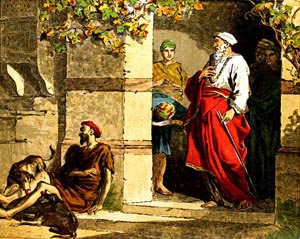
When I look over the Gospel reading for this Sunday, the famous parable of Lazarus and the rich man, I am struck by the last line.  It reminds me of the need to live by faith, and not by sight, as the old hymn goes.  This is a bit ironic, I admit, since one of the main points of the reading is that the rich man was too “blind” to see the poor man at his door.  Surly it doesn’t take faith to see a person in need and help them?  There are people who help others for strictly humanitarian reasons, this is true.  But the point I’m trying to make is that if we keep a division in our minds between faith and everyday life, we can miss where God is talking to us in the ordinary events of our life.

I am a firm believer in miracles.  There are some people, we call them “demythologizers,” who strip the Gospels of their supernatural character and explain everything that the Lord did or said in human terms. These are the people who say that the multiplication of the loaves never happened, that the people there simply shared the bread they already had; that Jesus didn’t actually multiply anything.  But all they are doing is robbing the Word of God of an important message that it has for us.  In the life of Jesus miracles doubled as prophetic acts, pointing us to what life in the Kingdom of Heaven will mean.  They were also signs to the people of his age, well versed in the prophetic scriptures, that He was indeed the promised messiah.  For us today miracles are a confirmation of the faith we have already.   Necessary? Maybe not, but they are a generous gift to those who believe.

All the same miracles are rare, and are not meant to be the foundations of our faith.  Jesus was impatient with those who were constantly seeking signs and wonders, and wouldn’t take His word for it.  Blessed are those who have not seen, were not at the empty tomb, did not put their hands into Jesus’ pierced side and yet believe.  The rich man needed a sign of some kind, and thought if Lazarus was to rise from the dead it would be just the thing to convert his brothers.  But the message is no; you have Moses and the Prophets, listen to them.  We have, as well, the four Evangelists, St. Paul and the other letter writers, the Fathers of the Church and the Magisterium guided by the Holy Spirit, handing down the Apostolic Tradition through the ages; listen to them.

We also have the gift of the Spirit in Baptism and Confirmation.  This is supposed to help shape our vision so that we can see the divine all around us, working in the world.  It does not take faith to believe a miracle, but it takes faith to believe that God is in the ‘hood, in the poor and suffering; that God is love in a world that seems to prefer hate and war.  It demands faith to see Jesus in the beggar sleeping at our door.

Wednesday, February 10, 2010

5th Sunday in Ordinary Time C


(Sorry that I’m VERY late with this one. Hopefully it will still help)

When Simon Peter saw this, he fell at the knees of Jesus and said, "Depart from me, Lord, for I am a sinful man." Jesus said to Simon, "Do not be afraid; from now on you will be catching men."—Luke 5: 8,10

The first reading, from Isaiah, and the Gospel passage, from Luke, both give us the stories of God calling people to service. In both cases fear is the great obstacle keeping those being called from saying yes. Isaiah and Peter are aware of their sinfulness and limitations as human beings. But they let this self knowledge become a millstone that kept them from moving forward and being the people God wanted them to be. They let fear paralyze them in the face of God’s call.

We are sinful and limited people. We should not fool ourselves. In a week we will begin the discipline of Lent where we will have the opportunity to examine our lives and set about on the path of reform with God’s grace. The fact that we are sinners should not keep us from perusing sanctity. As a matter of fact, this realization should drive us toward the way of holiness all the more, because becoming saints is what our journey on earth is all about. But we should not be afraid of what this entails.

To accept God’s call to reform means that we will have to abandon sin and the attachment to sin, yes. It will also mean giving up things that in and of themselves are not sinful, but may be an obstacle for me in following Christ. They could be material things, habits or even relationships that keep me from growing as a person. Christ never promised that following Him would be easy. He did not tell us that paradise would be now, but he did promise the cross. Through all this He told us also to not be afraid, that He would be walking with us on the journey of faith.

At the beginning of John Paul II’s pontificate he proclaimed this same message of Christ in this week’s Gospel: Be Not Afraid. John Paul had real reasons to fear in his life. By the time he was twenty-one his parents and brother had died. He was forced to work in a lime quarry and chemical plant during the Nazi occupation of his native Poland, all while studying secretly for the priesthood. For about the last year of the war he hid in the archbishops residence for fear of being arrested by the Nazi occupiers. Later under the communist government he would work, at times secretly for fear of government reprisals, with young college students. As Archbishop he publicly fought the government over the construction of a church building in a new housing development, a church eventually built and that he consecrated. As pope John Paul suffered an assassination attempt, illnesses and criticism, from both within and outside the Church. All the while the message was the same; be not afraid! He knew the transforming power of the Gospel, and the great things God does through those who remain faithful. Let the late pope’s example be a guide for us as we set upon the journey of Lent.

Thursday, January 28, 2010

4th Sunday in Ordinary Time / Feast of St. John Bosco


When the people in the synagogue heard this, they were all filled with fury. They rose up, drove him out of the town, and led him to the brow of the hill on which their town had been built, to hurl him down headlong.—Luke 4:29

When Don Bosco was a boy he was forced to go a neighboring city to continue his education. The little hamlet of Becchi, his home town, was simply too small to justify a public school. At first he walked the two plus miles every day to Castelnuovo di Asti to attend classes, and eventually found lodgings in the town itself. It was a difficult time, to say the least. He was separated from his family, and because he had never been to school before (he had only received private tutoring from a local priest) he took classes with student four or five years younger than he was. Being a poor farm boy, his cloths were ragged and this, combined with the fact that he was so much older than his classmates, made him the object of ridicule. His only saving grace was that his teacher, a local priest, treated him kindly. But when the priest was transferred to a nearby parish things changed. His replacement, Fr. Moglia, though John was a hick for whom formal education was a waste of time. Fr. Moglia was often heard to say “can anything good come from Becchi.”

In some ways John Bosco faced the opposite problem of our Lord in Sunday’s gospel. John was the outsider who was not respected because of his different background. In the case of Jesus, the people in the synagogue knew who He was, or at least thought they did; he was the carpenter’s son, no better than them. They were thinking, “how does he come here now to preach about how God’s salvation would be given to the gentiles instead of us?” In both cases the results were the same; people did not want to accept them or that God was working through them.

God does not always speak to us in the ways we expect. He uses people, events and circumstances to lead us along the path of life. It is the rare person who experiences some supernatural apparition or mystic experience. It is for us to be open to the possibilities of life, and read the will of God in what’s going on around us. This takes prayer, discernment and the help of a mature and trustworthy spiritual director or guide.

It also takes a sensitivity that allows the Word of God to truly touch our hearts. The words of Isaiah that Jesus quotes are ones of comfort and assurance, yet the people of Nazareth reacted negatively because our Lord was laying down a challenge. He was telling them to look beyond their narrow self interests to perceive the big picture; that God’s salvation is intended for all humanity, not just one race or nation. They were not ready to accept the Scripture as a two edged sword and be cut to the marrow by what it meant for them personally.

Don Bosco did complete his education, and was ordained a priest in 1841. But this would not be the end of his struggles. In founding the Salesians he would face innumerable trials and struggles, at times questioning where God was leading him. He would be abandoned by collaborators, misunderstood by brother priests and harassed by government officials. All the while he kept his eyes on the goal; the salvation of souls, especially of the young. May we take courage from Don Bosco’s example and not be afraid to follow God’s will, especially when it is difficult and trying.

Sunday, January 24, 2010


Now when the seventh month came the whole people gathered as one man in the open space before the Water Gate, and they called upon Ezra the scribe to bring forth the book of the law of Moses which the Lord prescribed for Israel…“Today is holy to the Lord your God. Do not be sad, and do not weep.”—for all the people were weeping as they heard the words of the law.
—Nehemiah 8:1,9


(Between the March for Life and other goings on at school I had trouble getting posts up this week. Here’s something I was working on for Today.)

They were a people who had been separated from their land and their customs for generations. Though they had tried very hard to preserve the old ways while they were in exile, their children, as well as many of them, had never heard the words of their ancient law. These books were more than just legal code, it was their story; the story of a people called by the God who created all of humanity in His image to be His witness before all peoples, called out of slavery to freedom, called to be holy. It was to be the rule that guided them, a story that grounded and supported them through the good times and bad. These words were meant to remind them of their national identity. It was to remind them of the call that God had given them. But now they wept.

This story from the Book of Nehemiah tells of the restoration of Jerusalem and the Temple after the Exiles were permitted to return from Babylon. Upon hearing the words of the Torah again for the first time they wept because they realized that they had not kept faith with the Covenant that their forefathers had entered into at the time of Moses. In their hearts they knew that they had been on the wrong path even before the Exile, and in the end their break with the Covenant is what led to their captivity. Only renewing faith in God and the Covenant was going to give them any lasting security.

We are not exiles, in the sense that we have been taken from our land and kept from worshiping God. But at the same time there is a gap between the Gospel and the contemporary culture that has led us off the right path, sometimes whithout being aware of it. We need to examine our lives, both individually and communally, to see where we have lost faith with the Covenant we entered into with God at our baptism and renew each week in the Eucharist. This past week we held the annual March for Life in Washington, D.C. It is a yearly reminder that we as a people have broken faith with God and have, at the very least, tolerated the great abomination of abortion in our land. Abortion is just one life issue, true. We will explore it and others in greater detail in future posts, but I start with it because all life issues stem from it. The preborn are the most vulnerable of God’s creation. They have no courts of appeal or lawyers to defend their cause. They have no rights that are recognized by the civil authority. The cheapening of their lives cheapens all life, be it that of the old and infirmed or develpmentally challenged .

As I wrote, abortion is but one issue. Let us make that communal examination of conscience and not be afraid to ask ourselves where we have gone off the path. Let us listen to the Word of God again for the first time, and allow it to drive us to tears. Then, let us rededicate ourselves to the Gospel that gives life.

Thursday, January 14, 2010

Second Sunday of Ordinary Time, Gospel


There was a wedding at Cana in Galilee, and the mother of Jesus was there.

-John 2:1

Two weeks ago we celebrated the Feast of the Epiphany, when we remembered Jesus being manifested to the Gentiles as the promised Messiah. In the Eastern Church this feast, along with the Baptism of the Lord and the miracle at the Wedding at Cana are all seen as reflections of the same mystery; Jesus revealing himself in Divine glory. Jesus does this in an act of generosity, helping a newlywed couple in an embarrassing situation. But Jesus is doing more than just saving the party. He uses it as an opportunity of give a sign of what His mission was all about. It isn’t an incidental detail that the water was turned to wine in those six stone jars. They were reserved for Jewish ceremonial purposes, and Jesus is pointing to the fact that in His mission the old rituals were being replaced with new. What came before had value in its place, but were to give way to the vital, powerful Sacraments of the New Covenant.


Jesus was hesitant to act at first, since the time had not yet come to reveal Himself. It was only after the intersession of Mary that Jesus acted. This form of intercessory prayer, where we urge God into action is not novel. The words of the Lord’s Prayer “thy Kingdom come, thy will be done on earth as it is in heaven,” are asking God to hasten the Second Coming and the ultimate renewal of Heaven and Earth. Mary is a sign for us, just as assuredly as the miracle itself. She is a sign that God wants us to be active in our faith, not passive. We are to pay attention to the needs of the people around us and respond to them, by both action and prayer.


For Mary, life went from simple to complicated very quickly. Accepting the angel’s message would bring misunderstanding, doubt, and almost ended her marriage before it started. In the midst of this Mary visited her cousin Elizabeth to assist her in her moment of need. Allowing Jesus into her life drove her to serve others, in spite of the challenges that she faced. In the great mystery of the Communion of Saints Mary is a sign that the blessed souls of heaven and we who still strive on earth are separated by less than we understand. Mary, the Queen of Heaven, is active still, praying for us to her Son just as assuredly as she spoke to Him on behalf of the young couple at Cana. She offers us an example of action and contemplation that helps us to manifest the love of Christ to all we meet.

Tuesday, January 12, 2010

Second Sunday of Ordinary Time, 1st Reading


As a young man marries a virgin, your Builder shall marry you; and as bridegroom rejoices in his bride so shall your God rejoice in you.
Isaiah 62:5

Sociologists tell us that we are living in an age in which many people view God as being both close and distant. They believe in God, and that there is a moral order that he set up, albeit vague, and that we can pray to him. But for the most part God is placed to the side and used when He is useful. God doesn’t necessarily have a place in people's everyday existence and in the decisions they make in their lives. He is like a cosmic fireman’s ax, behind a glass that we only break in cases of emergency. The technical term for this is Moralistic Therapeutic Deism (MTD). The deism born from the Enlightenment taught that it was God who put the world on a shelf, like a freshly wound clock, to be forgotten about as the hands moved into a meaningless future. But now it is the world that has put God on the shelf, only to be referenced when it is deemed necessary for some personal need.

The saddest part of this trend is that MTD has been adopted as the default position by many Western Christians (in fact, it has been deemed the “American Religion”). The problem, of course, is that this is not the biblical view of the kind of relationship God wants to have with us. While Isaiah’s words were directed to the Israelite community as a whole, we can also see in them the essence of the individual’s relationship to God. God wishes to enter into an intimate union with the individual soul, not a simple service agreement. Infidelity to God and his commandments, especially through idolatry, is often referred to as adultery. This marriage imagery appears throughout the scriptures, but is too often overlooked. If we read the writings of the great mystics the higher levels of contemplation are often described in almost romantic terms, as a lover might speak of his or her beloved. God consumes them, and every part of their lives is effected by this bond of unitive love.

When we love that deeply there is no sacrifice we won’t make for the other. That person is always on our minds and we fear doing something that would lose their affection. Putting someone on a shelf means that the relationship is over, or at the very least is taking a lower position on our list of priorities. But when we truly allow God into our souls, not as a helper or even as a friend, but as the true passion of our lives, there is no putting Him aside. He is a demanding lover who expects that our devotion be complete, and He doesn’t tolerate rivals. Right conduct is not defined in vague terms, but is very precise. Yes, He is a forgiving, quick to overlook faults and eager for us to return when we wander, but He will also let us go if we really don’t want to live with Him in our lives. God is a lover, not a slaveholder.

As we enter into this new year, it’s a good time make an examination of conscience, asking ourselves where God is in our lives. Is He the passion of my soul, or someone akin to a repairman we call when the cable goes out? Do we rejoice in Him and allow him to rejoice in us, or have we put Him on a shelf?

Friday, January 8, 2010

The Baptism of the Lord


And the holy Spirit descended upon him in bodily form like a dove. And a voice came from heaven, "You are my beloved Son; with you I am well pleased."

—Luke 3:22


A key to understanding the mystery of the Lord’s Baptism is the fact that it was not a necessary act. Jesus had no sin, original or actual. Even if he did John’s baptism did not have the power to forgive. This simple ritual did not yet have the fire of the Holy Spirit to make it effective. It was symbolic of repentance, but could not forgive sins as Christian baptism does. So why did Christ do it?


Jesus submitted to baptism in obedience to the Father, as the first public act of humiliation leading to the cross. He lowered himself to stand among sinners, to take his place with us. “Though he was in the form of God, (Jesus) did not regard equality with God something to be grasped” is how Paul puts it. He “emptied himself, taking the form of a slave, coming in human appearance.” (Philippians 2:6-7) Jesus’ entire life, from the cradle, when he received the myrrh from the magi, through his baptism, the journey to Jerusalem, the Transfiguration to the institution of the Eucharist points to his death on the cross, the ultimate act of humiliation. This is why he is the beloved Son, because his love, expressed through obedience, was boundless.


As Salesians, lay and religious, we make many sacrifices. We know that religious forsake much, but lay Salesians must also do without in order to live their vocation to serve the young. There are other careers that pay more, are less stressful or may even garner us a bit of fame. Don Bosco could have used his abilities and talents in a very lucrative career within the Church. There were those who tried to talk him out of his mission to the young with visions of miters and red hats. Instead he emptied himself of these earthly ambitions in imitation of the Good Shepherd.


For Don Bosco it was a selfless act of freedom. We are called to that same radical choice. I’ve heard it argued that cafeteria duty, black top supervision and the building of rapport with students are unprofessional, beneath the dignity of an educator (this was not from a teacher at one of our schools, thank heaven). But we know that this is the farthest thing from the truth. True, we always go down to the kids level in order to bring them up, but first we must meet them down where they are! We are to always be professional, but never slaves to a worldly professionalism. We are to empty ourselves of pride and pretentiousness. So when we follow the Salesian call faithfully, in the big and small things that we do (even the things that seem a little goofy), we are truly following Christ on the road to Calvary. But ultimately we follow to the glory due beloved daughters and sons of the Father as well.