Showing posts with label Theology of the Body. Show all posts

Wednesday, October 6, 2010

John of the Cross


It’s certainly been quite a month, and it’s hard to believe that October is already here and 6 days old.  The Pope’s historic trip to England and the relics of Don Bosco visiting the area took me off my regular rhythm of postings, but I don’t think that was such a bad thing. 

The feedback I’ve been getting has been pretty positive, but more than one person said that they can’t make heads or tails of the philosophical portion of our program.  I take this as a problem with the author, not the reader.  The purpose is to make things clear for everyone, not to muddy the waters even more.  There are others who know a lot more about things like phenomenology than I do and explain it better than I can, so I’ll leave it to them.  But I don’t want to abandon the Theology of the Body, and as I wrote before, you don’t have to understand the philosophical background to appreciate John Paul II’s work.
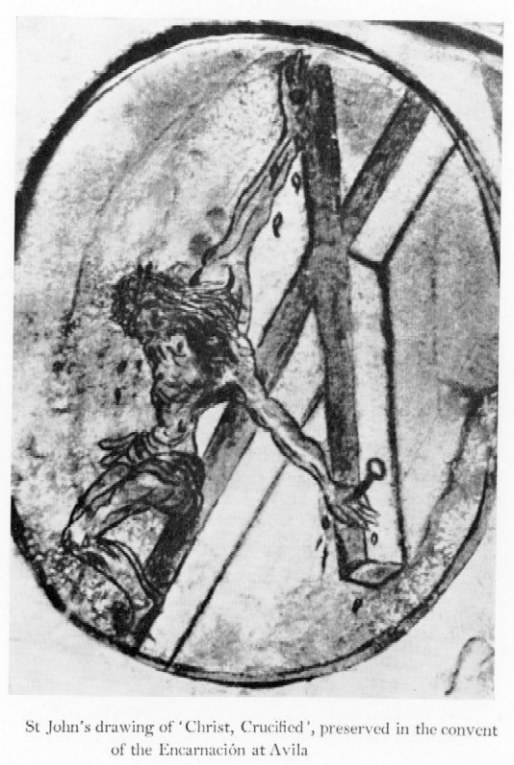
Drawing by St. John of the Cross that influenced Salvador Dali's 20th century portrait of Christ Crucified

One figure we must talk about first though is St. John of the Cross (Juan de Yepes).  John Paul did one of his doctoral theses on him, and knowing a little about him is important because he was such a big influence on TOB.

St. John (1542-1591) was the child of a Spanish nobleman who had abandoned his inheritance to marry a “commoner,” the daughter of a silk weaver.  When his father died young, the Yepes family wouldn’t give any help to the widow and her children.  They lived poor, sometimes on the streets, but John managed to work his way through school and became a Carmelite priest.  He was involved in the reform of that order, a task that led to great hardships for him.  When people, including dedicated Christians, fall into bad habits it can be difficult to change.  Some of his brother Carmelites resisted the call to reform, at one point putting him under what we might call house arrest.  He spent nine months locked in a tinny cell, enduring public humiliations and punishments.  It was during this time that he suffered a great spiritual crisis, as you could imagine, but also a time when he wrote some of his deepest spiritual poetry.  He finally escaped one night and went on to continue his work.

The Catholic Encyclopedia that we find online points out something I found interesting; that St. John, while a master of spiritual theology and Doctor of the Church, was not really a scholar in the usual sense.  We can read Teresa of Avila, his contemporary and collaborator in the Carmelite reform, and a trained eye can see her influences clearly (I’m not talking about my eyes, by the way).  The same could be said of many great thinkers, including John Paul II.  They read a great deal, what they read helped shape their minds and then influenced their own writings.  Out side of Sacred Scripture and St. Thomas Aquinas, John of the Cross seems to have few influences.  His mystical insights are drawn from experience.  In his life he understood suffering and rejection, as well as the joys of friendship in Christ, and most of all union with God.  All this went into his poetry and spiritual writings.  More on this extraordinary Saint and his spirituality next time.     

Thursday, September 16, 2010

Phenomenology

I know that I’ve been going in a bunch of different directions in the last couple of weeks, but I’ll try to get back on track here.  We were beginning to look at the Theology of the Body (TOB) by examining it’s philosophical roots.  I really don’t want to get too bogged down in the philosophy, but to mention that John Paul II taught philosophy and was very familiar with the contemporary philosophical currents about him.  He was a man of his times, while also being firmly rooted in the Church’s Tradition.  The branch of philosophy that the late pope is most associated with is phenomenology, which developed in Europe around the turn of the twentieth century and arguably reached its peak about the mid 1900s.  

There is a lot of debate about how much John Paul II really was a phenomenologist since it can be argued that it’s more a way of doing philosophy than an intellectual movement with a set of firmly held beliefs.  For example there are a wide variety of thinkers who are sometimes called phenomenologists whose views are very different.   You have John Paul II and St. Teresa Benedicta of the Cross (AKA Edith Stein) on one side and the likes of Jean Paul Sartre and Jacques Derrida on the other.  The first two stood firmly on the side of faith, the other two were atheists (to be fair, Derrida was a bit coy on the issue).  So the argument is that John Paul used the language and method of Phenomenology, but little more.

I must admit, that entire discussion is above my intellectual pay grade.  What I do know is that in TOB John Paul looks at scripture and tries to analyze it from the standpoint of experience, much like a phenomenologist would.  Contemporary philosophy had become more and more subjective, while traditional Catholic thought emphasized objective truth.  John Paul used this very contemporary method to bridge the gap between the two, showing how our personal experience points us to the universal truths of faith.

Like I wrote at the beginning, I don´t want to get too caught up in the philosophical part of the story.  As we move along I´ll try to point out where John Paul is using phenomenology as a springboard for  his teaching. But there is just one more stop we have to make before beginning TOB.  It’s a look at one of the great mystics in the history of the Church, and I must admit, one of my heroes, John of the Cross.  It is he who supplies the theological and spiritual foundation to TOB.

Monday, September 6, 2010

Philosophy is not Pretty


The comedian Steve Martin used to say that people who study philosophy in college remember just enough to screw them up for the rest of their lives. It could be added that most people who haven’t studied it, and a good number who have, think it’s too much of a waste of time to even accomplish that much. As one who has a piece of paper hanging from his wall proclaiming him a bachelor of philosophy I can say that my studies didn’t do me any lasting emotional harm (some might disagree on that point). And while I tended to treat these courses as a means to an end without any lasting importance, my view on this has changed over the years. I now wish I had paid better attention and dug a little deeper back in the day. I don’t know that we have to go back to past ages where everyone who went to university left with a philosophy degree (a practice that endured in many Catholic colleges well into the 20th century), but there needs to be some renewal of philosophy in the core curriculum, if such a thing still exists. If we are screwed up today, to use Mr. Martin’s vulgarism, it’s because we don’t really understand why we believe what we believe, and this doesn’t apply to non-religious people only, but for people of faith as well.

Faith is enough to get you into heaven, for sure. There are worse things in life than not understanding St. Thomas Aquinas or St. Augustine. To be versed in theology and philosophy doesn’t make you a saint. There was a professor of Scripture at Xavier when I was there who was very popular, and didn’t believe a word of what he taught. That is he approached the New Testament as an anthropologist might, not as a document of faith. I heard a beautiful and insightful lecture on Isaiah 6 by a professor at SUNY Purchase, but for him it was a poem, nothing more. Knowing something intellectually doesn’t mean that you really believe it, or really understand it in the same way. With faith we have a different way of seeing both the Scriptures and reality around us. We don’t need airtight arguments to convince us that Jesus Christ is the Way the Truth and the Life. But we don’t live in a world guided by the light of faith. We have friends, neighbors, coworkers, even family members who may not share our faith or may be uncertain if they really believe what the Church teaches. We ourselves may have doubts that won’t go way. Appealing to religious authority may not be enough to convince them, or us, of the truth of these teachings. This is where philosophy comes in. If we know enough of the intellectual underpinnings of our belief maybe we can at least convince them, as well as be convinced ourselves, of the reasonableness of our faith.

This is only a first step. What will ultimately convince people is our personal witness lived out in our lives. The writings of St. Thomas Aquinas have certainly helped people to better grasp their faith and even pushed some struggling with the idea of converting “over the edge” to embrace Christ. But it is the example of those like Bl. Theresa of Calcutta that truly move souls to change their lives for the better.

This is a long way around to say that I’m not making philosophy the be all and end all. But it is a tool, and an important one. The Theology of the Body was formulated by John Paul II, who was a philosopher, because the Church had reaffirmed its teaching that the use of artificial contraception is contrary to human dignity and the divine law. Many within the Church found this hard to accept, and to this day most Catholics ignore this teaching. His hope was to show people the religious justifications for this teaching, but also that it is in line with human reason as well.

And so I'm dusting off some old volumes, scouring some web sites and brushing up on my Aristotle, as well as Descartes and Kant. It's actually been enjoyable reacquainting myself with this material and I pray it bears fruit, not just for me but for you.

I had promised a posting on phenomenology, but I found that I need to go beyond TOB’s introduction to really do it justice. So, I’m still reading through some material and hope to have something on that by the end of the week.

Friday, September 3, 2010

Kant, You Romantic Fool


The last time we looked at the Theology of the Body we examined the philosophical roots of TOB, discussing the shift in the common world view after about 1500. In doing so I jumped over a few centuries to get to the idea of reductionism: that reality can be reduced to function, with no spiritual dimension to the material world. We should go back a bit though to see more clearly how we got to that point. There is one thinker who had tremendous influence on John Paul II, and really on all contemporary thought, who must be dealt with before going on.

Immanuel Kant (1724-1804) was a Prussian philosopher who spent almost his entire life in his hometown, never traveling more than a hundred miles from where he was born. In spite of his limited background his influence has been great. His work summed up and answered the philosophers that came before him, and all the philosophers that came after him have had to react to him in some way. His thought is too far reaching to summarize in a short space, so I’ll concentrate on the things that concern us most directly: his ideas on free will and the human person.

For Kant, to be human was to exercise free with without limits. This is not to say he didn’t believe in morality; he held to a very strict moral code. For him to be moral means acting in accordance with reason, so that what is irrational is also immoral. Any action that is based on desire, emotion or motivated by pleasure does not meet the standard of a rational act, and is thus immoral and dehumanizing. Any act that uses another person, not respecting his or her autonomy limits free will, and so is also immoral. Kant thought sex was dehumanizing because it is an action born of desire, emotion and, you got it, the seeking of pleasure. In his view sex partners are using each other as objects. This violates the individual’s free will and is immoral. Sex could be justified if the goal was procreation, which is rationally needed for the continuation of the human race, but for no other reason. As you can tell, Kant wasn’t big on Valentine’s Day; in fact he was never married.

It’s amazing to me that Kant was a devout Lutheran, and part of his goal was to set up a system that allowed for faith and the spiritual at a time when philosophers were becoming more and more materialistic. But his teaching on free will, which builds on Francis Bacon, soon became detached from his strict morality as questions over what is rational and who sets the standards of rationality rose up in later decades. Rather than safeguarding human dignity, Kant’s thought gave rise to increasingly individualistic philosophies that promoted the exercise of free will for the good of the individual or society, but often at the expense of others.

The challenge that John Paul II faced was maintaining the centrality of free will while convincing people that Christian morality is the highest way of using that freedom. Keep in mind that JPII was a philosopher, and he tried to use a new philosophical school to answer modern objections to faith. More on phenomenology next time.

Wednesday, September 1, 2010

Of Cabbages and Kings

The medieval period is often thought of as being backward and “unscientific,” denoted by the fact that we also call it the “Dark Ages.” These terms; Dark Ages, Middle Ages, Medieval and even Renaissance, for the time that followed, were applied by people centuries after the fact. The historian Morris Bishop observed that the people of the middle ages didn’t think they were living in the “middle” of anything, that is between the fall and rise of two great civilizations. They thought they were the continuation of ancient culture and tradition, as well as building upon it. Romano Guardini wrote that the medieval mind was much more subtle than it is given credit for today. For them humanity, nature and the spiritual realm were intimately connected, each functioning in harmony with the other. Through the study of actions, attributes and qualities it was possible to know what something was by its nature, and that a being was greater than the sum of its parts or practical function. Reality, including our earthly lives, had a purpose or an end to which it was directed. This end was ordained by God and it was our job, sort to speak, to find where our individual place was in this universal plan.

There is no doubt that at some point after 1350 new intellectual, cultural and scientific movements emerged that would lead to revolutionary changes in society. As the Theology of the Body´s introduction points out, beginning with Francis Bacon (1561—1626) the natural world became seen something to be mastered, controlled and manipulated rather than harmonized with. This process continued with Rene Descartes (1596-1650), further separating humanity, nature and the spiritual realm, putting them at odds with each other. Reality was no longer unified but fragmented, and our ability to know was limited to what could be observed. The nature of something was deemed unknowable, only its function could be discerned. There was no end to which reality was directed beyond what the individual decided it to be. In its extremes it lead to what some philosophers call reductionism; the human person is no more than a composite of parts without purpose or meaning. Human beings are a complex machine made up of the same biological “stuff” as the rest of creation. As the physiologist who discovered vitamin c once noted, “there is no real difference between a king and a cabbage.”

I do describe an extreme view, but this basic reductionism has trickled down to our common way of thinking and viewing the world and ourselves. Since the body has no inherent meaning or purpose beyond this life I can do what I want with it. This can lead, consciously or subconsciously, to accepting substance abuse, sexual excesses or various forms of self mutilation as morally neutral. In the realm of human sexuality specifically, it doesn’t matter who I have relations with since the body is a machine or organism to be satisfied, and nothing more. We need our body, so we’ll be careful about what we eat, to the point that we more and more speak about food in almost moral terms. How we care for the body is important, but what we do with it after is not.

TOB tries to get us back to a more integrated view of the body, that it does have a value and a purpose beyond function and pleasure. We should care for our bodies, certainly. But what we do with this gift we have been given has the greater importance. We are created in God’s image, not just because we have a soul, but the Divine is imaged in our bodies as well (but I’m getting a little ahead of myself). More on the philosophical roots of TOB next time.

Saturday, August 28, 2010

TOB Intro: Part I

In the past I never read introductions, or almost never. I usually cut right to the “beginning,” treating the intro as something disposable. This is a mistake in general and most certainly a mistake where the 2006 edition of the Theology of the Body is concerned. Michael Waldstein, who translated the text, offers an introduction that, far from being disposable, could be a book by itself. Roughly the first half is an exploration of the philosophical roots of TOB and the second is concerned with the theological influences. I’ve finished the first part, and have begun the second.


It’s been a long time since I studied philosophy, and when I did I treated it little better than I did book introductions. It was strictly a means to an end. I needed 27 philosophy credits before starting theology study, and the quicker I got done with it the quicker I could begin preparing for ordination. In honesty, I did grow to enjoy it. I have many fond memories of sitting in the Mirage Diner or Mr. Taco with my friends Bill and Matt discussing Aristotle’s teaching on substantial change and how Descartes destroyed metaphysics, over a burrito and a coke. But once I moved on to the Salesians my contact with things philosophical grew less and less. Philosophy had served its purpose, and now it was time to move on to something else, shall we say, more practical.


In time I have come to see that this utilitarian attitude toward philosophy has been damaging. The philosophical moorings that made the content of faith understandable in the past have been torn out by the roots. This makes explaining the content of faith difficult, to put it mildly. Joseph Ratzinger (AKA Benedict XVI) compared the task of the theologian in our times to a clown trying to warn an unsuspecting village of an approaching wild fire. The people see the strange, if familiar, dress and assume it’s all part of the act. Like a clown, religion has been relegated to a particular place in the collective mind; it’s there to comfort and reassure in times of difficulty, maybe, and to be used when some service is needed, like a wedding or a funeral, but is otherwise irrelevant when faced with the deep questions of life and reality. In this way we can say that Nietzsche was right; God is dead and we killed Him.


The Holy Father was writing, as a private theologian, over 40 years ago and in that time the disconnect has only gotten greater. What began as intellectual trends embraced by a certain elite class has trickled down to shape the popular mind. It took several hundred years for this to happen, but it has. Many critics of the contemporary scene like to blame the 1960’s for ruining the world, but in reality all that happened was that these various trends came to flower, not simply in the academy, but on main street, and without us really knowing it. I’ll save the how to the social scientists; I’m more concerned here with the what that changed. It’s that What we’ll look at next time.


Wednesday, August 25, 2010

Enough of the Drama


A couple of weeks ago I weighed in on the controversy surrounding Christopher West and his take on the Theology of the Body (TOB). To be honest, I’m backing away somewhat because I’m getting a bad feeling about the whole thing. Mr. West’s critics have many valid points, but there is an undercurrent of bitterness that’s palpable. I don’t want to accuse anybody of being uncharitable, but if it walks like a duck, swims like a duck…well, you get my drift. I am not a particular devotee of Mr. West but he and Janet Smith, who has also been the target of criticism, have been out there teaching the difficult message on pre-marital sex and contraception that few others in the Church have been willing to do. I think they deserve better than what they’re getting.

These then are my last unsolicited words on this controversy.

But these will not be my last words of TOB. A good thing that came out of my detour through this little imbroglio is that my interest in this relatively new field of theological inquiry has been renewed. I first heard about it back in the 90’s, and did some reading on it, and made it through about half of the 129 talks given by John Paul II that make up the guts of TOB. Pastoral work took me away from going much further, and while I’m still very much “on the front lines” (overused term, but it fits) I’m again tackling the late Holy Father’s work. There is a new translation, superior to the old one (better organized, more consistent use of language) with an introduction that’s served me well as a review of certain philosophical trends since Francis Bacon. As I work my way through I’ll share my reflections. I’ll still post my weekly bulletin letter and what ever musings on popular culture that hit me, but for the next few months I’ll be concentrating on TOB.

Now understand, I am not a professional theologian; I am a pastor in both the broad and strict application of the word. I don’t claim to offer a definitive interpretation of John Paul II’s theology, but rather very personal reflections based on experience and what I understand to be the mind of the Church.

And so, let the fun begin. And I really do hope it’s fun and, more importantly, helpful. Once I get through the introduction, which is so far proving to be worth getting the book for, I’ll begin the beguine.

Wednesday, August 18, 2010

TOB Controversy, Take Two

Last Saturday I put up a post weighing in on the controversy surrounding Christopher West and his interpretation of John Paul II’s Theology of the Body (TOB). I have since taken it down because I’m afraid I wrote too quickly. The appeal of a blog is that it is immediate, and allows the writer the instant gratification of getting his or her ideas out right away. Most of my entries are written within an hour or two. Others might get tinkered with for a little longer, but they rarely sit overnight before I post them. I am usually writing about spiritual and theological matters that I have already reflected on for years, or are critiquing movies or music drawing on my inner core beliefs, as well as the admittedly modest knowledge I’ve acquired about these topics over the years. Which is a long way around to say that I avoid shooting my mouth off about things I know little or nothing about. I do not need to be reminded that our desire for instant gratification can be destructive. While the post I took down was certainly not “destructive” I do fear I didn’t put enough time in reflecting on the issue and taking a look at both sides.

The problem is that this whole controversy is between Catholic intellectuals who might otherwise be considered to be “on the same side.” These are people who consider themselves orthodox, working closely with the Church hierarchy, and drawing on Scripture and Tradition in order to conform to these two fonts of the single Divine Revelation. They are not “progressives” challenging traditional views, or criticizing the Magisterium. It’s difficult for me because I can see where both sides are coming from.

And so I am taking a few steps back, but will return to this topic, because I do believe that it is important. TOB is increasingly being incorporated into catechetical programs and religious education materials for young people and adults. John Paul II’s theology is dense, and so we rely on people like Mr. West to help “break it down” into a language that the common person can understand. The little I have read of TOB leads me to believe that it has implications for theological and spiritual discussions beyond marriage and sexual ethics. I would not want to see it fall into disrepute because of a misinterpretation. At he same time Mr. West has been a long time laborer in the vineyard, respected by bishops and Catholic academics who I hold in high esteem, and so should be treated fairly and get a proper hearing before passing judgment.

In the mean time I point you a lengthy article by Alice von Hildebrand and about Dawn Eden, who are critical of West’s approach. I also point you to Christopher West’s response and a defense by Janet Smith.