Friday, September 30, 2011

Et Tu, John Henry?


Note: I first posted this just before Terry Francona's departure from Boston became official.  While the parting of ways seems to be mutually agreed upon, it doesn't change my basic feeling that this was not the right way for Francona to go out.

The Red Sox collapse was spectacular to witness.  I must admit that I really didn't think they would blow it in the end.  I figured that at the very least they would end up having to play the one game play-off, and then who knows?  Anything could have happened then.  In September they stopped pitching and hitting and had to deal with under performing stars and head case pitchers, not to mention the injuries.  It really was like the pre-2004 Sox who could never seem to get out of their own way and found new and increasingly torturous ways of losing out each year.  I'm hearing now that there is a good chance Terry "Tito" Francona will be out as manager.  There are many people to blame for Boston's September debacle, and certainly the manager has to take some of the heat as well.  It comes with the territory.  But he should not be the scape goat.  Shame on the Red Sox if they fire Francona.

In 1978 Don Zimmer's Sox blew a 14 and a half game lead to the Yankees, and then lost the one game play-off, a game that they were leading in the seventh inning when Bucky (Expletive Deleted) Dent famously took Mike Torrez over the Monster.   Zimm was given two more seasons as manager before being asked to move on.  Joe Torre's '04 Yanks suffered ignominy of being the first, and so far the only, Major League team to blow a three nothing series lead when they lost to the Sox in seven in the ALCS.  With it ended the mythic "Curse of the Bambino."  In spite of presiding over the greatest collapse in baseball history Torre managed the Yankees three more seasons.  In the Boston dugout that year was Terry Francona.  His team was considered dead in July, then scraped back to get the wild card.  After losing 19-8 in game three of the ALCS they were again left for dead.  By the time it was over the hated Yankees could do nothing as their blood rivals celebrated victory on their own field, before a stunned Yankee Stadium crowd.  After dispatching the Cardinals in four games Francona's team brought the title home to Boston for the first time since 1918.  That's 86 years between championships, if you're keeping count.  Don't you think that the man who broke "the Curse" deserves the same chance at redemption as Don Zimmer and Joe Torre?

And isn't redemption at the heart of the Red Sox story?  As a Yankee fan I can never hurt a Red Sox fan with the simple mention of Dent's or Aaron (Same Middle Name as Bucky) Boone's name again.  We may defeat them head to head in the future, even embarrass them along the way.  But nothing the Yankees will ever do will top how they beat us in '04.  They have one up on us, even if they never finish ahead of us again in our lifetime (highly unlikely, but you get it). All the pain of 1946, '67, '75, '78, '86, and 2003 when they came sooooo close and fell short were washed away by Curt Schilling's bloody sock.  And the manager had to take some credit too.  He also had a difficult to handle club house that year, dubbed "The Idiots" by Johnny Damon.  But he held it together and brought them home safe.  He deserves better than to be dismissed like this, if indeed that is what happens.  He deserves his chance to come back from this like he helped bring the Red Sox back from decades of failure to two Series titles in the double zeros.

Every manager is hired to be fired.  There is a time when even the best manager loses his club house or is tuned out by his players.  Change can be good for both the team and the skipper in that situation. But when a manager has had such an historic run with a team he should be given a fair chance to prove he's still the right man for the job.  I'm not sure that the man known as Tito is being afforded that privilege.  Francona is a class act who deserves better than this.  I hope Red Sox owner John Henry takes a day or two and cools down before he stabs the pride of Beantown in the back.

Tuesday, September 27, 2011

Baseball 2011


I have a lot of irons in the fire and loose ends to tie up, (excuse the mixed metaphors), what with the whole gay marriage thing, the Fr. Pavone controversy and my take on the show Mad Men; all themes I've started over the last few weeks but haven't finished. I'm not even going to mention the videos on why I'm a Catholic (I guess I just did).  But before getting back into the heavy subject matter I'd like to go light this time out.  The Baseball play-offs are starting on Friday and I have a few unprofessional observations.

The American League

As of this post the divisions were wrapped up, with the Yankees securing home field through the play-offs.  The wild card is still up in the air, with the Rays and Red Sox tied in the standings.  This is truly incredible.  On September 1 the Sox were in first place, a half game up on the Bombers, and Tampa was a distant 9 games off the pace.  Everyone thought the rest of the month would be spent in a fight between Boston and New York over how they would split the division and wild card amongst themselves.  Only Buck Showalter, the Oriole manager, predicted that Tampa would be in the mix.  At he end of August he told Ken Singleton, who calls the Yankees on Yes, that he thought they would contend for the wild card.  When Singleton mentioned it on the air the other announcers laughed.  One of them cracked, "Did he say what year?"  Well no one is laughing now, especially no one in Red Sox Nation.  The Sox are collapsing while Tampa has soared.

If Tampa completes the comeback, they should be feared.  The Yankees are slight favorites in a fairly even field, but the Rays are peaking at the right time.  The Tigers have the best pitcher, Justin Verlander, but the Rays have the deepest rotation.  The Yankees and Rangers have better lineups, but the Tampa Bay bats are coming alive at just the right time.  If I'm the Yankees, I want Texas in the first round, to avoid a short series involving the future Cy Young winner, Verlander, and that Boston gets enough of its mojo back to qualify.

The National League

As a Yankee fan I don't watch enough of the National League to really ask the right questions, beyond the obvious;  will anyone beat the Phillies pitching staff in October?  Yeah, they've been on autopilot since clinching home field advantage, but who wouldn't be?  And yes, I do believe that they can just turn it on once the play-offs start.  Joel Sherman in the Post wrote a couple of weeks ago that this year's Yankees reminded him of the '96 team that upset the Braves in the World Series.  Like that earlier team they have a solid lineup, a deep bench and bullpen to augment a questionable starting rotation.  The Phillies, like Atlanta of old, has a good all around team, an OK bullpen and starting pitching second to none.  But while these Yankees have a better lineup then their predecessors, I think their rotation isn't as solid.  And the big four of Philadelphia are better and, more importantly at play-off time, tougher than the 1990's Braves.

I'll save predictions for when all the play-off spots are filled, but if it does come down to Phillies-Yankees, Halladay, Lee, Hamels and Oswalt beats Sabathia, Nova and fill in the blanks any time.

Wednesday, September 14, 2011

Mad Men: Part 1

I wasn't going to comment on the AMC program Mad Men until March of 2012, when it's scheduled to return from a prolonged hiatus.  But I see that the networks are premiering shows in the next weeks that are attempting to cash in on the popularity of the early 1960's retro drama, so now seems as good a time as any weigh in on the trend. On the off chance you've never seen the show but plan to check out the back episodes, let this serve as a SPOILER ALERT.  


Mad Men
TV-14
AMC (New season to begin in March, 2012. Back episodes streaming on Netflix)

I had read all the hype on AMC's show Mad Men, about its spot on production design that uncannily recreates the look and feel of the early 1960's, its perceptive social commentary and solid cast.  It had been on hiatus since last October due to a contract dispute between it's producer and the network, but is now filming it's fifth season and is scheduled to return next March.  To catch up, and see if the hype was just hype, I trudged through the first four seasons in August on Netflix. And it is true; the sets, clothing, hairstyles and even incidental props all point, almost obsessively, to that earlier era.   The cast is very good, and they're given literate things to say.  But not far into the first season it dawned on me that for all the genuine quality on display Mad Men is really just an over glorified soap opera. And like many Soaps it's moral message seems to be a bit confused.


Mad Men takes place in the most politically incorrect setting imaginable. The series transports us to the fictional Madison Avenue advertising firm of Sterling Cooper (later Sterling Cooper Draper Pryce) between the years 1960 to '65.  The men are hard drinking, heavy smoking, skirt chasing, sexist, racist, homophobes, and loving it (after two heart attacks one of the main players admits that he's lived like he's been on "shore leave" for the last twenty years).  The women are over worked, underpaid, unappreciated, sexually repressed and or under constant threat of being put upon for sexual favors. And when they give in they are more often than not thrown to the side once it's over.  In spite of all the good times and material prosperity there are deep wells of depression and lack of emotional fulfillment welling up in the main characters.  The only people who seem to have it together are divorcees, bohemians and unmarried working women in their thirties (though even they get their comeuppance eventually).  Like all Soaps there are more characters than you can shake a martini at, and it would take a small booklet to describe them all and the somewhat convoluted predicaments they get themselves into.  

More important than the individual personalities, it's the show's mood  that sets it apart. We see the United States at the zenith of its material wealth, international power and influence, with boundless optimism over the future.  The men are in sharp suits and Fedoras and the women are dressed in concealing yet form fitting dressed that scream femininity.  Yet underneath the surface lies an understanding that it's all fake.  No one is who they pretend to be or satisfied with who they are or what they have. This is personified most clearly in the show's main character, Don Draper (Jon Hamm) whose adventures and tragedies the series follows.  He's the creative director of Sterling Cooper, a position he conned himself into.  But his con wins him not just a job but also a beautiful wife, who he has two children with when the show starts, and a spacious home in suburban Ossining, New York.   He is highly successful, and the other "big boys" on the Avenue are hot to steal him away from his midsized firm.  He's also a serial philanderer and, like almost all the main adult characters, has a serious drinking problem.   But Don has a deeper secret to keep than his womanizing and alcoholism; he's not who he says he is.  During the Korean War he switched identities with a dead officer who had been burnt beyond recognition in a freak accident. Richard Whitman (Don's real name) is assumed dead while Donald Draper lives on.  He's able to carry on the charade with cunning and more than a little help from the real Draper's amazingly understanding widow, with whom he begins a close but platonic relationship.

Much of the ground Mad Men covers is not terribly new; movies like American Beauty or The Graduate have shown the soulless, hypocritically phony suburbs and Fight Club gave a critique of our consumer driven, conformity obsessed society.  While I must admit that what's new about the show is its packaging more than it's content, and that it seems to loose steam a bit in the third season, I was hooked.  Part of it is the style.  But viewer be ware; the fashion covers up a multitude of sins and moral confusion, not just of the characters but of the basic message being proposed.  More on that next time. 

Sunday, September 11, 2011

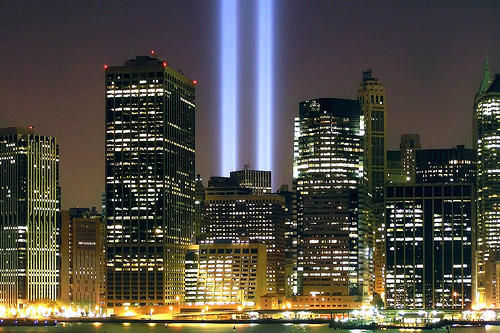
9/11+10

We began school Thursday across the parking lot at what is now called Our Lady of Guadalupe Academy, the former St. Anthony's School.  I teach the 8th grade religion class and the second day I looked out at the group and reminded myself that they were between the ages of three and four in 2001.  They obviously have no real memory of September 11, nor any real concept of what the events of that almost preternaturally sunny Tuesday meant.  The world that they have grown up in has been shaped by the war on terrorism, much like my childhood was by the Cold War.  I couldn't imagine a world without the Soviet Union, or the fear of nuclear annihilation.  I grew up after the duck and cover days, and only remember one bomb drill during my elementary school years, when I was in first grade.  I can't say I lived in constant fear and loathing, but I knew the threat existed, and more than once wondered if I would live to see adulthood.

I don't know what's in the heads of these kids.  I know that they have preoccupations that I didn't growing up with in suburban Westchester; gangs are a problem here, the pressure to do drugs, drink and get involved in premarital sex is already upon them.  I'm not sure if they feel any anxiety over the possibility of a dirty bomb going off, or if the sight of one of the low flying jets approaching Newark Airport, right next to us, gives them a slight twinge in the gut.  I know I'm less paranoid now than I was in 2002 or '03, when we had color coded alerts and anthrax scares.  But we still have our reminders that we live in a post-9/11 world; the public service announcements telling us to be suspicious of abandoned bags on subways and the constant war footing that has now become a part of the background noise.  I lived in a time before all this, when you didn't have to empty your pockets before entering Yankee Stadium, or take your belt and shoes off before getting on a plane.  But for those young people, this is life as they've known it; the only normal they've ever experienced. 

Today most of the memorial services and news coverage will focus on remembering the events of ten years ago, and especially the victims.  This is only right.  But I can't help but think of now, and the world our children are inheriting.  I could never have predicted the fall of the Berlin Wall, the symbolic end of the Cold War.  I don't know what the end of the war on terror will look like, but I've got to have the courage to imagine it.  Not so much for me, as for the children, that they might have a chance to shape a new, better reality.

Friday, September 2, 2011

More on Bill Keller, The Eucharist and Marriage

Bill Keller's op-ed piece in the Times on Sunday has drawn criticism for a flippant remark about the Eucharist and its generally condescending tone toward people, in public life particularly, who practice their faith.  I highlighted a line that has gone pretty much overlooked, about religious people looking to limit others' civil rights that I thought was important. I touched on the Eucharist last time, and I want to put a bow on it a bit before moving on to the next point.

I don't know Mr. Keller's story; I don't know if he is a "fallen away" Catholic or thinks of himself as being "progressive," but either way he shows a disturbingly unsophisticated understanding of the Eucharist for someone who feels comfortable commenting about it publicly.  I have many opinions, but few I choose to share in this space because I know my limitations.  Does this mean I that I never over reach? No, I can put my foot in my mouth with the best of them, but generally I try to stick to what I know.  The Eucharist is a mystery.  Not in the Agatha Christie sense of the word, but in the sense that there is subtlety and nuance to the doctrine that can never be fully understood, that demands faith first.  Faith always needs to come first, then understanding follows, along with humility.  Without faith we are left with the sophomoric statement Mr. Keller made Sunday. Without humility we stop trying to go deeper because we think we know it all already.

If there is misunderstanding about the Eucharist out there part of the blame has to be placed on bad catechesis, but there is also the relativist mentality of our contemporary age.  The spirit of our time tells us that we control reality and its meaning in a radical sense.  We write the definitions that fit us, without reference to tradition or precedents.  If we find the True Presence difficult to accept, we go ahead and make the Eucharist mean what we want it to mean, or mean nothing at all.  Scripture, Tradition, what the faith community has believed down the ages is irrelevant.  All that matters is now and my own needs and my own ego. This brings me to the issue of marriage and how it is defined.

Marriage is a public institution with private implications, but we tend to look at it the other way around. Rather than married life and family life being synonymous they are viewed as being distinct.  Sex and procreation have also been cleaved apart in our contraceptive culture.  Sex, family life and all of marriage's constituent parts are now dismembered and set up like a buffet that we can pick and choose from.  Marriage is redefined to fit the needs of the individual exclusively without reference to the community.  We know somewhere in our hearts that the family is the building block of society, so we redefine family to fit our individualistic view of the world.

Mr. Keller commented in his article that he didn't want elected officials limiting his fellow citizen's civil rights because of their religious values.  I don't think it's going out on a limb to conclude he's referencing the gay marriage debate.  Marriage is a human right, but what is marriage?  If you're talking about the union of a man and a women for their own benefit and the good of their children, I'm with you.  If your talking about a vocation of service that grows and nurtures the family, and by extension the society, I'm on board.   Marriage is these things and much more.  Gay relationships simply can never fully encompass what marriage is, and no editorialist, activist or civil law can make it so.

When I was a child growing up in the early 70's our next door neighbors, a middle aged couple whose kids were adults and on their own, moved away and two middle aged men moved in.  I was five or six years old and didn't know what straight was let alone gay.  I know that my father wasn't happy when they built a tall wood fence along the property line to conceal their back yard.  (I understood the objection to be one of esthetics since the unfinished side would be facing our yard).  Otherwise they were good neighbors, and after the initial controversy was settled everybody seemed to get along well.  We moved a few years later, and they lived there together for better than a decade.  One day years later my mother and I got to talking about the old neighborhood, and she told me that she had heard that one of the two had died of AIDS and that his partner had moved away.  I was sad to hear the news.  They were both kind to me, and I only had fond memories of them. I don't doubt the love and devotion the two men had for each other and the pain the surviving partner must have experienced.  But all my sympathy doesn't change my mind that what ever life they shared, what ever name you want to put on it, it simply wasn't a marriage.

Marriage, as I've written, is the building block of society.  It is not primarily a private relationship that allows the couple to fulfill an emotional need. Certainly our individual needs are important, but in marriage they come second, maybe third.  The couple lives now, not for themselves but for each other and the children that are a living testament to their love.  In the family the life of the couple is extended through time.  As individuals they will die eventually, but their children and their children's children keep the memory of their union alive in a tangible way.  The hard work that they do builds up and ensures the continuation of the Church and the society.  A homosexual relationship can, at best, shadow this reality, (and I'm being generous conceding that much) but can never equal it.  Did that gay couple have a right to share a house and a life together in peace?  Yes, I believe that they did.  But what they had was essentially private and passing.  What ever it was, it simply wasn't a marriage in the way the human race has always understood it up to now.  It was a personal arrangement with no public interest, and therefore not needing or meriting governmental sanction.

This debate goes deeper than marriage as a social institution.  At the root of this entire debate is how we  view human sexuality, and no discussion on this topic can be complete without examining that question.  I'll save that for next time. 

Thursday, September 1, 2011

The Eucharist and The Paper of Record

I was going to write about marriage between women and men this time out, which I will, but was caught off guard by something I saw on the Internet last night.  To go back for a second, I'm embarrassed that so much time has gone by without making a comment about the new gay "marriage" law in my home state of New York.  This summer has been a blur of meetings, weddings, retreats and trips up to Massachusetts to see my father, who needed heart surgery in July (Saw him yesterday; doing much better. Thank you all for the prayers).  The whole thing came and went and I was ill prepared to comment.  But for now, I want to talk about the Eucharist and the New York Times.

Sunday Bill Keller, the outgoing executive editor of the Times, wrote a piece in the Magazine section that advocates for greater scrutiny of the presidential candidates' religious beliefs.  All in all, this is not a bad idea.  A person's faith, well integrated into their lives, will influence how they think, act and, yes, govern.  The controversial part of the article comes when he tries to differentiate between what he considers more inconsequential, if odd, beliefs held in various religions and more central ones that could effect policy decisions. I quote at length:

I honestly don’t care if Mitt Romney wears Mormon undergarments beneath his Gap skinny jeans, or if he believes that the stories of ancient American prophets were engraved on gold tablets and buried in upstate New York, or that Mormonism’s founding prophet practiced polygamy (which was disavowed by the church in 1890). Every faith has its baggage, and every faith holds beliefs that will seem bizarre to outsiders. I grew up believing that a priest could turn a bread wafer into the actual flesh of Christ. 

But I do want to know if a candidate places fealty to the Bible, the Book of Mormon (the text, not the Broadway musical) or some other authority higher than the Constitution and laws of this country. It matters to me whether a president respects serious science and verifiable history — in short, belongs to what an official in a previous administration once scornfully described as “the reality-based community.” I do care if religious doctrine becomes an excuse to exclude my fellow citizens from the rights and protections our country promises. 

I highlight the offending line, about the Eucharist, and one that has gone largely unnoticed, one that I read as relating to the gay "marriage" issue.  What Mr. Keller is saying, in essence, is that it's alright to have your exotic and esoteric beliefs, as long as you don't make a show out of it.  But when faith actually influences your world view, well we just can't have that.

I can't and won't speak for Mormons and their adherence to the texts they hold as sacred, or how they believe those scriptures came into existence, but as for Catholics, the True Presence is not some fringe, disposable belief.  It is central and holds the key to our entire belief system and world view.  It is the concrete reminder that God so loved the world that he sent us his only Son, that we might not die, but live eternally.  It is the reminder that God walked our streets, ate in our homes, healed the sick and raised the dead.  More to the heart of the matter, it is here to remind us, it is the memorial of Jesus' death, Resurrection, and Ascension.  The Eucharist is the fulfillment of Jesus' promise to remain with us for all time, until He comes again.  When we receive the precious Body and Blood we experience intimate communion with the Lord, and also with our brother and sister communicants.

When we say "Amen" before receiving communion we are saying that we believe in the True Presence, but also that we believe in what the Catholic Church teaches, reveled both in Scripture and Apostolic Tradition.  We are saying that we are in union with our brothers and sisters but also with the Pope, the successor of Peter.  We are saying "Amen" to a deep relationship that impels us to think differently, to to see the world and others differently, to live differently.

The Eucharist is nothing less than the extension of the Incarnation through history.  In the Eucharist Christ is present in the transubstantiated bread and wine and in the believing community united by the Sacrament.  It is the "bread for the journey" that gives us strength and makes us the Body of Christ so that His work of proclaiming the Kingdom will continue here on earth until the General Resurrection. It is also the reminder that God is close; as close as the tabernacle in your parish church, as close as our neighbour.


As for the second point; faith as an excuse to deprive people of their civil rights, I will enter into next time.  As I've tried to say, in so many words, ours is an incarnational faith.  The Word was made flesh and dwelt among us.  He came in the form of a human being, in a living body, as a man.  That the Second Person of the Trinity came among us as a man rather than a woman was purposeful, and points to the reality that the body matters and says something about who we are.  It is more than just a matter of how the plumbing is arranged, a quip I've heard now and again. But it points to our personal identity, how we are created in the image and likeness of God, and how we cooperate with Him in the ongoing work of creation. 


Tuesday, August 23, 2011

The Kennedys Mini-Series

 
The Kennedys (ReelzChannel, presently streaming on Netflix)  
OO

This past winter and spring there was a great deal of noise made about a TV miniseries about the Kennedy family that was purported to be less than flattering.  It had a solid cast, including Greg Kinnear as JFK, Barry Pepper as RFK and Katie Holmes as Jacqueline Kennedy Onassis, but because it focused on the scandalous aspects of the story the Kennedys wanted it buried, or so the story went.  It was supposed to air on the History Channel, but was dropped and after much hand wringing ended up on the ReelzChannel (I never heard of it before either).  The eight episode series is now streaming on Netflix for anyone interested in actually checking it out.  Let's just say the fuss was less than a tempest in a tea pot, considering that the final product is pretty sympathetic toward our titular heroes.  Are the main characters all squeaky clean?  Well, no they aren't.  And I want someone to tell me what historical figure is treated like a saint by film makers today?  We live in a post-modern, historically critical world where we are told to reject myth or hagiography for truth, even if, and especially if, the truth shatters our false illusions.  If The Kennedys was denied airtime on a top cable channel it shouldn't have been because it defamed anybody, but because it is shockingly sub-par television.  No one should have felt threatened by it, and considering that some people may have points to an apparent belief in some corners of the popular press that nothing less than a warts free, airbrushed portrayal of the 35th president should be presented to the public.


The eight episodes are constructed as a series of flashbacks and forwards, more or less covering the years that Joseph Kennedy, Sr. (Tom Wilkinson) was the U.S. Ambassador to the Court of St. James before World War II, to his death in 1969.  Joe Kennedy is really the central character for most of the series, the great emphasis in the early episodes being the elder Kennedy's living out of his own failed political ambitions through his children.   Is there womanizing by Joe Sr. and Jack?  Yes, but it doesn't dominate the story in any way.  Are there depictions of JFK's health problems? Yes.  Do we see him taking a potpourri of different prescription medicines and getting injected with pain killers by "Dr. Feelgood" in the White House?  Yeah, we do.  But all this is public record by now, and only the most strident hero worshiper would claim it had no effect on his ability to govern. 


But JFK is always presented as a likable, if flawed man, whose heart is always in the right place.  He is shown as a champion of civil rights and a leader who learned from the mistakes of the Bay of Pigs Invasion to stare down the Soviets during the Cuban Missile Crisis. Even Joe Sr. for all his conniving and cruelty is, in the end, presented as a loving father who wanted the best for his children.  After his stroke, early during his son's administration, Joe gets less airtime but his specter still looms large.

Again, are there depictions of Joe Sr. dealing with the Mafia?  Yes, but done in a way that diverts blame and make the whole thing look like a misunderstanding.  If anything the estate of Frank Sinatra should be more upset than the Kennedys.  Do we see the questionable handling of their daughter Rosemary's emotional problems? Yes, but again its a matter of record that she was lobotomized, the wisdom of which was questionable even by the standards of the day. In spite of these depictions The Kennedys is far from the "hatchet job" some have claimed.  We know too much today to be fooled by the tightly controlled myth making that passed for biographies and biopics in the two decades following JFK's untimely death. I don't think we should go out of our way to focus on the negative aspects of the Kennedy story, but neither should we pretend that it was all Camelot. 


If The Kennedys fails it's because it's simply not very good.  There is little complexity given to the characters; Rose Kennedy is presented as an unstable religious fanatic,  Robert Kennedy is practically sainted,  Jackie is uptight as opposed to the free spirited Ethel.  And Katie Holmes plays the former First Lady with this strange accent that seems to sway between Brooklyn and Brookline.  This is a good cast, but the script gives them little to run with, and the entire production never rises above an average made for TV movie. 

JFK is still a mythic figure in our history partly because he was our first, and so far only, Catholic president and his murder in 1963 is seen by many as the end of an innocent time in American history.  The social scene in the United States would grow increasingly turbulent over the next five years, culminating in the assassinations of Martin Luther King in April and RFK in June of 1968 (The sequence depicting the younger Kennedy's death are the only truly moving and affective scenes in the entire series).  As I'm pretty sure I've written before, getting our history from movies or TV is foolish, and I'm not defending The Kennedy's as good history.  But I am criticizing the mentality that brackets those three years as some sort of charmed time when knighthood was in flower, and that the troubles that followed would have necessarily been avoided had JFK lived.  Life is too complex for that, and we are too knowing today, or at least should be. 

Sunday, August 7, 2011

Father Patrick Diver, S.D.B. (1943-2011)


Saturday we lost a great Salesian Priest, Fr. Pat Diver (pronounced like river).  He was my predecessor as pastor here at St. Anthony's, and was a tremendous help during the transition period last year.  More than that he was a brother in Don Bosco and he was loved by both his confreres and the parishioners here in Elizabeth.  He had a warm heart, but also a feisty spirit, who didn't suffer fools or, being from Boston, Yankee fans gladly.  But most of all it is that warm heart and dedicated spirit that people remember.  As I went about the difficult task of informing the people this weekend at the beginning of our Masses, you could see the sadness expressed in the tears that were shed upon receiving the news.  As I wrote, Fr. Pat had a feisty spirit, and bravely battled cancer for a number of years, never surrendering, always fighting to keep on serving the people of St. Anthony's who he loved so much.     

Here is the obituary prepared by Fr. Michael Mendl, S.D.B.
            After a long bout with cancer, Father Patrick Diver, S.D.B., died early in the morning of August 6, 2011, at Father Hudson House, a hospice in Elizabeth, N.J. He was 68.
            Father Diver was born in Boston on August 5, 1943, to Patrick and Mary Connolly Diver. Within the month he was baptized at St. Margaret’s Church in Dorchester, which remained the family’s parish.
            Following his graduation from Don Bosco Technical High School in Boston in 1961, Patrick enrolled in Don Bosco College Seminary in Newton, N.J., as a candidate for Salesian life. In August 1962 he entered the novitiate, also in Newton, and made his first profession of religious vows on August 16, 1963.
            Like all Salesian seminarians, Brother Diver majored in philosophy at Don Bosco College, graduating with a bachelor’s degree in June 1967. He minored in classical languages.
            Having volunteered for the foreign missions, Brother Diver was sent to the Philippines, where he taught at Don Bosco Academy in Pampanga, the province’s high school seminary, from 1967 to 1970. The students greatly appreciated him as a teacher and friend. At the same time he undertook a master’s program in guidance and counseling at De La Salle College’s Graduate School of Education in Manila, completing his degree in May 1970. One of the papers that he presented for the degree was titled “The Counselor in the Salesian System of Education.”
            Brother Diver returned to the U.S. in 1970 to study theology at the Pontifical College Josephinum in Worthington, Ohio. He was ordained in Columbus on March 30, 1974, and awarded a master of arts in theology from the Josephinum in June of that year.
            Father Diver’s first priestly assignment as dean of students at Don Bosco College in Newton (1974-1976). Twenty-one years of high school apostolate followed, during which he ministered as a guidance counselor at St. Dominic Savio High School in East Boston (1976-1980), treasurer at Dom Savio (1980-1984), and director of the school (1989-1995); he was treasurer at Mary Help of Christians School in Tampa (1984-1988) and then principal there (1988-1989), and guidance counselor at Don Bosco Technical High School in Paterson, N.J. (1995-1997). He later had another short stint as guidance counselor at Savio Prep in East Boston (2003-2004).
            Father Diver made a lasting impression on the young men at Savio. One alumnus, C. David Surface, writes: “He was the most honest and caring priest I have ever known. His influence helped to shape my life both professionally and from a family perspective…. I will never forget him and how he made my days at Savio truly special.”
            During his first assignment in East Boston he was certified as a school guidance counselor in Massachusetts (1978).
            Father Diver worked in parishes, too. He was pastor of Mary Help of Christians Church in Manhattan for a year (1997-1998), associate pastor at Nativity Church in Washington, D.C. (2002), acting pastor of St. Theresa’s Church in Leeds, Ala. (2003), and pastor of St. Anthony of Padua Church in Elizabeth, N.J., and director of the Salesian community there (2004-2010).
            From 1998 to 2002 Father Diver was director of Salesian Missions in New Rochelle, coordinating a vast fundraising program in service to Salesian missionary activities all over the world.
            In 2007, while he was pastor in Elizabeth, Father Diver was found to have colon cancer and went through a long treatment and recovery.
            In the summer of 2010 Father Diver completed his pastorate and directorship in Elizabeth and was assigned once more to the formation of young Salesians as a very experienced and highly valued staff member at the Don Bosco Residence in Orange, N.J. Late in the spring of 2011 cancer returned in a very serious form. When treatment was unavailing, he entered hospice care.
            Brother Gustavo Ramirez, S.D.B., one of the young Salesians from Orange, said of him: “Father Pat Diver was a great example of perseverance and love for the young. I will always remember him as the vital man who loved the young to the last minute of his life.”
            Father Diver is survived by his sisters Kathleen Tubman and Maureen Fitzgerald, both of the Boston area, and by his Salesian confreres of the New Rochelle Province.
            The funeral arrangements for Father Diver are:
            Wake at Saint Anthony of Padua Church, 853 Third Avenue, Elizabeth, N.J., 07202, on Monday, August 8, from 7:00 to 9:00 p.m. and on Tuesday, August 9, from 2:00 to 5:00 p.m.
            Mass of Christian Burial at Saint Anthony’s, August 9 at 7:30 p.m. Father Thomas Dunne, S.D.B., provincial, will preside, and Father Thomas Ruekert, S.D.B., will preach.
            Burial in the Diver family plot at Newton Cemetery, Newton, Mass., on Wednesday, August 10, at 1:00 p.m.

Friday, July 15, 2011

The Tree of Life

The Tree of Life
PG-13, for some thematic material 
OOOO out of 4

As I walked out of the theater, after seeing director Terrence  Malick's new film The Tree of Life, I trailed behind an elderly couple who were clearly confused.  The woman grumbled that she "didn't know what they were trying to say, but it was so depressing!"  And I was tempted to butt in and say, "Depressing? The creation of the cosmos, depressing? The emergence of life from the primordial waters, depressing? The struggle between Nature and Grace, depressing?  The final reconciliation of creation in the age to come, depressing? Oh woman, we were clearly watching two different movies!" But, I kept my mouth shut since the lady seemed truly agitated and capable of flooring me with her handbag.  No, mutely I kept on going, hitting the street, breathing in the deliciously cool fresh air, a great relief after these days of heavy humidity, joyful that there is a God.

Part of the problem in viewing The Tree of Life is that it does not follow a strict linear narrative.   And oh yeah, there is very little dialogue to boot. The other problem is that the story encompasses no less than the history of creation from the Big Bang through to the End Times, a tough trick to pull off in less than two and a half hours.  A project this ambitious is going to have holes in places, and indeed I was left wanting more of those highly impressionistic, almost surreal episodes that depict creation and the evolution of life on earth.  Another problem is that if you arrive late, even if it's only by two minutes like my confounded couple, you might as well walk out and wait for the next showing.  If the movie is going to make any sense to you every frame must me seen. 

While the large backdrop of the movie is creation and its meaning, the "micro" story, if you will, focuses on a family in Waco, Texas in the 1950's.  We see an overbearing, but loving, father (Brad Pitt) who represents Nature; the world is a tough, dog eat dog place and he wants to make sure his boys are ready for it.  His counter part is the caring and affectionate mother (played by the transcendentally beautiful Jessica Chastain), who represents Grace; the need to give of one's self to the other, loving and forgiving unconditionally.  Why someone might find the movie depressing is that much of the movie's middle section is handed over to chronicling the struggle between these forces as it is played out in the life of this family. The center of this struggle is their young son (Hunter McCracken plays the boy, Sean Penn plays him as an adult), who clearly loves and is drawn to his mother, but struggles with his father.  And if I have one criticism, it's that it might linger on this part of the story a little too long.  Malick more than makes his point clear, and while I admit that an unconventional film of this kind needs time to spread out and unfold its mysteries, less would have been more here.

Hovering over all this is the Book of Job, and a quote given at the beginning which informs everything that follows (a key that my latecomers missed).  In a way The Tree of Life is a modern retelling of that story.  There are questions about the meaning of life and death, good and evil, and there are no neat answers to any of them.  Only that, yes Virginia, there is a God, and His plan is bigger than the details of our lives, yet intimately wrapped up in them at the same time.

A small detail that I picked up on was that the family is a church going bunch, a rarity in movies these days.  When institutional religion is depicted in contemporary cinema it's often presented as being in conflict with the "true faith" of the individual as opposed to being a help and support.  Here one of the more profound statements is made during a Sunday sermon, and sacramental images are used quite beautifully and effectively.  I'm not suggesting that Malick is promoting religious practice per say, only that when it is shown it's a positive thing rather than in the usual ironic or derogitory way I've grown accustomed to.


This was one of those movies like Lars von Trier's Breaking the Waves (1996) that underwhelmed, and even kind of bored me, as I was watching it, but blew my mind once I left the theater and really reflected on what I had just seen.  At a time when the "New Atheism" is on the march, and organized religion is put down in many Hollywood movies, it's refreshing to see an intelligent movie that acknowleges the Creator and, in a quiet way, treats faith respectfully.

Monday, July 11, 2011

Jeter at 3000

Anyone who knows me knows I am an obnoxious Yankee fan.  Yes, they are the Evil Empire, emblematic of all that is wrong in baseball; how they contribute to the gross income disparity between big market and small market teams, how they collect All - Stars during free agency time like some people collect stamps, the high ticket prices and the even more ridiculously priced food stuffs at the concession stands.  Most of all what non Yankee fans hate is the sense of entitlement we devotees of the Pinstripers feel; for us it's the World Series or bust.  Any October that doesn't end with a trip down the Canyon of Hero's is considered a failure. While I don't agree with all the criticisms, even I have to admit that this last one is valid.  It is simply unrealistic to expect to win it all every year, and too many Yankee fans have bought into the hype.  Look, I'm a demanding fan, and lets face it, winning never gets boring, but some years are more special than others, and going a while without winning does make the eventual victory that much more sweet.

The Yankees have won seven World Series in my lifetime.  The two that stand out are 1978 and 1996. Why?  Because those were the two that they weren't supposed to win. '78 was the great comeback year, where they overcame a 14 1/2 game deficit in the division to the Red Sox and a 2-0 hole in the World Series against the Dodgers to win it all. In '96 they had been out of the Series for fifteen years, and hadn't won since that fateful '78 campaign; 18 years in the desert.  I know, you Cub fans have been waiting 103 years, but we Yankee fans have less patience than you all (Think of it this way, your sufferings have helped release many poor souls from purgatory). That '96 group were a bunch of upstarts, with a few solid veterans thrown in.   None of the experts picked them to beat the Atlanta Braves, the dominant team of the decade to that point.  Like the '78 squad they dropped the first two games and then won four strait to take the crown.  Both were sweet because they were both unexpected.  

That '96 campaign was the beginning of the modern Yankee dynasty that saw them win five pennants and four World Series between '96 and '01.  At the heart of that Dynasty was Derek Jeter; the Captain.  He embodied, and still does, all the class that the organization ties to project.  He has always been about putting the team first and the individual second.  He also helped fuel that World Series or bust attitude.  Even when they won I would look at him and see more relief than real joy.  If winning is what you're supposed to do then why celebrate?  No one gets a prize for doing what's expected of them.  He had the demeanor of a business man who just closed a deal, never showing the awe and appreciation of a grown man playing a kid's game and getting payed handsomely for it.  There was satisfaction, to be sure, but it seemed like there was very little joy.  I wondered if the unrealistic expectations and pressure to win kept him from really enjoying the moment.

Saturday Derek Jeter became the 28th player in the 142 year history of Major League Baseball to collect 3000 hits, and the first Yankee to do so.  3000 hits puts a player in the company of the likes of Ty Cobb, Stan Musial, and Willie Mays, just to name three.  Then you think of legends like Babe Ruth, Micky Mantle and Joe DiMaggio who didn't reach that mark.  It is an instant ticket into the Hall of Fame, as long as you didn't do steroids (Rafael Palmiero) or bet on baseball and lied about it (Pete Rose).  More than seeing him reach one of the big milestones in baseball, it was probably the first time I saw him truly happy on a baseball field.

I was driving back from Massachusetts where I was visiting my parents, more than a little jealous that two of my brothers copped tickets for the game, and heard the play by play on the radio.  It wasn't until I got home that I saw the replay of all his five hits.  What I saw was more than just relief or a business like glint in his eyes.  There was true happiness as well.  The big hit came on an un-Jeter like tape measure  home run.  As he rounded first base there was a hand clap and a big smile that reflected an enthusiastic little boy more than the cold professional we usually see.  After the game he admitted to feeling the pressure, something he never did in the past.  What we saw on Saturday was a more human DJ than before; prideful, in a good way, of his accomplishments, grateful to his parents and teammates and truly touched by the response of the fans.

Winning will still be the number one thing for both the Yankees and Derek Jeter.  He said that it would have been awkward dealing with the post game adulation had they lost.  But for once I was glad to see that he enjoyed the ride.  And any professional athlete should.  The time they have to play that little boy's game is short, and very few even get the opportunity.   So play the game to win, for sure, but remember to appreciate the gifts that the competition brings.

I'll have more to say about Derek Jeter and his career soon, especially concerning the things I heard on sports radio in the weeks leading up to the big day.