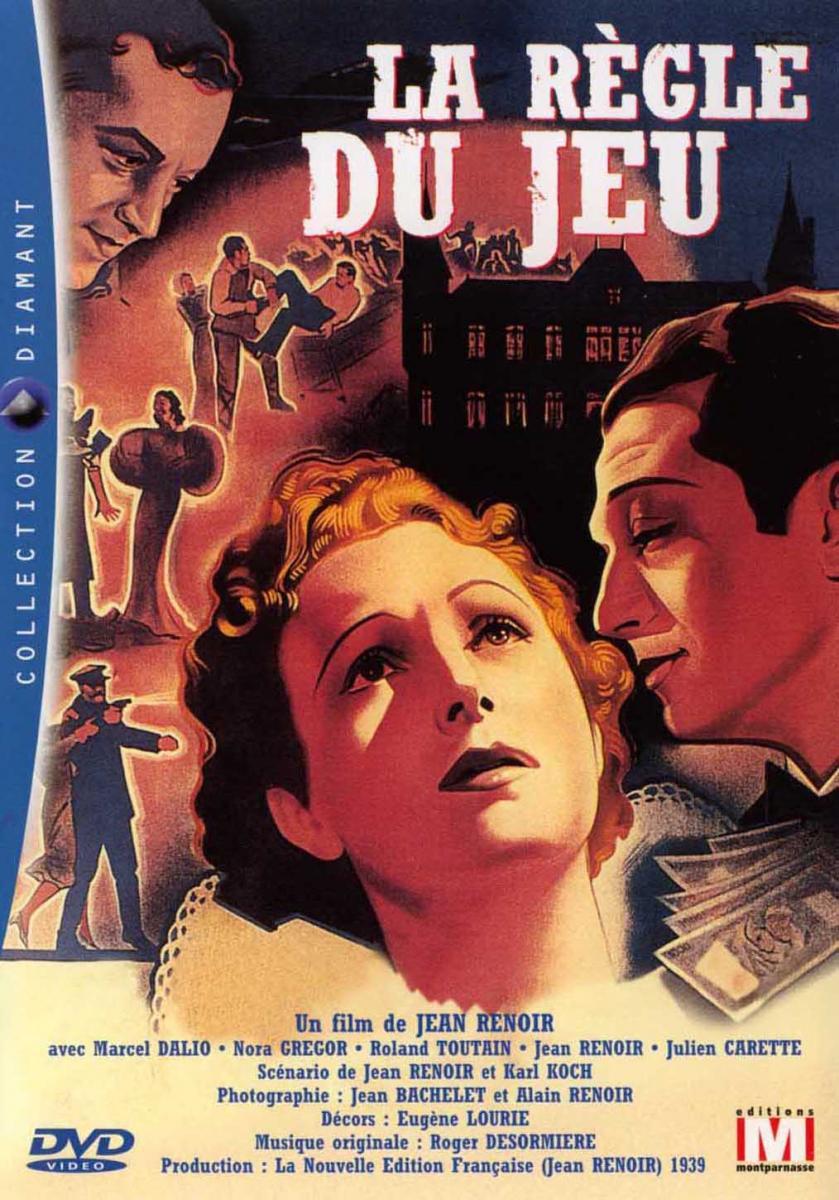
Jean Renoir, The son of the French impressionist painter Pierre-Auguste Renoir, was one of the most influential film directors of the 20th century (Orson Welles thought him the greatest). His fame came mostly in Europe, though he did make movies for a time in Hollywood. In the last couple of months I finally got around to seeing two of his more famous works,
The Rules of the Game (
La Regle du Jeu) (1939) and
La Grande Illusion (1937). Both movies were controversial in their day, with
Rules provoking a near riot at its Paris premier. Both were also banned, and
La Grande Illusion almost lost before being restored in the fifties.
Renoir was involved in left wing politics during his early life, and these tendencies certainly come through in these two films.
Rules is a direct attack on the French aristocracy before World War II. They are portrayed as self centered and wasteful. They are petty pleasure seekers who have grown detached and lazy. Not that the servants that these well healed elites depend on for almost everything are without their faults. But their concerns revolve around holding down a job and feeding their families, where as their bosses are caught up with the next party or illicit affair. Renoir's gift, I think, is that he doesn't totally vilify the objects of his scorn, nor sentimentally lionize his heroes. They are all human beings, full of noble intentions and high minded ideals that they don't always live up to.
Though
Rules (which Renoir also co-stars in) was released less than two months before the German invasion of Poland, the fascist threat isn't dealt with in a major way. But the message is clear; French society has been built on a class system with self absorbed idlers at the top, ill prepared to defend the privileged life they have taken for granted against the Nazi threat. The movie, though over seventy years old, is timely for us now. While watching it I thought of the social unrest we are experiencing caused by the economic downturn, coupled with this strange celebrity culture filled with men and women who are famous for being well known (do I have to name names?). Most of these "reality stars" are from inherited wealth (American Aristocracy?) and spend their time moving from photo op to photo op, with no real purpose in life other than to be seen. If their life does have any meaning it appears to be self-gratification at all cost. On one end we have conspicuous consumption that would make Marie Antoinette blush and on the other better than ten percent of the people are either unemployed or underemployed. As I've stated in this space before, I'm no socialist, but I don't think you have to be to question the consumerist values our society promotes and the effects they have had on our national character.

La Grande Illusion is a war movie set in a series of prisoner of war camps. It also deals with questions of class distinctions, but at its core is an anti-war film, and the best I've ever seen. Most movies trying to make the anti-war argument depict the horrors of combat and the dehumanizing nature of war. Think of
All Quiet on the Western Front or
Apocalypse Now. Here there are no battle scenes and only a couple of shots fired. Renoir appeals to our common humanity to expose the folly of war.
There are no real villains in this story only men doing their duty the best they know how. The film was considered shocking in part for the depictions of camaraderie between the officers of the two enemy sides. As Renoir points out, in a short introduction shot in the 1950's, 1914, when the movie takes place, wasn't 1939, and the Nazis had not yet poisoned the world. World War I was to some extent, in his estimation, a war fought between gentlemen. So when the lead characters, two French officers, are shot down and captured by the Germans they are invited to a sumptuous meal by an aristocratic commandant before being sent off to a prisoner of war camp. The camp it self is not such a harsh place, and the guards are not so menacing, but it is the frustration of being kept under lock and key that drives the prisoners to devise ways of escaping. There are no hard feelings though; the prisoners' job is to find a way over (or under) the fence and it's the guards' duty to stop them.
After numerous attempts to break out of several camps three French officers find themselves in a castle fortress deep in Germany where the high walls and steep cliffs are believed to make escape impossible. The commandant is the same gracious German officer (Erich von Stroheim) who shot two of them down and shared his table at the beginning of the film. Now he is unable to fight due to severe injuries he suffered during combat. He continues to be gracious with his captives, even fostering a friendship with a fellow aristocrat (played by Pierre Fresnay) while making it clear he will fulfill his duty to keep them behind the castle's stone walls at all cost. Two of them (Jean Gabin and Marcel Dalio) do manage to escape and find their way to the farm of a young German widow (Dita Parlo) who lost her husband and brothers during some of Germany's "greatest victories." She and one of the officers fall in love, but they both know that he can not stay. Duty calls him back to fight, in what he hopes will be the war to end all wars. As they make their final run for neutral Switzerland his companion tells him not to delude himself on that point. There will be other wars and their participation will not make any difference one way or the other. But still, in spite of this grand illusion, they go back.
La Grande Illusion touches upon the changing social structures in Europe, the decline of the aristocracy, antisemitism, and the folly of war. But for me it is the humanity of the characters that make this movie great. You can feel the loneliness of the widow, forced to raise her daughter alone, knowing that what were victories for her country were defeats for her and her family. We struggle with the commandant who must choose between friendship and duty, and we experience the heartbreak of the officer leaving the woman he loves to return to a fight he doesn't really believe in. In some ways each character chooses their obligation to some social or political duty over their natural instincts, sometimes to tragic results. In a movie like
Casablanca this type of self sacrifice is noble since it contributes to a higher good; the defeat of an oppressive, genocidal power. But here it is folly since such actions only contribute to the continuation of a corrupt and morally bankrupt system.
In Jean Renoir we have a director who was truly provocative. This word is often used to mean that a movie or book is sexually explicit. But in Renoir we see the word's higher meaning; we are provoked to think, we are challenged to reconsider our view of the world and each other, we are maybe even angered a bit. Here's to that more film makers strive to be provocative in the fashion of Renoir.
 Overshadowed, but not entirely eclipsed, by the Penn State-Joe Paterno Scandal was the passing this week of former heavy weight boxing champion Joe Frazier. Known as Smokin' Joe, and possessing what experts deem the most lethal left hook in boxing history, he is best remembered for his three epic battles with Mohamed Ali. Frazier came out on the short end in two of those fights. But unlike his other great rival George Foreman (the only other boxer to defeat Smokin' Joe) who was a good friend, he and Ali never buried the hatchet (Foreman said to ESPN that he won't go to the funeral because he's too upset. "I love this one," were his exact words).