Wednesday, September 12, 2012


Monday, September 10, 2012
Saturday, September 8, 2012
Thursday, September 6, 2012
Of Gods and Platforms

The right has made a bit of hay over the non inclusion of God, as well an omitted reference to Jerusalem as the capital of Israel, in this years Democratic Party Platform. Both God and Jerusalem were put back, but only after a rather contentious floor vote. As Stanly Kurtz points out, God was not mentioned in the 1992 platform either, with a line about the American people's faith added only after Sen. Joseph Lieberman made an issue of it. I have never read a party platform before, and had no idea that God was mentioned in either side's quadrennial manifesto. But apparently it is a regular feature of such things, with the Democrats doing it less frequently since about 1972, and not at all that one time. What should we read into this controversy, if anything?
Firstly I'm not so ready to condemn the delegates inside the convention for booing after the floor vote. I did not take it, as some suggested, that they were jeering at the Almighty or Holy Mother Zion, but rather demonstrating their disapproval at the shredding of parliamentary procedure (there is no way two-thirds of the hall responded "ay" to the proposed modifications). Nor did it leave me with the belief that Democrats are Godless, as Illinois senator Richard Durbin claimed his party was being painted, in a bizarrely defensive rant on Fox News the day before. This choice does say something though, especially since this is evidently common language in these documents.
I would say that this omission, and the reticence by some on the left to talk about God at all, reflects a misunderstanding of the role that the Creator and religion was meant to play in American life from the time of nation's founding. We can argue over the religious status of the founders; were they deists, Masons or Protestants? They all believed, in one way or another, in a supreme being from whom emanates our rights. Government does not give us rights, it can only recognize them, protect them or deprive them for a just cause. This was acknowledged by Thomas Jefferson, the one usually invoked to support the "Wall of Separation" reading of the Constitution. The framers did not want to establish an official religion, true, but they did not intend to eliminate God from the public square, either. They wanted the nation to be non-sectarian, not radically secular as some believe.
To establish a particular religion, or favor a particular form of a religion as being normative for a nation can be destructive to national unity. The framers knew this. But to acknowledge God as the giver of our rights does not depend on sectarian allegiance or religious practice. It is, in the end, the greatest affirmation that government is limited. If the source of rights is purely human, they can be made up, taken away, given to some and not to others, dispensed from the barrel of gun or ignored, all arbitrarily. If God is not recognized as the creator of our rights, some thing less will be, and that something less is usually the civil government. Governments who claim to be the highest authority of all are almost always dictatorships, who seek the total loyalty of the people. They not only claim priority over God, but over family and community as well. To deny God as the source of our rights is to slide toward spiritual serfdom and political idolatry. Recognizing God as the source of our rights is actually the greatest protection to our personal liberty.
I happen to think we have, by and large, a good government, and agree with Sen. Durbin that there are God fearing people in both parties. I have friends on both the right and the left who sincerely look to their faith for guidance in forming their political views. I'm glad the Democratic Party put the reference to God back in their platform (even if the process was a bit off). Once is enough, you don't have to be showy about it. Once is enough to show that you know that we are not laws unto ourselves, no government's power is absolute, and that all of us, even the President of the United States, must answer to a higher power.
Tuesday, September 4, 2012
Do Morals and Politics Mix; 1st of a Series on Faithful Citizenship
I was gone for two weeks, taking my yearly retreat and a week of vacation home with the family. I emerged from my Fortnight for Relaxation to check the internet only sparingly, which was easy to do on retreat. Even though the place we stayed is no longer a retreat house, but a kind of hotel-bed and breakfast for Canadian pensioners, the internet access was blissfully limited, and nary a TV in sight. Once I hit my parents’ house the seclusion from the world became impossible, especially with the Republican Convention going on. I come from a long line of political junkies, so you bet it was on all the time.

During general election years I get many questions about Catholics, and people of faith in general, and how they should vote. I don’t believe a priest should endorse particular candidates, and Don Bosco advised against getting involved in politics; that’s our lay cooperators’ responsibility, if they feel so called. During his life he worked with all sorts of people of different political persuasions. As long as they didn’t try to limit his religious activity he would cooperate with them as best he could. Catholics, both lay and clergy, do have a responsibility to vote, even if getting involved directly in party politics is inadvisable. To that end I will discuss a few general guidelines that we can follow to help us make an informed, faith filled, decision this November.
I begin with the issue of moral values and how they should influence our vote. I often get the objection that values have no place in politics, because these are strictly personal in nature. We cannot legislate morality or impose a certain religious view on others. Some go as far as to say the Church shouldn’t comment on political or economic issues at all, that they are beyond Her competency. Besides, there is the principle of separation of Church and State that needs to be respected. To these objections I say, you have some things right, but others wrong. Let me explain.
As for the Catholic view on Church State relations, we have always understood that there are two realms; the secular and the religious. Both have different functions, and while both should cooperate with the other, there is a clearly delineated division of responsibilities. The Church shouldn’t dictate specific policies to the government and the civil authority shouldn’t interfere with the internal workings of religious bodies. But the Church has the right and the responsibility to comment on social and political matters because She is in the world, sharing in its joys and pains. Her members live and participate in civil society and are effected by its policies. It’s not the Pope’s job to determine the upper marginal tax rate or how many weeks of unemployment insurance should be granted to people out of work. But he does have the ability to suggest basic guidelines and principles for the just ordering of society based on Scripture and Tradition, rooted in reason informed by faith. After that it’s up to the prudential judgment of civil leaders, and the electorate, to act as they see fit.
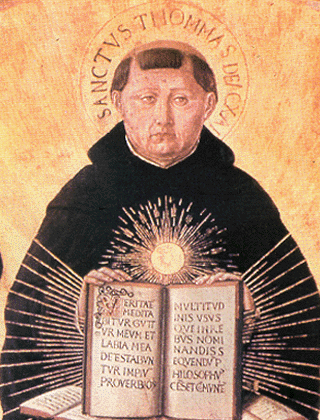
I agree that it’s not the government’s job to regulate personal morality, and the Tradition backs me up. St. Thomas Aquinas wrote that prostitution, while being gravely sinful, should not be outlawed. For him it was another form of extramarital sex that, while morally objectionable, is not in the public interest to criminalize. I’m not sure I agree with the Angelic Doctor on the particular issue of prostitution, but his general principle is correct.
In the case of marriage the government has a regulating interest because matrimony is more than simply a matter of who a person is choosing to sleep with. It has always been associated with family life, and the family is the building block of society. The family socializes the next generation. Our tax codes are built around it and the stable transfer of wealth from one generation to the next is facilitated by it. It is the basic support system for the individual, and when it fails the effects ripple through society. The Church is not opposed to the legal recognition of gay marriage because we believe a Commandment is being broken. It is this concern over the preservation of the family unit and stable ordering of society that is of greater consequence. Are there moral and theological reasons to oppose gay marriage? Yes, but these alone would not justify political action. This only becomes necessary when some aspect of the common good is seen as being compromised.
So I say yes, moral values matter, and should be promoted. We don’t need civil laws against particular moral failings, true. But we do need to understand the difference between personal rights and the common good, and not be afraid to participate in the political process when the latter is in danger.
Friday, August 31, 2012
Sunday, August 26, 2012
Paul Ryan and Catholic Social Teaching: A Commentary by Fr. Barron
As usual Fr. Barron lays out the issues without being partisan about. I'll have more to say about the social doctrine of the Church, distributism and faithful citizenship as we get closer to November 6.
Wednesday, August 22, 2012
Gone Praying
I'm presently staying on the Ile Saint Bernard in Chateaunguay, Quebec. It was a retreat house run by the Gray Sisters of Montreal, but it was sold last year and is now a hotel open to the public. I'm on my yearly retreat, and in general the atmosphere is pretty tranquil, considering most of the people here are on vacation, and so not into the whole prayer and recollection thing.
So, you won't be getting any heavy stuff from me this week. Even if I wanted to, the only Internet connection is in the lobby, and writing with the world going by isn't conducive to deep, penetrating thought. I'll check in now and again. I'm praying for all of you. Please pray for us!
Wednesday, August 15, 2012
The Assuption of Mary

This is a piece from a couple of years ago that I'm not sure I can really add to, so I'm just gonna go ahead and republish it. Have a blessed Feast of Our Lady. May we always trust in her loving, motherly care!
Today we take a break from the regular cycle of Sunday readings as we celebrate the Solemnity of the Assumption of the Virgin Mary. So I will take a break from our examination of Salesian Spirituality and focus our attention on our Blessed Mother. She is the Queen of Heaven, yet as St. Therese of Lisieux wrote, she is more mother than queen. She loves us very much and always calls us to follow her Son. Today’s feast, in part, teaches us that Mary, and all the saints are powerful gifts from God, that they are active within the Church, and that, if we are faithful, we will share in the glory they have been given.
That Mary was assumed body and soul into heaven was attested to from Apostolic times and was always believed by the Church, both in the East and West. It was not defined formally as a dogma until 1950 when Pope Pius XII proclaimed, “By the authority of our Lord Jesus Christ, of the Blessed Apostles Peter and Paul, and by our own authority, we pronounce, declare, and define it to be a divinely revealed dogma: the Immaculate Mother of God, the ever Virgin Mary, having completed the course of her earthly life, was assumed body and soul into heavenly glory (Munificentissimus Deus, 44). Because Mary was preserved from original sin in preparation to be mother of the Savior, and was obedient to God’s call, she was also given the grace of not suffering the corruption of the grave. In a special way she already enjoys the fruits of the resurrection won by Jesus’ death on the cross. She is alive in the fullest sense of the word, and is active still within the Church.
In the Gospel reading for today we hear the story of the Visitation. Mary, after saying “yes” to God, goes to visit her cousin Elizabeth who is pregnant with John the Baptist. Mary has Jesus within her, this great grace prompts her to go forth and serve her neighbor in need. She is an example for us to follow. As we receive Jesus in the Eucharist we are also called to go and serve others. She and all the saints are united to us and help us by their prayers and example. In a special way Mary is active, as we can see by her apparitions in places like Guadalupe, Lourdes and Fatima. She always calls us to follow her Son more faithfully and covert our lives.
The celebration of the Assumption also points us to the reality of the resurrection. As Mary lives in glory now, so shall we. Mary was blessed in her life, but she also suffered greatly. Her heart was truly pierced by a sword when she saw Jesus suffer as he did. Through it all she was faithful to God’s call. She is a sign for us that if we are faithful through life’s problems and struggles we too will share in gifts from God beyond our understanding.
Tuesday, August 14, 2012
Monday, August 13, 2012
What is Distributism? No, Seriously, What is it?

Enter Distributism, which was popular, relatively speaking, in the early twentieth century among the likes of G.K. Chesterton and Hilaire Belloc. In truth I stumbled over this concept only yesterday as I was doing research on line, so I would not want to put myself up as an expert. From what I can make out of it Distributists believe strongly in private property, but ownership needs to take place on a broad scale if people's rights are going to be protected. The mantra is small communities, small farms, small factories, small schools. They identified the same problems with capitalism as Marx, but saw direct ownership of the means of production, without the mediation of the state, as the solution.
Basically, from what I can make out of it, what's being proposed is something like a return to the medieval guild system or the creation of cooperatives. But the key is that the farmer owns his land and his farming implements, the carpenter owns his shop, and the tools he uses. The worker actually earnes money from his labor, with the goal being security and sustainability (to use a modern term) as opposed to economic growth. In their view capitalism limits property rights to a few who take advantage of the workers' labor, exploiting them for profits that they do not share in in an equal way. Socialism makes people dependent on the state who robs the worker of the right to enjoy the fruits of his labor or gain security that comes from private ownership. In its beginnings the movement was agrarian in nature, but later adapted itself to address urban realities as well.
Dorothy Day, who is associated with city life and is often accused of being a communist, was really a distributist. She was critical of Social Security, calling it an example of "Holy Mother State," that made people dependent on government, robbing them of their personal responsibility to act charitably. On the other hand she supported President Truman's attempt to nationalize the steel industry in 1949, but only if the government served as a place holder until the factories could be sold off to multiple buyers (naive, if you ask me, but the point is that she did not see nationalization as an end in itself, or the state as being synonymous with the people).
I still have more to read about this intriguing theory. I'm not sold on it from my first reading, but I want to be patient and give it a chance. When you see Chesterton mentioned you have to take the thing seriously. I down loaded an anthology from Barnes and Noble and in the introduction the author-editor came off as defensive and a bit arrogant. The defensiveness comes from the fact that Belloc and others supported Franco in Spain, and had some nice things to say about Mussolini in the '30's, so they've had to fight the fascist label ever since (its always been strange to me: you can cuddle up to Marx or Lenin and not raise an eyebrow, but mention Franco or Ayn Rand and people rend their garments...but I digress). Then he went on about the evils of the Internet economy, which I thought was a bit ironic, considering I bought the thing as an e-book. I'm eager to get into the primary source authors themselves and see what they have to say. I don't know if I'll return to this with a full fledged critique, but I'm sure I'll mention things about it here and there.
Saturday, August 11, 2012
In Brief: What the Paul Ryan Selection Means

With Mitt Romney choosing Congressman Paul Ryan (R-Wis.) as
his running mate we will probably see a renewed debate among the Catholic
academic class as to the 42 year old law maker’s Catholic “street cred.” Back in the spring he was heavily criticized
in an open letter by members of the Georgetown faculty before a
scheduled speech there, and also earned a rebuke from a committee of the
United States Conference of Catholic Bishops (USCCB) for the budget he proposed
in Congress. It called for entitlement
cuts as a way of handling the deficit, and this was interpreted as a violation
of the Church’s preferential option for the poor. Ryan didn’t back down, saying that Catholic
social teaching calls for a balance between solidarity-the
recognition and living out of the interdependence of all members of society,
and subsidiarity-the principle that
local problems should be solved locally, beginning with the individual, before
appealing to a higher authority. Both
principles have more to them, and both sides accused the other of over
simplification. What was hopeful about
Ryan’s response was that he said what many of us “conservative” Catholics have
long thought; that the Church’s social teaching has had a one sided
presentation up to now. We’ve for a long
time needed to have a real debate about whether the welfare state, usually
proposed as the best embodiment of Catholic thought, really alleviates poverty,
promotes the common good and helps people fulfill their God given call to
holiness. With Congressman Ryan as a
part of the ticket that opportunity has finally arrived.
Subscribe to:
Posts (Atom)