Wednesday, November 11, 2015

Two Very Different Spy Movies: "SPECTRE", "Bridge of Spies" // Movie Reviews


SPECTRE

Daniel Craig's tenure as James Bond has been frustratingly uneven. While I stand by my opinion that he is the best Bond since Sean Connery, and possibly even better, the individual movies haven't been as consistent as his legendary predecessor's were. Of the four Craig era films two are among the best in the franchise's fifty plus year history (2012's Skyfall might be the best of all time), one (Quantum of Solace) was a complete disaster, and now the latest, SPECTRE, while not a disaster, is middling at best. 


Craig has complained that he wants out of the role he's grown tired of playing (too bad for us), but I can't say that he comes off here like an actor phoning it in for the paycheck. No, the problem isn't the leading man, or any of his supporting players, who are all given plenty to do and do it well (unlike in many Bond films, 007 here isn't a one man army). The problem is a script that tries to be too clever by half, setting up a backstory between Bond and his villain du jour (Christoph Waltz) that made me think of Austin Powers; and when a Bond movie starts to remind you of it's spoof, something is wrong. I also found myself confused a bit about whether there was a back story concerning Bond and his latest love interest (Léa Seydoux), which made me wonder what creepy direction things might go into, which thankfully they didn't. There is also an attempt to tie all the previous three films together which, while not implausible or even undesirable, comes off as an after thought rather than a strong driving impulse of the native. 


The ever glamorous Monica Bellucci, is well, the ever glamorous Monica Bellucci, in what amounts to an extended cameo. Ralph Fiennes, Naomi Harris and Ben Whishaw show that their respective characters of M, Moneypenny and Q can do more than supply exposition and light hearted sexual tension, and we get the most indestructible adversary since Jaws in the Roger Moore days (Dave Bautista). The ingredients are all there, along with the spectacular action and stunts you expect from a Bond movie. But the plot, motivations and relationships are murky and the running time too long, with gaps in the action that become a drag.


So, SPECTRE is not terrible by any degree, with many things to recommend it, but over all nonessential for any one other than a Bond true believer. My recommendation is to either see it in IMAX (which I did not) to get the full impact of the action set pieces or else wait for the video.


Bridge of Spies


Forty years ago Steven Spielberg was the young hot shot director who was changing how Hollywood made, distributed and marketed movies. He, along with George Lucas are credited, for better or worse, with inventing the big budget summer block buster. He's had his share of Christmas season Oscar bait films over the years as well. But now the Young Turk is an elder statesman, with newbie directors such as J.J. Abrams creating homages to his style like people once affectionately aped Hitchcock or John Ford. 

But even when he was young, Spielberg, like his colleague Lucas, always had one foot in the past while while making the films of tomorrow. They may have used the latest in special effects but their stories often harkened back to the days of movie serials like Buck Rogers, and projected a certain innocents of youth. Spielberg has been criticized, in fact, by the likes of director and Monty Python veteran Terry Gilliam for his overly optimistic take on life, specifically for giving his Holocaust epic Schindler's List a victorious ending when the Sheol is really about humanity's failure. 

Spielberg is a bit of a throw back in other ways as well. You could accuse him of being a typical Hollywood liberal, but typical for 1946 or 1962. His heroes recall the likes of Fredric March's Al Stephenson in The Best Years of Our Lives, or Gregory Peck's Atticus Finch from To Kill a Mockingbird. These were men of the Left who believed in fair play, fighting for the underdog and that if the system doesn't work it's not because the system itself is wrong, but because the people running it have forgotten the ideals on which the nation was built. One could argue that this is not the spirit of contemporary liberal or progressive thought. People of the Left today, broadly speaking, see the system as the problem and believe that it needs to be fundamentally transformed. It was flawed from its inception and is irredeemable, so that appealing to original intent or the founding spirit is self defeating. 


Spielberg's latest Oscar season offering is just such a throwback to the earlier form of American progressivism. Bridge of Spies tells the, more or less, true story of  James Donovan (Tom Hanks), a New York insurance lawyer recruited for the unenviable task of defending a captured Soviet spy at the height of the Cold War. He's honest, competent, had experience at the Nuremberg Trials after World War II: just the guy to give the "appearance" that the accused is being given a fair trial. Only Donovan doesn't know that this is a show trial. He thinks that he's really there to win the case. His vigorous defense annoys the judge and brings him under the suspicion of the government. While he doesn't get his client off, he does manage to talk the judge out of giving him the electric chair. Who knows, Donovan reasons, maybe the Russians will capture one of our spies some day and we'll be able to make a swap. And don't you know? that's exactly what happens. 

As I wrote, Donovan's zealous defense of the accused spy Rudolf Abel (Mark Rylance) runs him afoul of the CIA who sets a tail on him. He's confronted on the street on a rainy night, invited to a local bar for a drink by an agent (Scott Shepherd) who then attempts to extract information from the lawyer. When Donovan reminds agent Hoffman of lawyer client privilege, he is told to not be such a "boy scout" and remember that there's no rule book to be followed; all's fair in this Cold War game. To wit Donovan asks a seemingly random question about Hoffman's ethnic roots, correctly guessing that he's of German extraction. He continues:

My name's Donovan, Irish, both sides, mother and father. I'm Irish, you're German, but what makes us both Americans? Just one thing, one, one, one: the rule book. We call it the Constitution and we agree to the rules and that's what makes us Americans and it's all that makes us Americans so don't tell me there's no rule book, and don't nod at me like that you son of a bitch.

For Hanks' Donovan the problem isn't that America is inherently unfair or on the wrong side of history, but that people are too quick to forget about the values that make us Americans to begin with. People in times of a national security crisis, like during the Cold War or, as is meant to be implied, in today's post 9/11 world are too quick to trample over the rights enshrined in the Constitution to ensure a measure of perceived security (a similar point is alluded to throughout the new Bond movie as well, which is about the only thing these two spy movies have in common. That and a spectacular scene involving the crash of a spy plane). 

This is arguably a true point, but also terribly old fashioned. As is a scene showing Donovan taking his appeal to overturn Abel's conviction all the way to the Supreme Court. The presentation of the noble lawyer in his formal dress, in the hallowed halls giving a stirring statement on how American reliance on the rule of law is the moral high ground that separates us from our Soviet adversaries is straight out of Frank Capra. I'm not saying that this is a bad thing. Unlike Mr. Gilliam I don't mind a little corn once in a while, especially if I believe it to be true in spite of its corniness.  But it does make me wonder if the message still resonates in the culture, and if the only reason a film like this still gets made in Hollywood is because a director of the clout of Spielberg made it and that there are still enough nostalgic Baby Boomers around to buy tickets. 

We are living in a culture right now where students at major universities are ready to jettison free speech in exchange for something much less earth shaking than national security--their own emotional security. We also have one of the leading presidential candidates of a major party who indeed buys into the idea that the nation is flawed from it's roots, and so calls her founding principles into question. The Constitution is a political and legal document, not a sacred one, true. It can and maybe should be altered. The foundational principle that we are a nation of laws and not men should under gird any amendments or revisions of the law though. Even the Pope, in his address to Congress, referenced how important it is for us to remember the guiding principles that have shaped our nation from the beginning. They always need to be purified, refined, and reexamined, but without them we forget who we are. We are more likely then to be swept away in all sorts of directions we may later regret. 

While the film does dabble in more than a little moral equivalency at times, and calls into question whether we were over reacting to the Soviet threat, its still clear that the U.S.A. wears the White Hat and the Eastern Block, if not a Black Hat, at least a Grey one. Even with these qualifications, Bridge of Spies does present a rather traditional vision of American idealism: that we base our system on the rule of law and not of men or of an individual man or woman. But this is one ideal I'm not sure the emerging generation shares.

The second part of the film deals with the prisoner exchange envisioned by Donovan. Francis Gary Powers (Austin Stowell), pilot of the U2 spy plane is shot down over Russia and captured. Meanwhile an American student (Will Rogers) gets detained in East Berlin just as the wall goes up, and is accused of being a spy. Donovan wants to free both, the CIA is only interested in Powers. So the second half deals less with high minded ideals and more in good old fashioned-make the audience wonder how he's gonna pull this off-suspense. And the suspense is dulled a bit by the fact that we know how it ends, or at least anyone who bothers to check Wikipedia will know how it turns out. 

In the end, a solid, well produced and acted film, as one would expect from a master filmmaker. It's also probably one of the last of its kind, at least for the foreseeable future. 

Wednesday, November 4, 2015

Why We are Fascinated by Artistic Greatness


A good friend of mine, who also happens to be an evangelist for Frank Sinatra, one who is so effective at his mission as to count me as one of his converts, recently mused quite eloquently on Facebook questioning the necessity of yet another book length biography of Ol' Blue Eyes. He was linking to a book review critiquing two new tomes on the late Chairman of the Board timed to coincide with his upcoming centenary of birth on December 12. We have the music, he reasons, which means we have the emotion, the torment and and triumph captured for eternity on sound recordings. Can two more bios capture all this better than the man and his music? Add to this that my friend had a memorable close encounter with Sinatra in a Las Vegas show room, where the singer actually engaged him is a brief, if slightly inebriated tete a tete from the stage. He lived, he loved, he lost, he rose and fell and raged. We know all this. Why ponder the details that aren't greater than the sum of their parts? When you have all this; the memories, the poetry, the pure experience, what can the written page supply that will surpass it? 

Point very well taken, and I can't disagree with it. And yet I felt moved to reply (here only slightly edited):

We read to know that we are not alone, so said CS Lewis, and we read of great people to know that they really do exist. They don't exist on some mythical Olympus, or occupy astral bodies that shape shift. They (are) flesh and blood, touched by the divine spark yet still capable of burning up and burning out. We see (Michelangelo's) Sistine Chapel, watch (Olivier's or Branagh's) Hamlet and listen to (the Sinatra-Count Basie version of Cole Porter's) I've Got You Under My Skin and wonder, "what god wrought this? If not a god but a man, why can't I?" And there in lies the rub.

Many of us are fascinated by those who excel, either in the arts or sports, or in more weightier fields like politics, the military or the sciences, marveling at what these incredible, almost superhuman, men and women were able to accomplish in their lives. For those who achieve greatness in whatever given field, the road is almost invariably paved with hardships, struggles and set backs. For those who are artistically inclined, their ability to see the world in a different way and unlock meaning hidden to the rest of us is quite often also a product of, or at least accompanied by, emotional or mental imbalance. 

There is a great deal of personal pain that gets poured into great art, as well. Paul McCartney, when asked what gave his late writing partner John Lennon's songs such a sharp edge, and didn't he wish he could write similarly, answered that it was all the pain that his friend had experienced in his early life that gave his tunes their sardonic wit. While a great song smith in his own right, and no stranger to hardship himself, he conceded that he would not want to exchange his lot for Lennon's; the art came at too high an emotional cost from his estimation.

Yet many like me are fascinated by not just the art, but also the personalities who produced it and the process they employed. It makes me wonder, "why can't I do these things?" When I read a great writer or look upon a powerful work of visual art, or become enraptured in a piece of music or a fine film, I feel sometimes like the caricature of Antonio Salieri from the film Amadeus, who laments bitterly, to the point of losing his faith, because he has the burning desire and the exquisite taste to be a great composer but nowhere near the ability of his divinely gifted rival Mozart. Then I remember that the real life Salieri was no mean composer himself, and so I can't even compare myself to him. 

We can either despair with a sarcastic laugh, embracing our mediocrity like the mythical Salieri or use these great ones for inspiration; not in imitation so much as to unlock the God given uniqueness within ourselves. As Paul Stanley of Kiss once said, when he was a kid growing up in Queens, New York dreaming of a music career he said to himself, I may not be as good as the Beatles, but if I can hit a musical and cultural nerve like they did, it will be enough. We might say that he understood that success would come if he set out to be the best Paul Stanley he could be, not an imitation McCartney.

And so we look to these great ones for inspiration to help us discover the unique greatness within ourselves. If all it is is idol worship then their greatness will be wasted on us, and we will never discover our own.

This month of November kicked off with the Solemnity of All Saints, a day to remember that all of us, not just a few, are called to heroic holiness. We remember all the unnamed saints praising God around His heavenly throne right now, and that we can, and really should, be one of them. 

For us the Saints are the great "artists" of the faith. They struggled, overcame hardship and intense personal suffering in their lives. Some even suffered from mental or emotional instability. Yet they offer an example to follow, one that will not lead to fame and fortune in this life (though some did experience a measure of popularity in the here and now), but to eternal glory. 

It is true that I will never be another St. John Bosco or Ignatius of Loyola, but that's not the point. I must touch the nerve of holiness that they did and be the Saint God made me to be. They offer the inspiration, they show that it is possible. Now it is for us to trust in God that He can make of us artists of the faith. 

Monday, November 2, 2015

No Joy in Flushing: A Quick World Series Postmortem

This year's was probably the most unique World Series I've ever seen. As we stand today the Kansas City Royals are the champions of Major League Baseball. But the Series could just as easily still be going on, with the Mets either clinging to life or even ahead in wins. I can even imagine a scenario where it could have been the Mets spraying the champaign around their clubhouse in the early AM hours as opposed to the Royals. Three of the Met losses were products of late game collapses fueled by untimely errors (not that they're ever really timely), base running blunders and questionable bullpen management. Two of those losses, including this morning's, were decided in extra frames. Everything went right in their series against the Cubs, but baseball karma was cruel this time around. Someone out here in Chi-Town suggested that maybe the Billy Goat Curse rubbed off on the Metropolitans from their stay in the Friendly Confines, they seemed so snake bit.

But this isn't all about things the Mets did wrong. Kansas City benefitted from timely hitting, heads up base running, taking advantage of errors and forcing them as well. They were the more complete team and deserve the crown.

Oh, but what could have been. I predicted a long series because the Mets have four studs on the mound which can cover a multitude of deficiencies. You had to expect Daniel Murphy to cool (no one can keep that kind of a pace up), but no one really rose up to take his place. Cespedes was invisible at the plate and looked less than focused in the field. But they were finding ways to get the lead, but alas, they too often couldn't hold on to finish off the relentless Royals.

Met fans should be properly disappointed this morning. But not without hope. This is a young team, with a core of young pitching already in the Big Leagues, and a cadre of quality arms down on the farm that will be contributing soon, or else can be used as trade bait to acquire the offensive help needed to round out the team. So don't be too down, February is closer than you think.

Friday, October 30, 2015

Scattered Thoughts on the Synod and Ross Douthat

Synod of Bishops

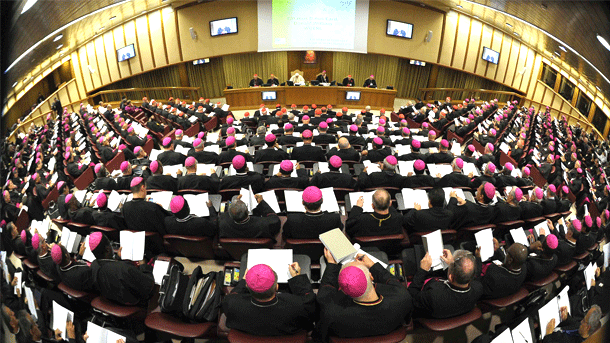
I haven't written much about the Synod of Bishops that just concluded this past Sunday in Rome. I stayed away, in part, because of a lingering Synod fatigue that I haven't fully recovered from after last year's extraordinary session. I just didn't have the mental energy for it. Now that it's over, I've only been able to find the Synod's final document in Italian, with excerpts in English here and there, so I really don't have a full grasp on what the bishops decided.

And in the end, whatever the bishops "decided" is secondary to what will be suggested (or mandated?) in the post synodal exhortation that the pope will likely publish within the next six months to a year. For all the talk of decentralization it will still come down to the Holy Father as to what direction the Church takes on the pastoral care for families of all shapes and sizes.

I do have some thoughts on the debates that have arisen over following the spirit of the law as opposed to adhering strictly to the letter, which I hope to get into later. All I'll say now is that the impression many people have is that to follow the spirit is to throw away the rule book and make it up as you go along. We may keep the general norms in mind, but by and large the spirit frees us to follow our own conscience, which in the contemporary scene seems to be the equivalent of following one's muse. But when Jesus was confronted with a legalistic question concerning divorce and remarriage he didn't offer a solution that was subjective or open-ended. In appealing to the spirit, in this case the way the Father intended them from the beginning, he spoke of the indissolubility of marriage, something none of his listeners, including the Apostles, were expecting or prepared for. In allowing divorce and remarriage Moses was giving in to the hardness of the people's hearts, and Jesus was calling us back to the spirit of God's plan from the beginning. In light of this, many found, and still find the letter much more forgiving than the spirit.

Ross Douthat and the New Pharisees 

I read the October 17 column by New York Times blogger Ross Douthat, which has caused no little buzz around the Catholic bloggesphere, only after reading several articles in defense of his right to free speech (more on that a bit later). In the given article, is he hard on Pope Francis? Yes, but not as hard as George Will was lately, and Maureen Dowd and Margery Eagan have been concerning previous popes (Dowd found cause to take a few jabs at the reigning pontiff, referring to him as the perfect 19th century pope: generous of spirit but still hopelessly backward when it comes to women). Yet a laundry list of theologians decided to write a letter to the editors of The Times condemning the post and asserting that Douthat shouldn't be allowed to write on the religion he is a practicing member of because he's not a credentialed theologian.

There are good responses, better than I can put it, from Bishop Barron here and from Rebecca Hamilton here.

What I will add is that there are some theologians who will argue that they possess a form of mangisterium similar to, if not equal to, that held by the pope in union with the bishops of the Church. Needless to say that I think this is nothing more than a bucket load of self aggrandizing horse spit. Theologians are at the service of the Church, and in the final analysis it is the hierarchy who passes judgement on the works of a theologian, not the other way around. I understand that, in my case, I may be a baptized Catholic, ordained to the priesthood, sent forth to preach and teach, as well as minister the sacraments, but I am not a trained theologian. I need to measure my words, know my limitations and be open when someone wiser and more learned than myself offers a correction, or even a rebuke.

But we must never forget that the Master chose 12 relatively uneducated men and a hand full of unschooled women (or at least whatever level of education they may have had, none were the equivalent of a what a credentialed theologian would have be in their age) to witness in His name. It was not the learned and wise who recognized the coming of the Messiah, but the old window Anna, who I'm pretty sure never stepped foot inside a classroom at Georgetown or South Bend (Lk 2:36-38).  It was the religious intellectual class who tried to shut up the man born blind when he made the right observations, observations they had no response for (Jn 9:24-36). It strikes me a bit ironic that these fine minds have taken the collective role of the Pharisees who saw their own learning as a pedestal that separated them from the lowly, sinful masses.

The one New Testament Apostle who could pass for a professional theologian was Paul. But he constantly referred to himself as a servant of the Gospel, not it's master. Even he, who took second place to no one, went to Jerusalem to have his preaching examined and approved before continuing with his work. What we all need is a bit of humility, and not judge a person's wisdom by the letters after his or her name.

I have a lot of respect for Ross Douthat, even though I don't agree with the tone and much of the content of the article in question. The pope isn't just another bishop, he is Christ's vicar, and Mr. Douthat at the very least came too close to crossing a line into disrespecting Christ's vicar for my taste. As a Catholic he should show more prudence, but as an American citizen he has every right to express his opinion on whatever topic suits his fancy. As a member of the baptized he has as much of a right to weigh in on the issues facing the Church as anyone, for we are all of us made, by that sacrament, into the image of Christ: priest prophet and king. All of us are called to be these three things, especially prophets, whether we have a credential or not.

Wednesday, October 28, 2015

Why I'm Not Scared of Halloween


The first time I heard that Halloween was an evil demonic celebration was when I was studying in Mexico in the late '90's. It was by way of an article by an Argentine priest condemning the feast, as not only the work of Satan but as an act of American style cultural imperialism. I would later hear the same argument, minus the demonic angle, condemning sending Christmas cards, and Santa Clause. Now that I work in a predominantly Latino parish every year I must endure the same questions about if it's alright to let children dress up and go trick or treating on October 31. If people only knew how much I'm not scared of Halloween, and how much better the world would be if more Christians (particularly adults) took the same attitude.

I'm not scared of Halloween because I know that it is, from it's origins, a Christian observance. The word Halloween comes to us from 18th century Scotland, where the night before November 1 was referred to as All Hallows Even (All Hallows = All Saints, Even = Eve). So the name itself simply means the Eve of All Saints Day, which is exactly what it is. While the term was being used regularly by the 1740's, there doesn't seem to be any evidence that it was used at all before the 1550's. So it's origins are tied to the Christian observance of All Saints Day.

For a more detailed explanation of the Catholic roots of Halloween go here.

Don't get me wrong, I understand the Celtic pagan influences on the observance. I also understand that various groups, including satanists and wiccans, have adopted the feast and twisted it to their own purposes. What I find more disturbing is how what was always an innocent carnival for children has been turned into an adult affair complete with overly sexualized and ghoulish costumes. But does this mean that Christians should just give up and surrender the day to these unsavory elements? I say no. I say the answer to the problem that is Halloween is to reclaim it and accent it's Catholic roots.

Just as we fight to keep Christ in Christmas and keep the focus on the Resurrection at Easter in the face of the secular distractions associated with those feasts, we should keep the Saints in Halloween. While the Nativity and Easter are more important than All Saints Day, it is a Solemnity and a holy day of obligation. We shouldn't surrender, even it's vigil, to secular tastes. If we are unhappy with the emphasis on the dark side, then it is for us to shine the light on holiness, which is what All Saints Day is about. So if I am going to make any suggestions it would be these 2:

1. Re-establish in our minds the link between Halloween and All Saints Day. These are not two celebrations that just happen to be on successive days. Halloween is not a demonic inversion of All Saints Day, either. It is the Eve, or Vigil of All Saints Day. We will celebrate the Mass for the Solemnity that evening, and any parties celebrated should reflect that fact.

2. Dressing in costumes are good, especially for children. It helps to cultivate their imaginations, and is just plain fun. But either have your child dress like saint or at the very least like something positive and innocent like a historical figure or fictional hero.

What I wouldn't do is just say no to Halloween and not offer an alternative. Their friends will be out that night, and your children will simply sit at home not understanding what the big deal is. Eventually they may come to understand, but we still will have missed an opportunity to catechize and build community spirit.

Worse yet, we will be surrendering to the dominant culture, denying our own heritage while thinking that we are doing the opposite.

Friday, October 16, 2015

Cubs-Mets: Taking Exile in Baseball Switzerland


The first draft of this post assumes you know me and my background, so it might be a little confusing at first. You could put two and two together by reading my profile, but who has time for that? I'm a New Yorker living in Chicago, who loves both places, and while my sports allegiances mainly reflect my East Coast roots, I pull for the adopted home town teams when they aren't playing the Yankees, Giants or Knicks. But what about when they play those other New York teams? In here lies the dilemma. 

For the first time, probably ever, I'm in a no lose sports situation, that simultaneously is no win. That the New York Mets are facing the Chicago Cubs in the NLCS, that begins tomorrow in Queens, is leaving me in a bind. For those who know me, I'm a life long Yankee fan, but I'm also a fan of the game and it's history.

I'm also no Mets hater. When it comes to the team in Flushing I take the attitude Vito Corleone had with The Turk: I wish them luck so long as their interests don't conflict with mine.

And actually this post season my interest in the Mets goes beyond just New York-centric jingoism. I feel good for Terry Collins, the Mets manager. He took the job in 2011 knowing that the organization was in a shambles financially, which meant no big free agent signings to cover for the lack of major league ready prospects down on the farm. The Mets weren't very good between 2011 and '13, it's true, but they always seemed to play hard. It might sound strange to say about a consistently sub .500 team, but they were often fun to watch, and I have to believe that owed to their manager's no nonsense yet enthusiastic style.

Collins, after holding the fort for three seasons, cheerleading a loser, enthusiastically waving the orange and blue in defiance of reality, had to be relieved to see, like most of us did last year, that things were going to finally change for the better. Most experts saw them competing for a wild card berth this year, but beyond all expectations they won the division out right. There were rumors before last season even ended though that now that the Mets were competitive again they were going to shuffle Collins out and bring in a "real" manager. That didn't happen, and now the Mets are back in the LCS quicker than most expected. I'm happy Terry Collins gets to enjoy the rewards after suffering through some very lean seasons, made more agonizing, I must imagine, knowing that losing was a part of the short, and even intermediate, organizational game plan.

As for the Cubs, according to some records, there are possibly fewer than 75 people alive in the world today who were born before the Cubs last won the World Series. This is even more amazing when you consider the blessed event happened in 1908. I'd be surprised if any of them remember it, or if they are still in the mental state to remember something that happened 107 years ago, cared then or now.

Yes, 1908. Teddy Roosevelt was president of the United States, of which there were 47. Ronald Reagan, Richard Nixon, Gerald Ford and JFK weren't born yet, and Lyndon Johnson was two months old. Blessed Mother Teresa was also yet to be born. There was still a czar in Russia. St. Pius X was pope, and the Vatican City State was yet to be established. A loaf of bread was .5c, and people still though the moon was made of green cheese (OK, I made that last one up). I could go on, but you get the picture: the North Siders are due.

And the city of Chicago and its environs are electric with anticipation. Like the Mets, everyone thought that the Cubs would be improved this year, but no one thought that they were a serious contender. They are a wild card team, but out of a very tough division that produced three playoff teams, and had a better regular season record then either the Mets or the NL West champion Dodgers.  So the City of Big Shoulders has a reason to celebrate and be confident.

When they won the division series Tuesday the next morning's Tribune published something like a 100 point front page headline normally reserved for for luxury liners hitting icebergs and world wars ending. That night the streets around Wrigley Field were crowded with people waiting to go crazy at the final out, neighborhood bars were filled to overflowing, the stars fell from the sky and the moon turned a blood red. As a jaded Yankees fan I can't help but wonder what they're going to do if they actually win it all? I mean, don't they know it's still a long way to go, and while winning the first round is wonderful, it's not a dancing with wild abandon in the streets with an Old Style in one hand, a Vienna beef frank (NO KETCHUP, EVER!) in the other while kissing a total stranger worthy event? Come on guys and gals, a little decorum! Act like you've been here before!

Well, the truth is they haven't been here very often in the last century plus, and when they have it's ended in bitter disappointment. So while I'm a spoiled Yankee fan, for whom anything short of getting to the World Series is considered a failure, it's actually refreshing to see the enthusiasm, joy and just plain giddiness of the Cub fans, and the affect the team's run has had on the city.

I really do hope all goes well for the Cubbies. I was here for the Bartman "incident," and things got ugly really fast. The city was in a similar state of euphoria at the prospects ending the then 96 year championship drought, and the team's collapse in the 2003 NLCS (not Steve Bartman's fault, by the way) left the eternally optimistic Cub fans uncharacteristically bitter for years afterward. The positive spirit is back, and it's great to see.

So what to do? I have friends who are fans of both teams, in both metropolitan areas. I'm a New Yorker by birth, and a Chicagoan by the grace of God. Any other year, with the Yankees polishing off their golf clubs in October, I'd gladly take a brief joyride on either teams bandwagon. But I just can't get myself to take a side. First, because I feel strongly about both teams, and I hate admit it, I'm not sure its safe to. I have to live here, and I would like to visit New York again in my lifetime.

I could say that I'm rooting for the Chi-York Cubmepolitans, which I know is not going to get me off the hook, either. I'm just going to stay in a neutral country the next week or so, knowing that whoever wins the LCS, I'll have someone to root for in the World Series.

Sunday, October 11, 2015

Synod Fatigue, and Other Scattered Thoughts


I share Fr. Z's Synod Burnout, which set in for me about a week before last year's ended. I followed 2014's extraordinary session closely, but this year I don't have the energy. It's enough to still have to digesting the Pope's visit to the U.S. two weeks ago, a gift that seems to keep on giving.

If you picked up a brush stroke of sarcasm in that last line, you're on to something. But it's truly only a touch of irony, because the pope's visit was a true gift, and pouring over his public words delivered during both the Cuban and U.S. legs of his visit to the Western Hemisphere is a great source of spiritual nourishment. Whatever disquiet I'm feeling isn't with Pope Francis, but rather with many of his supporters and detractors. We still don't get it: the pope is not a politician. He isn't a Republican or Democrat. He isn't here to satisfy our preconceived agenda concerning what direction the Church should go in. He is here to testify to the truth and hearten the faithful. But we can't help but pick over every word and gesture of the Holy Father and use them to justify our own agendas.

When Pope Francis speaks before Congress, calling for the universal abolition of the death penalty and international arms trade progressives rejoice and traditionalists cringe. When he visits the Little Sisters of the Poor, who presently have a law suit pending against the government over certain provisions of the Affordable Health Care Act, the gesture proves that he's a culture warrior. But wait, he also privately met with a former student and his same sex partner, so he must be open minded about marriage "equality." Oh no, he also met with Kim Davis, the county clerk jailed for not issuing marriage licenses to same sex couples: it simply can't be! Will this man make up his mind who he is?

Who he is is the supreme pontiff: the great bridge builder. Within the Church his mission is to insure unity, correct error and encourage the faithful. To the world he is to be a link, a bridge, between Christ and all people of good will, and even those lacking in such favorable intentions. He points out where the Church and the world share common cause, and where we may disagree, but always in the spirit of keeping the lanes of communication open. So he meets with all sorts of people: Jews and gentiles, Christians and pagans, clean and unclean, hoping to persuade at least some.

Now the Church is in the midst of a synod. It doesn't carry the same weight as a full blown council, but it does have some of the qualities of one. As Bishop Robert Barron has observed in the past, during a council the Church is in a state of suspense as She makes an examination of Herself, questioning what is the truth and what is the best way ahead. When a council ends, then its back to business as usual, but with a renewed sense of purpose and focus. The present synod, in particular, has this quality of keeping us in suspense. Even if there are no great doctrinal pronouncements made, there will surly be administrative and process changes made or solidified that will change the way marriage prep is done and the annulment process is conducted. This is not just speculation: we've been told, in so many words, by our local tribunal office to wait until December before initiating annulment proceedings so that we can see exactly what the extent of the reforms initiated by the Holy Father last month will be. There is also the small, practical detail, that the reforms already put in place won't take effect until December 8 (the beginning of the Holy Year of Mercy) and the new forms aren't prepared yet. Whether the changes are big or small, two straight years of living in suspense has taken its toll on my delicate psyche, and I've just needed to take a step back.

Fatigued as I am, this will be the week I start to really pay attention to the goings on in Rome. I'll be back with more reflections on that, and on the pope's recent U.S. visit.

Monday, September 28, 2015

Pope Francis in the United States: A First Last Look

I'm sure I'll have more to say about the Pope Francis' just concluded visit in the days to come, but here are a few "post-pilgrimage" first impressions.

While there is more to Francis' homilies and speeches than meets the eye (for someone who speaks so plainly he leaves a lot to be read between the lines), it was the simple gestures, his steady joyful presence on our shores that made the greatest impression. At times I could tell that he was in real discomfort, if not pain, as he was being shuffled from one event to the next. News outlets reported that his sciatica was acting up, and it's well documented that he has had to endure most of his adult life with one lung. At the same time I got the feeling that he wouldn't have wanted to miss a moment. The joy he exuded as he was driven through the streets of Manhattan couldn't be faked, considering his condition. He wanted tomb with the school children in East Harlem, the homeless in Washington and the prisoners in Philadelphia. In throwing away the script at the World Meeting of Families Saturday night and speaking off the cuff he showed himself to be a simple pastor who simply wanted to have a chat with his parishioners.

There were two very small, quiet gestures of the pope that stuck out for me. The first was when he blessed the food for the homeless at Catholic Charities in Washington. What struck me was that he didn't make a big show of it, extemporizing some long winded benediction to show how spiritually profound he is. He simply, quickly, yet reverently, with only the most essential words and simplest of hand gestures blessed the meal so the hungry crowds could eat. It showed a practical man who's worked "in the trenches" of pastoral ministry. He understood why he was there; not for himself, not to make himself the center of attention, but rather to serve others. His simple blessing said: these people 've been waiting. They're hungry. Bless the food, we should: it's right and just. But let's not make a grand stand play out of it. Let's get these people fed.

The second happened in New York later that evening. As Cardinal Dolan gave the pope a brief walk through of St. Patrick's Cathedral before the Thursday night vesper service they stopped in the Lady Chapel, where the Blessed Sacrament is reserved. A prie-dieu was placed in front of the tabernacle, and my guess is Francis didn't use it because of the aforementioned sciatica. This does not mean a lack of reverence or recognition on the Holy Father's part. As he approached the tabernacle he seemed to me to stop short, dead in his tracks, as if an invisible force had grabbed him. He just stood there gazing at the Blessed Sacrament with a steady, peaceful but intense gaze. In that moment it was he and the Eucharistic Lord, and the rest of the 2,500 odd people crowded into the cathedral seemed to fade away.

It had been a day lived at a pace that would have tiered a much younger person: meeting with law makers, a speech before Congress, the Catholic Charities visit, flight to New York, a parade through the crowed streets of Manhattan, and now a vesper service at St. Pat's. And while he was there for prayer, the very public setting and the need to make yet another address, whether he liked or not, made him the center of attention. Surely all this frenetic activity was distracting from the recollection and devout focus on the Lord that should accompany any prayer. In that brief moment of adoration Francis was united in mind, heart and body with the Lord who gives him the strength to fulfill the huge responsibilities he carries. In the midst of the noise and activity, rushing from one location to the next, hurried along by handlers and pushed upon by crowds, in these few brief moments I got the sense that Francis was looking into the eyes of the Master, giving thanks, paying homage, asking for strength. At that moment he was speaking heart to heart with an old friend who he knows well, who he loves and who he know loves him.

Like the simple blessing before meals revealed an experienced pastor, this brief prayer encounter shows us a man for whom prayer is a daily habit. An article I read over the weekend mentioned that the pope rises between four and five in the morning to get a head start on his heavy work load. Not exactly. He rises before dawn to get in about two hours of prayer before facing his daily administrative, ceremonial, diplomatic and pastoral responsibilities. He knows where the source of his "power" comes, and it isn't from a human engine, but rather divine fuel.

I'll have more to write about the pope's visit, specifically two of his addresses: the one he made to the joint session of Congress and the other on religious liberty given at Independence Hall in Philadelphia on Saturday. Both are eliminating both for what he said and how he appeared to omit certain "hot button" topics, but really didn't.

Friday, September 25, 2015

A Few Observations as the Pope Takes Washington, Sweeps into New York

New York City, just like I pictured it. Skyscrapers, and everything

I got a text from a good friend and former parishioner in New Jersey who wanted me to write a post on the media coverage of Pope Francis' visit to the States. he wants me to "drop the ax on em." Obviously he's none too happy with the how the major U.S. news outlets have been spinning the papal journey.

I have to be honest, I haven't really seen much of the coverage live. I caught the speech to the joint session of Congress on a C-SPAN on demand stream after the fact, and have in general been going for the live feeds sans commentary over the internet or catching clips as I can. Partly it's because of my schedule, partly I have wanted to avoid the secular press coverage. Even assuming their best intentions, and with their expert commentators, secular outlets really don't do a very good job covering the Church. To use a really bad analogy, it's like an art critic covering a sporting event; even if he or she is a fan, they still come off sounding like like they don't know a home run from a corner kick. In this case these reporters and TV hosts, accustomed to covering politicians and celebrities, fall back onto what they know: politics and publicity in analyzing the pope's words and actions. Never mind that they don't know the difference between a cardinal and a mother superior. The combination of their tendency to over politicize the pope, and lack of general knowledge of the Church makes the going a bit groan inducing. So thank heaven for new media.

No axes are falling right now now. Just a few observations of Pope Francis' trip so far, in no particular order.

1. I don't think we can underestimate the importance of the pope's address to a joint session of Congress. The Holy Father alluded to the difficulties surrounding the first encounters between Europeans and Native Americans and the struggle for civil rights exemplified by the work of the late Martin Luther King, Jr.. But he could have also mentioned the anti-Catholicism that has also been a part of our nation's heritage. This was a Protestant country at it's founding, and the loyalty of Catholics to country over their Church has always been called into question. Such suspicions kept Al Smith from the presidency in 1928, and dogged JFK on the campaign trail in 1960. I know Catholics who either grew up or lived for a time in the South and can testify to the bigotry they encountered from some in that region within our own lifetimes. That the successor of Peter addressed the legislative branch of the United States government would have been unthinkable during the first papal visit to our shores fifty years ago. So in a trip of firsts, this was probably the most significant milestone.

2. In observing the memes that inevitably pop up on Facebook and other social media sites, both progressive and traditional Catholics are finding ways to claim the Holy Father as their own. I find the whole thing distasteful, to tell the truth, but it's the age we live in, I guess. Again, focusing in on the speech to Congress, the pope hit various topics dear to all "wings" of American Catholicism, though in more opaque ways. He was explicit about climate change at the White House, but here gave a more general appeal to environmental responsibility. He talked about the sanctity of life at all stages of development, which was an undeniable reference to abortion, but never said the word. He also made veiled references to the redefinition of marriage which anyone even remotely sensitive to a rhetorical "dog whistle" would have picked up on. What he was more direct on was justice, tolerance and mercy for immigrants and refugees,  and the abolition of the death penalty and international arms trade. It is true that he tries to strike a less confrontational, "culture warrior" stance than some conservatives would like. But he nonetheless paid an unannounced visit to the Little Sisters of the Poor in Washington who are suing the Obama administration over the more onerous provisions of the Affordable Care Act. Francis is simply not a politician who can be easily categorized, another reason I prefer to watch the coverage as unfiltered as possible.

3. The U.N. speech this morning also saw the pope deliver more muted, if clear words regarding the cultural shifts taking place right now. He spoke of fundamental differences in men and women which are rooted in human nature itself as opposed to shifting cultural constructs. This echoes other comments he's made concerning the inadequacy of contemporary gender theory in addressing the fundamental truths of human sexuality. Again, he was more explicit on topics that a progressive might find appealing, like climate change and the environment, but he still hit on issues of cultural imperialism that would link aid to developing nations to their adoption of Western sexual mores.

4. The Pope's speech in front of Congress was an event 20 years in the making. Speaker John Boehner had been trying for years to make it happen, and it finally did. He took heat for the invite, especially from members of his own Republican Party suspicious of the Holy Father's positions on climate change and the economy. He cried a lot yesterday, which is par for the course with him; his unofficial nickname is the Crier of the House, his emotions are so easily stirred up. But it's not a stretch to guess his tears were provoked by the gravity of the event, but even more so because he knew that he was going to announce his retirement from the House today. It was quite a way to put an exclamation point on his political career.

These are four quick takes. More to follow.

Tuesday, September 22, 2015

Salt+Light: First three days of the Pope in Cuba - Perspectives Daily


The Pope arrives in Washington this afternoon, but here is a recap of the Holy Father's just concluded visit to Cuba from Canada's Salt and Light network. I'll have more to say about Francis' apostolic visit as it unfolds over the next days.

Francis is the fourth pope to visit the U. S., but with the possible exception of St. John Paul II's first visit to the States in 1979, none has been so anticipated, and I don't believe that any has been so controversial in it's lead up. Will the pope talk about global warming? Will be criticize capitalism? Will he denounce gay marriage and abortion? He will be the first pope to address a joint session of the United States Congress, and already one Republican congressman (a Catholic, by the way) has said he will boycott the speech because of the Holy Father's stance on climate change. He will also address the General Assembly of the U.N., a tradition going back to Paul VI in 1965, during the first ever papal visit to the New World. Many in the political world, both right and left are eager to hear what the Argentine pope has to say.

Pope Francis' reason for coming to the United States is the World Meeting of Families taking place in Philadelphia over the weekend. This gathering can be seen as the kick off for the Synod of Bishops in October, which, like last year's synod, will be concerned with the challenges facing the families and the Church's mission to evangelize in the modern social context. So there will be much to think about.

For now, here's the rundown on the Pope's visit to Cuba.

Tuesday, September 8, 2015

Bishop Barron on His Episcopal Coat of Arms

A Note on Abortion, Excommunication and Absolution

This is a portion of my letter that will appear in this Sunday's St. John Bosco Parish Bulletin. It deals with the Pope's recent delegation to priests allowing them to absolve the sin of abortion when it is sincerely repented of. As I write, there is joy, but also some confusion over this, and I hope this clears up any questions you may have.  

Now we are entering into a time of grace for the parish and the Universal Church. Pope Francis has declared December 8, 2015 to November 20, 2016 a special Holy Year of Mercy. This is a time when people are going to be encouraged to receive the mercy of God through the Sacrament of Reconciliation, as well as live mercy by forgiving others who may have hurt them, as well as seeking forgiveness for themselves.

In this spirit the Pope has proclaimed that all priests will have the ability to forgive the sin of abortion without having to get permission from their local bishop. Right now abortion is what is known as a reserved sin. This is a sin that has the penalty of automatic excommunication attached to it. Since only a bishop can remove an excommunication, a priest would normally have to consult him first. The Pope has taken that requirement away for the Holy Year, and in fact told priests to exercises this authority immediately.

This is a source of great joy, but also confusion for some. Many women have already confessed this sin and may be wondering if their confession was valid. It was. Bishops have long had the ability to delegate this authority of lifting the excommunication penalty attached to the sin of abortion to the priests of their diocese. It has been the long standing policy in the Archdiocese of Chicago, as well in just about all the diocese in the U.S. that I know of, that the archbishop delegates the authority to remove the penalties associated with the sin of abortion, and validly absolve the sin to his priests. The Holy Father is using his authority as pope to extend this privilege to every diocese, no matter what the local practice may be. No one should feel that they need to confess this sin again. But if this, or any grave sin, is weighing on your conscience, you should feel confident to approach a priest and be reconciled to God and the Church.


The Sacrament of Reconciliation is a moment of healing for broken souls, and encouragement on the journey to holiness. It is where we meet Jesus, who is all merciful, and is Mercy itself.  I will be writing more on this Year of Mercy throughout 2015-2016. For now, be not afraid to allow the Merciful Savior into your heart. 

Sunday, August 23, 2015

More on the Shemitah

For the first installment click here.

I understand why the more mainstream Catholic outlets, whether they be left, right or center, hesitate to bring up the Shemitah. As I wrote previously, we live in a very rationalistic age, even inside the Church, so no one wants to be thought of as being "out there." We ignore things like the Shemitah, because the main proponent is Jonathan Cahn, "Jew for Jesus" (not because he happens to be a Jew, but because he's Evangelical, and if there's one thing traditionalists and progressives agree on is that those guys can't be right, though not for the same reasons). We also ignore the steadily approaching 100th anniversary of the apparitions in Fatima, which many in the prophetic "underground" Catholic press see as being a pivotal moment in the near future (2017, the centenary of the Fatima apparitions is also the quincentennial of the Protestant Reformation). Again, I get it. It's hard to deny that the Fatima devotion has a substantial fringe element coopted by sedevacantists and conspiracy theorists. I also understand that chasing after apparitions and religious phenomenon while reading the newspaper in one hand, with the Book of Revelation in the other hoping to figure out the day and hour of the Second Coming is futile and foolish. It is fair to ask, "How many storefront preachers must come and go predicting the end of the world and getting it wrong before we stop listening to them?" 

But I think there is something happening right now, and as I've said, one doesn't need to be clairvoyant to see it. Some, including Time Magazine, have questioned if 2015 is the new 1968; a milestone year of cultural change, political discord and social unrest. Only time will tell. It's in hindsight that we can see '68 as being a crescendo to the tensions building in the society over the previous years. Who knows, could '15 be just the build up to even greater upheaval in the future?

It's hard to look at the early stages of the 2016 presidential campaign and not see a real upending of the political order taking place right now. On one side there's celebrity real estate mogul Donald Trump outpolling career politicians on the Republican side and Bernie Sanders, a self described socialist, making gains on the previously presumed Democratic nominee and Washington insider, the now very beleaguered Hillary Clinton. There are conspiracy theories, which I'm not ready to dismiss so easily, that the Trump candidacy is a Clinton plot to divide the Republican vote, similar to what happened with Ross Perot in 1992. The other is that Hillary's e-mail scandal only has legs because President Obama wants it to. The FBI and other governmental agencies don't investigate such things, so the reasoning goes, unless the president gives at least tacit approval. He wants to choose his own successor, and she's not it.

No matter what the truth is to such speculations, the public would not be responding the either "dark horse" candidate the way they are unless there was a deep unrest and frustration with the status quo. There are many people who don't believe that they are being listened to by the people they've elected. Whether they are progressives who believe Wall Street, major banks and big business run the country, or conservatives who believe the government is overly intrusive and coercive in the lives of the people, they don't believe the people they've elected to solve these problems are really doing anything about it. This has led to the almost chaotic situation we find ourselves in at this point of the election cycle. A year on the political calendar is like a century in real time, so much can change in the year before the conventions. But I won't be surprised if the respective party nominees aren't any of the current front runners, and might just be candidates who haven't even declared yet.

So where does this leave us with the Shemitah? 

I think there is a middle ground between a rationalistic approach to religion and one that sees heavenly signs in every thunderbolt streaking through the summer sky and burp in the stock market. As Christians Scripture supplies the foundation for how we should form our mind and conscience. It gives us an insight into how God relates to us which is not culturally conditioned, but eternal and universal. God speaks to us: through nature, through the events of our lives, both personally and corporately. He speaks to us through the rhythms of the seasons, and the ups and downs of the economy. If society is disordered, if it has rejected God's way, He doesn't have to send down fire and brimstone: the social structure will simply disintegrate under it's own weight. 

If the economy does go into a catastrophic free fall over the next weeks and months it will be because we set the process in motion by own greed and selfishness. The fall will come because we put money before people, convenience before respect of human life, political power before public service, our willfulness before the will of God. God won't be the cause of the reckoning, if anything He's been trying to help us avoid it. He speaks, and if we don't hear it's because some do not want to listen, and others simply haven't been trained how, much like when the child Samuel first heard the voice of God in the night, but didn't know what it was. 

I pray that the Shemitah ends up being like Y2K: something we'll look back on and wonder why we got so exited. I believe, though, that it would be unwise to look at the current world situation and act like everything is business as usual. We shouldn't be fearful: just alert, and ready with lamps lit.

Saturday, August 22, 2015

Shemitah Rising

There are three broadly defined camps in the world of Catholic journalism and blogging. One is a mainstream, nonpartisan, Catholic chicken soup for the soul variety represented by publications like Our Sunday Visitor. They are certainly not progressive, but not really traditionalist either. They are faithful to Church teaching, offering Church related news and human interest stories to inspire the faithful, but generally speaking stay away from controversial topics. Then we have the more conservative branch, exemplified by the National Catholic Register. They are going to be more outspoken on moral issues: the more partisan outlets will be critical of bishops, priests and theologians who propose a progressive vision, and can be very crudely described as the Republican Party at prayer. The other is the progressive wing of Catholic media represented by the National Catholic Reporter. They advocate for change on priestly celibacy and the all male priesthood. They focus on social justice issues, and look for a general relaxing of Church teaching on sexual morality. They can be described, again very crudely, as the Democratic Party at prayer. John Allen's new site, Crux, is a marvelous example of someone trying to bring all three camps together under one cyber roof. 

Along with these three prominent streams of Catholic media  and websites there is a fourth branch that operates quietly under the radar. I don't know hoe to categorize or name it, but concerns itself with what might be considered the more fringe topics of apparitions, super and preternatural phenomenon and prophesy. While just about all the writers in this category I've read can be safely described as conservative or traditional, they are either unknown to or ignored by most of the mainstream of all three stripes. They are best exemplified by Michael Brown who operates a site called Spirit Daily; a kind of Catholic Drudge Report. Like his secular inspiration (the layout of the main page is almost identical to Drudge's), Brown's page serves as a clearinghouse for articles from other sites. Not all, or even most of the stories he links to have to do with the extraordinary, but a good number either have direct or inferred connection with how what is seen and unseen interconnect. 

For the last year or so this "underground" prophetic Catholic blogosphere has been caught up with the possibility of a coming Shemitah (I've seen it spelled a couple of different ways). What is a Shemitah? It's a sabbath year occurring roughly once every seven when the economic deck is supposed to be reshuffled. The idea is that debts are forgiven, any ancestral lands that had to be sold revert to the original owner, and everybody starts from zero again. Ancient Israel was called to it, but never really did it. It's believed that if we don't do it, God will reshuffle the deck for us.

Jonathan Cahn, a messianic Jew, has been pushing the idea of a coming Shemitah for a few years now. His book, The Harbinger, is popular among both Catholics and Evangelicals who are interested in Biblical prophesy and how they might be playing out right now (I haven't read it myself). He predicts that this fall, September to be precise, is when it could hit. He is careful to say that it could because, as he explains, this is a cycle which God controls. It's foolish to try and tie the Shemitah to specific dates because God may decide to hold off, lighten its effects or cancel it all together if the people repent and return to him. He proposes that since 1967, when Jerusalem became the capital of Israel once again, we have been experiencing these Shemitah years. 1973, 1980, 1987, (1994 was a good year economically as far as I could tell), 2001, 2008: all these years saw great turmoil in the markets, and obviously 2001 also saw the 9/11 attacks, which directly led to the economic distress that fall. 

Roy Schoeman, a Catholic of Jewish heritage (he prefers being called a Fulfilled Jew rather than a "convert," but won't make a big deal about it) has also talked about the Shemitah, fleshing out that September is the month when Yom Kippur, the Day of Atonement for Jews, happens, so that a reshuffling of the economic deck during that particular month makes sense. This is especially true if we consider the Shemitah a chastisement for sins, both personal and social, as both men do. Adding a Catholic twist, he also finds it interesting that September is the month we celebrate the Exaltation of the Cross: Jesus' death on the Cross being the great act of atonement for humanity. Atoning for our personal, economic and social sins during the month of Yom Kippur and the Feast of the Holy Cross is no coincidence to Schoeman. 

I started writing this post before Thursday's and Friday's 888 point cumulative drop in the Dow Jones, but the events of this week convinced me to follow through. I don't think one needs to be a mystic, though, to figure out that the economic situation internationally is a mess. The Eurozone crisis remains unresolved, China's currency is in flux, and the U.S. economy has been a house of cards for sometime. The West is increasingly secular and materialistic, rejecting Biblical morality with increasing speed. The Church exists in the culture, so as a result has absorbed a spirit of rationalism: many, including believers, have stopped seeing God as working with us through history. We don't believe that God chastises because it seems to go against the rational, gentile, if slightly detached, God of the contemporary theologian. 

But in Scripture God doesn't chastise to be cruel, but to correct and bring back. In the parable of the Lost Son, the father, who represents God, does lovingly embrace his wayward child upon his return. But he also allowed him to experience the humiliation of going hungry while feeding swine. He let his son wander, fall, thus permitting him to suffer the natural consequences of his folly. Once he comes to his senses the father welcomes him back home. One could argue the lost son, thinking more of his empty stomach than the wrong he had done, experienced "imperfect contrition." God accepts even imperfect repentance, though, as long as we come home. 

I won't go too far out on a limb here. I agree with Jonathan Cahn that making specific predictions is foolhardy. And I do have a natural aversion to reading too much into current events. The constant drum beat of wars, famines, earthquakes and recessions are not unique to our time. But if we see the signs of the times, and they do seem turbulent, more so than usual, we shouldn't be afraid to ask where God is in all this, and is he trying to say something to us. I'll have further thoughts on this soon. 

Thursday, August 6, 2015

Marshall McLuhan: My Latest Obsession. Does This Mean I'm Stuck Looking in the Rear View Mirror?

Marshall McLuhan in the mid-1960's


I've become fascinated lately with media analyst Marshall McLuhan (1911-1980) since reading an article about his mysticism, and possible mystical encounters with the Blessed Mother. A fuller examination of his faith can be read here. I always knew that he was a convert to Catholicism (his brother, incidentally, was a Presbyterian minister), but never understood how faith impacted his work, if at all. And for good reason: he never explicitly spoke or wrote of his faith in public, or the influence theologians like Teilhard de Chardin had on his work. Author Tom Wolfe, a friend and supporter, thought this omission had to do with the fact that Teilhard was somewhat persona non grata inside the Catholic Church in the '50's and '60's for his writings on Darwinian evolution, but was still considered a strange Catholic mystic by the secular intellectual elite. McLuhan could't win either way, and so kept the connection hush hush. By all accounts though, he was a man of deep faith; a daily communicant who would sometimes "trick" others into going to Mass with him where he taught, at the St. Michael's College chapel. According to his son and frequent collaborator Eric, his father would suggest to guests a midday walk on campus just as the bells tolled, calling the faithful to Mass. Of course while we're here, he'd say, why not go in to spend some time with the Lord.

Marshall McLuhan, who was born in Canada and spent most of his professional life teaching at the aforementioned University of St. Michael's College in of the University of Toronto, burst onto the pop culture scene internationally in the 1960's: a literature professor turned media analyst, whose pithy, enigmatic statements are still in use today. The odds are you've heard our contemporary mass media dominated, computer driven, social media connected world described as a "global village," even if you don't know that the "medium is the message" or can't tell the difference between a "cool" and "hot" medium. All these catch phrases were McLuhan's. He analyzed how media like movies, television and print transmitted their messages, changing us both individually and collectively. He didn't believe that the message being communicated was the important thing, but rather how it was being communicated that made all the difference.

Roughly 1964 to 1968 were his hay day as a public intellectual, when he was a best selling author, a much sought after guest on panel shows and did consulting work for ad agencies and major corporations. While his star had dimmed somewhat as the 70's wore on he was still seen as relevant enough to be called upon by the Today Show to give an analysis of the 1976 U.S presidential debates, from a purely media craft perspective (he found it wanting), as well as making a clever cameo as himself in Woody Allen's Annie Hall the following year. McLuhan was silenced the last 15 months of his life by a series of debilitating strokes that left him unable to speak or write. He died at the age of 69 in 1980.

He was, and still is frustrating to read or listen to because he wasn't a linear thinker. He liked to say that he worked in the intuitive right hemisphere of the brain, as opposed to the concrete sequential left brain. He left gaps in his thought, forcing the listener or reader fill in these gaps by using their "wits." He also didn't give opinions, he rather made observations, which led some to think he was enthusiastic about the emergence of mass media and instantaneous communication. This couldn't be father from then truth. His form of resistance was to understand the processes at work, the mechanism, if you will, so he could figure out where the turn off switch was.

He posited that the print dominated media of the preceding 500 years had led to the development of private identity as we understand it. Previously the oral tradition prevailed and information was passed on in a communal fashion, which resulted in a strong corporate identity among the people, but little or no sense of a private self. With the advent of the book each individual became the mediator of the information being passed on. Information wasn't so much memorized as take in, mulled over and understood one person at a time. With the coming of radio and television we were now regressing to that oral transmission, but with a difference. I could be wrong here, but he seemed to be saying that information now comes so quickly, from so many different sources and so primally that there isn't a chance to truly integrate what's being communicated. He used the language of computer programers of his day by saying, like a computer, when there is information overload our brains move into pattern recognition. We no longer truly comprehend but simply try to pick up on general structures and patterns of thought and hold on as best we can.  There is no private self any longer, since things are moving so fast that there's no time to process it all, to really come to understanding of what "I" believe, but nor is there a truly corporate identity either since the media are fragmented. Imagine, all he was dealing with was movies, TV and the radio. Telephones were still tied down by wires in the home or office, and besides, all they could do was make phone calls. Computers were still more or less tools for business and government usage, and the Internet revolution hadn't happened yet. If he thought we were heading toward a post literate world then, what would he think of the situation now?

If I can borrow from his method a bit, McLuhan works better on the "cool" medium of TV then the "hot" medium of books. His whole theory of hot and cold media is confusing at first because he's not using the words literally, especially in the case of cool. A so called "hot" medium is one that presents it's information at a high intensity level, in a straight forward presentation, leaving few gaps for the viewer to have to fill in. A "cool" medium, using the argot of Jazz, is low intensity, forcing the viewer to engage in a more intense way. TV was cool because it is a right brain intuitive way communicating, necessitating us to "fill in the gaps" more then movies or radio. Thus the Vietnam conflict was a hot war being played out on a cool medium. It being the first "televised war," people were repulsed by the images of carnage flooding into the intimacy of their homes and psyches. On radio or even the movies their "hot" nature forces the participant stands aloof, not needing to become too involved in the media itself, just as one stands apart from a fire rather than experiencing it from amidst the flames. So watching an interview with McLuhan is more profitable than reading him, at least in the case of the his 1967 classic The Medium is the Massage ("Massage" was a printer's error he eagerly embraced because it fit what was trying to say). Here he has text in his typical, almost beside the point, style mixed with images, some that make sense, others not obviously so. It can be a bit jarring to read if you're use to a straight ahead narrative or discourse. It's almost as if he's using a cool method in a hot medium. In the cool atmosphere of the talk show, where the interviewer can get him to try and clarify his thought (no easy task) he's a bit more easy to comprehend.

I wasn't intending this to be a summary of Marshall McLuhan's thought (at that this was very incomplete). But I am fascinated by an aspect of his educational theory. He believed that even those who are considered on the cutting edge are still looking at things through "the rear view mirror" of progress. If the latest gadget is in the hands of the public, or even the elites, right now it is a technology that is already obsolete, waiting to be replaced by the truly latest thing still haunting the test labs. With education, both in the '60's and now, we still more or less use a 19th century industrial model of education. The charter school we rent to has gone to a more module based, free form classroom set up where the students are free to move from one station to the next to work on tasks as they please. While the school director (good man that he is) probably thinks this is the latest in pedagogy, in reality they were doing this stuff at least as far back in the 1970's. So congratulations, they've moved from the 19th into the 20th century.

So where I go from here is asking: at this moment of history, where we are still debating the merits of capitalism versus socialism or communism, where our collective consciousness is still shaped by Darwin, Freud, Marx and Nietzsche, are we 21st century people stuck looking into the rearview mirror intellectually at the 18th and 19th centuries thinking this is all new? When will the paradigm shift (and it will, eventually) and what will that shift represent? Will it be in our own time, or centuries from now? Obviously we can't answer these questions with certainty, but I would like to dig a little into these ideas next time, if not sooner.


Woody Allen (c.) Marshall McLuhan (r.) and some other guy (l.). From Annie Hall (1977)