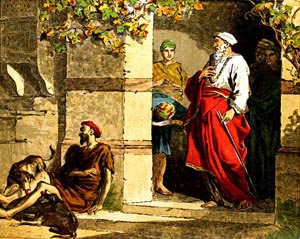
'If they will not listen to Moses and the prophets,
neither will they be persuaded if someone should rise from the dead.'"
-Luke 16:31
When I look over the Gospel reading for this Sunday, the famous parable of Lazarus and the rich man, I am struck by the last line. It reminds me of the need to live by faith, and not by sight, as the old hymn goes. This is a bit ironic, I admit, since one of the main points of the reading is that the rich man was too “blind” to see the poor man at his door. Surly it doesn’t take faith to see a person in need and help them? There are people who help others for strictly humanitarian reasons, this is true. But the point I’m trying to make is that if we keep a division in our minds between faith and everyday life, we can miss where God is talking to us in the ordinary events of our life.
I am a firm believer in miracles. There are some people, we call them “demythologizers,” who strip the Gospels of their supernatural character and explain everything that the Lord did or said in human terms. These are the people who say that the multiplication of the loaves never happened, that the people there simply shared the bread they already had; that Jesus didn’t actually multiply anything. But all they are doing is robbing the Word of God of an important message that it has for us. In the life of Jesus miracles doubled as prophetic acts, pointing us to what life in the Kingdom of Heaven will mean. They were also signs to the people of his age, well versed in the prophetic scriptures, that He was indeed the promised messiah. For us today miracles are a confirmation of the faith we have already. Necessary? Maybe not, but they are a generous gift to those who believe.
All the same miracles are rare, and are not meant to be the foundations of our faith. Jesus was impatient with those who were constantly seeking signs and wonders, and wouldn’t take His word for it. Blessed are those who have not seen, were not at the empty tomb, did not put their hands into Jesus’ pierced side and yet believe. The rich man needed a sign of some kind, and thought if Lazarus was to rise from the dead it would be just the thing to convert his brothers. But the message is no; you have Moses and the Prophets, listen to them. We have, as well, the four Evangelists, St. Paul and the other letter writers, the Fathers of the Church and the Magisterium guided by the Holy Spirit, handing down the Apostolic Tradition through the ages; listen to them.
We also have the gift of the Spirit in Baptism and Confirmation. This is supposed to help shape our vision so that we can see the divine all around us, working in the world. It does not take faith to believe a miracle, but it takes faith to believe that God is in the ‘hood, in the poor and suffering; that God is love in a world that seems to prefer hate and war. It demands faith to see Jesus in the beggar sleeping at our door.
These are a few very scattered reflections on the Pope's recent visit to the UK.
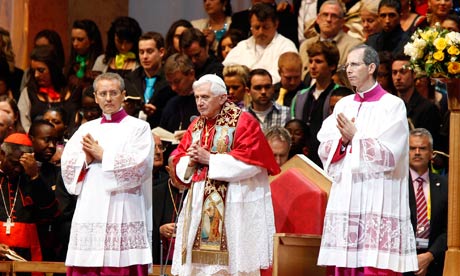
After all the controversy and build up, the Papal visit to England is over, and the Holy Father didn't come close to being arrested. There were protests, and even though some tried to down play it by working the percentages, almost 10,000 dissenters at one event is not insignificant. Though he did make a great point about the demographic breakdown of the protesters versus the faithful. While the protesters were mainly white middle class sophisticates the author suggested we:
Compare the protestors to the Catholics in Hyde Park: old Polish ladies, tweedy gents from the shires, African hospital cleaners, self-consciously cool teenagers, Filipino checkout assistants and, as one of my friends put it, “some rather tarty-looking traveller women who’d obviously had a glass or two”. They don’t call it the CatholicChurch for nothing: if not a universal cross-section of humanity, it was a damn sight closer to it than the humanist smugfest. (Damian Thompson, UK Guardian)
I'm just beginning to read through the Pope's words, but you have to hand it too him; he's unafraid. He chose to defend the place of religion in public life on the spot where St. Thomas More was condemned for defending the role of the Papacy. For those who will respond that St. Thomas was defending freedom of conscience, I counter that as a judge he had no problem condemning Protestants who were following their consciences no less sincerely. No, he was standing against a civil authority that had overstepped it's legitimate bounds of authority, and I would add, competency, in declaring the King of England and his successors, supreme head of the church in England. This was not done for religious reasons, but rather political expediency, the very motives Benedict is urging us to avoid.
He has made these hard points with clarity and charity. I have for a long time thought we are in a culture war, but the Pope is showing me that if it is a war, our weapons must be those of simple reason and a charitable heart, and of course, deep faith in Christ.
It seems my post on phenomenology left some people in the dark. This was not intentional, but what was purposeful was not going into a detailed analysis of this branch of thought. In the context of the Theology of the Body it's enough to know that it was an influence. You can understand and appreciate John Paul II's writing without knowing his influences, much like you can enjoy the Beatles and never know anything about Buddy Holly or Chuck Berry. Like I wrote before, I don't want to get too caught up in the preliminaries and bore people with philosophy.
The other issue is time. Things are beginning to heat up here in Elizabeth, and the spare time I use for this little project of mine is getting scarcer by the day. I've been doing this TOB thing for over a month and still haven't gotten into the text with you all. But I'll try, in brief, to sum up what phenomenology is.
Remember that beginning with Rene Descartes contemporary philosophy became more and more subjective in its vision of reality, meaning that the Western mind accepted that there is no universal truth that we can all agree on. Truth either doesn't exist or we can't know it because of our limited human abilities. We also can't know what a thing is beyond it's outer physical attributes. In contemporary thought what St. Thomas Aquinas called a thing's essence simply can't be known. To put it in modern parlance, we really can't know what the definition of is is. When Descartes says I think there for I am (his famous cogito ergo sum), he's placing the inner life of the mind as the only sure thing we can grasp on to. Our vision of the outer world is tainted by our perceptions, which can be effected by any number of factors like past experiences, prejudices, or even physical defects. There fore we can't trust our senses, and since it's through our sense that we learn, we can't really know things as they are, only as we perceive them. (Are you still with me? because I'm not sure even I am) As the late Larry Azar, one of my professors from Iona, used to say Descartes put us in our minds and we've been trying to get out ever since.
Phenomenology was one of those attempts to get us out of our minds and into the real world again. It tried to analyze human actions by means of what is called bracketing; looking at an action or a thing as it is, putting aside all our preconceived notions. This even includes any scientific knowledge we may have about a thing, in order to get to its essential meaning.
The difficulty with phenomenology is that as a movement it quickly scattered into many different directions, so that you end up with someone like Jacques Derrida who believed that words have no inherent meaning beyond what we place on them (again, no such thing as universal truth). Rather than taking us into the real world, you could argue he's gone full circle back into our mind. Obviously John Paul II is taping into an earlier form of this philosophy when writing TOB, and is also at heart a follower of Thomas Aquinas and his Christian philosophy.
It's tough, but I do have to get back to work, but I will return to an important point later; why this all is important. We often think of philosophy as being very detached from everyday life, especially when we start to to get into the details of these thinker's beliefs. But the denial of objective truth had consequences and is a reality we are living with today. What starts as a tiny, maybe even quirky movement is a university somewhere can spread into our common way of thinking, usually without us knowing it.
The Pope’s visit to England is making me reflect of St. Dominick Savio’s dream concerning that country’s eventual return to the Church of Rome and the role that the Holy Father would play in it. The pope he saw in his dream was Pius IX (sometimes called Don Bosco’s Pope because of their close relationship), but these prophetic visions need to be seen in a less than literal light. This is not the first time that Pope Benedict has been at the center of a Salesian prophesy. Don Bosco’s Dream of the Two Pillars had the pope being shot, recovering to steer the Barque of Peter again before finally dying. Then he is quickly replaced by one who would succeed in anchoring the boat between the two pillars of the Eucharist and Mary. Only three months after John Paul II’s death, who had survived an assassination attempt in 1981, we have photos of Pope Benedict sailing up the Rhine with a monstrance and a statue of Mary to kick off World Youth Day. More than one person, including cardinals and archbishops, saw a connection between Don Bosco’s dream and this event. Now we have him in England, not on a pastoral visit undertaken on his own initiative, as was pointed out to me, but by invitation of the government. What that means, I don’t know; I’ll leave that to others to ponder.
John Paul II was really the contemporary incarnation of “Don Bosco’s Pope” in many ways. He was a member of a Salesian parish for a time in his youth, and was taught by them when he studied theology underground during the Nazi occupation of Poland. He had a deep love and concern for the young people and for the Salesian family. He was very close with at least one Rector Major. When he died we did wonder how the relationship would change. Considering the fact that Pope Benedict chose Cardinal Tacisio Bertone, a Salesian as Secretary of State, I would say we still have a good friend in the Holy Father. But these are two very different men, full of paradoxes. John Paul was charismatic and connected with people immediately, but his writings could be dense and hard to understand. Benedict is a bit more reserved, and while no less an intellectual than John Paul was, his writings are more accessible. He has the gift of taking complex ideas and making them understandable. Responding to reports that the crowds for the present Holy Father were greater than those of his predecessor, Peggy Noonan commented that people came to see John Paul II, but that they’re coming to listen to Benedict XVI.
So, what the Pope’s visit to England will mean in the long run is a mystery. But I will go out on a limb and write that it is connected to Dominick Savio’s dream. Whether he is the pope to bring England back into to Catholic fold or whether he represents the first stage to be completed in later pontificates only time will tell the tale. But he’s taken concrete steps to out reach already by making it easier for Anglicans to enter the Church while keeping many of their liturgical traditions. So we could say the prophesy is being fulfilled before our eyes.
John Paul was the quintessential “Salesian Pope,” but in his own understated way Pope Benedict is proving to be just as much at the heart of the Salesian Family.
I know that I’ve been going in a bunch of different directions in the last couple of weeks, but I’ll try to get back on track here. We were beginning to look at the Theology of the Body (TOB) by examining it’s philosophical roots. I really don’t want to get too bogged down in the philosophy, but to mention that John Paul II taught philosophy and was very familiar with the contemporary philosophical currents about him. He was a man of his times, while also being firmly rooted in the Church’s Tradition. The branch of philosophy that the late pope is most associated with is phenomenology, which developed in Europe around the turn of the twentieth century and arguably reached its peak about the mid 1900s.
There is a lot of debate about how much John Paul II really was a phenomenologist since it can be argued that it’s more a way of doing philosophy than an intellectual movement with a set of firmly held beliefs. For example there are a wide variety of thinkers who are sometimes called phenomenologists whose views are very different. You have John Paul II and St. Teresa Benedicta of the Cross (AKA Edith Stein) on one side and the likes of Jean Paul Sartre and Jacques Derrida on the other. The first two stood firmly on the side of faith, the other two were atheists (to be fair, Derrida was a bit coy on the issue). So the argument is that John Paul used the language and method of Phenomenology, but little more.
I must admit, that entire discussion is above my intellectual pay grade. What I do know is that in TOB John Paul looks at scripture and tries to analyze it from the standpoint of experience, much like a phenomenologist would. Contemporary philosophy had become more and more subjective, while traditional Catholic thought emphasized objective truth. John Paul used this very contemporary method to bridge the gap between the two, showing how our personal experience points us to the universal truths of faith.
Like I wrote at the beginning, I don´t want to get too caught up in the philosophical part of the story. As we move along I´ll try to point out where John Paul is using phenomenology as a springboard for his teaching. But there is just one more stop we have to make before beginning TOB. It’s a look at one of the great mystics in the history of the Church, and I must admit, one of my heroes, John of the Cross. It is he who supplies the theological and spiritual foundation to TOB.
Even though I’ve been bloging on and off since ’04, I really haven’t taken it seriously until the last couple of months. The audience, while still small, has grow steadily in recent weeks (We passed 500 hits all time this past weekend, most are since the end of July), and for this I am grateful to God and to you. I am also appreciative of the kind words and encouragement I've received from many of you. I really have no idea where this is going, but if you like what you read, spread the word. If there are topics you think I should address, let me know; I’ll see what I can do. And again, thank you for reading.
Yesterday (Friday, September 10), I was in my office doing data entry for today’s baptisms (the most tedious work imaginable; the data entry, not the baptisms).The doldrums were broken by the sound of a plane.This is not so unusual since we’re probably 2 miles from NewarkAirport. It’s that this baby was flying low and moving fast.It was a jet fighter, (I understand that there may have been two) and it made four passes in about a five minute span. I didn’t see it, but Fr. Rich did and we got a call from our secretary’s husband who saw them from his back yard, just a few blocks away.One of our parishioners has connections in the Elizabeth PD so he gave a call.They knew what was up, but they weren’t talking.
The first time the plane passed overhead, the moment I realized that this wasn’t simply a jumbo jet making its approach but was a plane of war on patrol a feeling of dread came over me in a way I haven’t felt for a very long time.On 9/11 all those years ago I felt numb, but in the days and months that followed I felt this creeping sense of disquiet, like I was waiting for the other shoe to drop.That subsided by the following spring, but then just after the first anniversary of the attacks I was in Chicago settling in to my new assignment when the terror level was raised to what ever color represents it’s time to put your head between your legs and kiss it goodbye.New York was armed camp, from what we could tell from the cable news stations, so the director, our financial administrator and I sat down to discuss what to do if a dirty bomb went off in the Loop.We concluded that we were close enough to down town that there probably wasn’t much we could do to save ourselves and the men in our community if the worst happened.We made sure we had enough canned food and bottled water and hoped for the best. My feelings those times mirrored what I felt growing up during the Cold War.I didn’t live through the Cuban Missile Crisis or anything like that, but there was an awareness that nuclear war was a real possibility.I certainly didn’t live in constant fear during those years, but there was a sense of the fragileness of life and that the future was far from assured.These were the feelings that came back to me for that brief moment yesterday morning.
In the end it is faith that sustains me in those moments. This is not to say that being a priest or a Christian will save me from hardships or tragedy, but that if I am doing what I am supposed to do right now, I have no need to fear, even if that something is as tedious as plugging names and addresses into a spreadsheet. Life is unpredictable, even without the threat of terrorism and nuclear war.We just have to live now, as if it’s our last day; live to the fullest this life that is a gift from God.We remember today those who died nine years ago.We pray for them and for their families that still struggle with pain and grief.But the greatest memorial we can give them is to remember that life is short and fragile, so we need to live every moment, not in fear, but in love.
Many people have been asking me lately my opinion on the mosque controversy in Manhattan. I haven’t brought it into the blog, mainly because I didn’t think I had anything new to add to the discussion. I still might not, but for the sake of satisfying my questioners, I’ll have go at it.
Obviously, I’m a publicly religious man, so the preservation of religious freedom is important to me. I believe that the Constitution has been twisted to mean something it doesn’t say. The exact text of the establishment clause of the first Amendment reads: Congress shall make no law respecting an establishment of religion, or prohibiting the free exercise thereof. Nowhere do the words “separation of church and state” or “wall of separation between church and state” appear in the clause. These phrases represent a particular interpretation of this clause; it is the prevailing one at this time, but it’s an interpretation nonetheless. There are people who want to keep religion in a box, on the shelf and out of public life and they use the Constitution to justify it. I don’t want to get sidetracked too far into a discussion on the nature of the constitution, but I only want to make clear that I don’t believe that the First Amendment was written to limit religion, but rather to safeguard its free practice.
In light of this, I have no problem with the idea of a mosque being built in New York City. I am against this particular mosque near Ground Zero though. On a related issue, I understand that our constitutionally protected freedom of speech allows us to do many things, like burning objects that have a symbolic value to make our point, but I’m against the burning of Korans by anyone, especially those who claim to be doing it for Christ. Do both groups have a right do what they’re proposing? Yes they do. But just because you can do something doesn’t mean you should do it. I’m not writing as a constitutional scholar here, but there are reasonable limits to our rights. Some limits are imposed by the courts; some should be imposed on ourselves by using a little common sense. Both actions are insensitive and unnecessarily provocative. They are both, in their own ways, mean spirited acts that go against the values that religion in general should stand for.
In the case of the mosque, or community center, or whatever they want to call it, I have concerns as a citizen about the whole thing as well. While there are people who will cynically use the Constitution to limit religious freedom, there are those who will just as cynically use religious freedom to disguise less than holy objectives. I hate to use a popular cliché, but the Constitution is not a suicide pact. I want to know where the money is coming from and whether this community center will really be nothing more than a front for those who want to do damage to our country. In light of recent history, we would be foolish not to ask these questions.
So I am against the mosque, on both religious as well as civic grounds.
There Will Be Blood OOOO(4 Hallows out of 4) Rated R for some violence.
I’m taking a break from Saleianity this week, mainly because I have to put a financial report into the weekly parish bulletin, and I spent too much time on the Theology of the Body and getting the Spanish edition of the blog up and running this past weekend.
But I did find time to take in a movie. This was done in the privacy of my room, so as you can guess it was a DVD, and so not a first run picture (no piracy here). In the spirit of "better late than never," it was 2007’s “There Will Be Blood,” based loosely on the Upton Sinclair novel “Oil!”. I understand writer-director P.T. Anderson only used the first 150 pages as a jumping off point for the story, though catapulting seems like a better way of putting it. This is one of the most unusual movies I've seen in the last few years, and I mean that as a compliment. Anderson leaves the viewer to make up his own mind as to what is going on without making things overly confusing, a favorite tactic of film makers who really have nothing to say but want to pretend. This wasn't as gory as I thought it was going to be, but it is brutal; not for the faint hearted.
I must say, I feel bad I didn’t see this one on the big screen when it came out. While Daniel Day Lewis certainly deserved his Oscar, (he has a couple of scenes where he's his usual out of body self) this is really a visual picture. There’s no dialogue for about the first ten minutes, and even after that the actors use facial expressions to project their thoughts and emotions more than words. The always exciting cinematography moves seamlessly between claustrophobic and sweeping, with the barren desert, that serves as the setting for the middle portion of the story, becoming almost a character itself. (As I bother to flip the DVD case over I see that Robert Elswit won for best cinematography, which makes sense)
I would be amiss not to point out that the film does go in for some tried and true anti-religious stereo typing. Eli Sunday, a Pentecostal style minister played by Paul Dano, is a fraud and anyone who is religious is either a fool or a conniver. It would be nice to see a movie where religion and religious people are actually taken seriously, and while the variation on this tired theme is handled more subtly than in most recent pictures, it’s still not very original. It seems like the only theology we get in films these days is the twisted kind found in certain horror movies, with all religious people being treated like Eli Sunday, only crasser. I long for the days of Carl Malden’s Fr. Barry or even Jason Miller’s Fr. Karras, but alas I fear they have passed away, hopefully not forever.
To be fair, the Godless are even worse. Lewis’ Daniel Plainview is a murderous, misanthropic maniac who brooks no competition in his pursuit of oil wealth. At the beginning he shows real humanity in the tender way he treats his son, but as the story progresses he becomes more and more erratic and violent as he pursues the digging of an oil well in a far off desert town.
But it would be an oversimplification to say Plainview is motivated strictly by money or even power. No, simple greed is left as Rev. Sunday’s great vice. Plainview is a man without family or roots who fosters an inner rage that we are left to guess at. He never reconciled with his estranged father before his death, and every close relationship he has turns out to be fake somehow. By his own admission he hates most people, but there is something in him that yearns for connectedness. He is constantly disappointed in the people who represent themselves as family and often with reason, but his disappointments provoke violence and drive him deeper into himself and his work. He becomes an isolated bitter man, trusting no one but a longtime adviser. Ultimately he rejects the only person who truly loves him because his entire life has been built on a competition that grants him only a hollow victory.
A.O. Scott, the fine film critic for the New York Times, took issue, in an otherwise enthusiastic review, with the story veering off into a psycho drama rather than expanding its critique of capitalism. But I think you could argue that in the character analysis of Plainview lies the social commentary. Plainview is successful at every turn, and even his apparent defeats turn out to be victories in the end, yet the more he gains the more and more he devolves into madness and isolation. For the purposes of the story Plainview is the embodiment of the capitalist system, a system built on a greed that can never be satisfied; a greed that destroys the bonds of family and society; a system that is dehumanizing and in the end self destructive. This isn't my view of capitalism, to be sure, but the one argued by the film through the warped mind of Daniel Plainview.
If you haven't picked it up by now, this is not a feel good movie. It has a dark, pessimistic view of humanity where almost everyone is not what they present themselves to be as they grasp for wealth and security. Plainview is the only transparent one here simply because the palpable contempt he has for all those around him makes his attempts at deception seem halfhearted. He hates people, and he doesn't care who knows it. The only sympathetic figures in the story are HW, Plainview’s son, but he has to suffer a disabling injury to earn that right, and Mary Sunday, Eli’s sister. They are the sole bright spots in an otherwise dark universe.
“There Will Be Blood” is a movie that defies easy analysis, and while I had problems with it’s view of human nature, to put it mildly, it was refreshing to see an American film that made me think without resorting to tricks and gimmicks.
The comedian Steve Martin used to say that people who study philosophy in college remember just enough to screw them up for the rest of their lives. It could be added that most people who haven’t studied it, and a good number who have, think it’s too much of a waste of time to even accomplish that much. As one who has a piece of paper hanging from his wall proclaiming him a bachelor of philosophy I can say that my studies didn’t do me any lasting emotional harm (some might disagree on that point). And while I tended to treat these courses as a means to an end without any lasting importance, my view on this has changed over the years. I now wish I had paid better attention and dug a little deeper back in the day. I don’t know that we have to go back to past ages where everyone who went to university left with a philosophy degree (a practice that endured in many Catholic colleges well into the 20th century), but there needs to be some renewal of philosophy in the core curriculum, if such a thing still exists. If we are screwed up today, to use Mr. Martin’s vulgarism, it’s because we don’t really understand why we believe what we believe, and this doesn’t apply to non-religious people only, but for people of faith as well.
Faith is enough to get you into heaven, for sure. There are worse things in life than not understanding St. Thomas Aquinas or St. Augustine. To be versed in theology and philosophy doesn’t make you a saint. There was a professor of Scripture at Xavier when I was there who was very popular, and didn’t believe a word of what he taught. That is he approached the New Testament as an anthropologist might, not as a document of faith. I heard a beautiful and insightful lecture on Isaiah 6 by a professor at SUNY Purchase, but for him it was a poem, nothing more. Knowing something intellectually doesn’t mean that you really believe it, or really understand it in the same way. With faith we have a different way of seeing both the Scriptures and reality around us. We don’t need airtight arguments to convince us that Jesus Christ is the Way the Truth and the Life. But we don’t live in a world guided by the light of faith. We have friends, neighbors, coworkers, even family members who may not share our faith or may be uncertain if they really believe what the Church teaches. We ourselves may have doubts that won’t go way. Appealing to religious authority may not be enough to convince them, or us, of the truth of these teachings. This is where philosophy comes in. If we know enough of the intellectual underpinnings of our belief maybe we can at least convince them, as well as be convinced ourselves, of the reasonableness of our faith.
This is only a first step. What will ultimately convince people is our personal witness lived out in our lives. The writings of St. Thomas Aquinas have certainly helped people to better grasp their faith and even pushed some struggling with the idea of converting “over the edge” to embrace Christ. But it is the example of those like Bl. Theresa of Calcutta that truly move souls to change their lives for the better.
This is a long way around to say that I’m not making philosophy the be all and end all. But it is a tool, and an important one. The Theology of the Body was formulated by John Paul II, who was a philosopher, because the Church had reaffirmed its teaching that the use of artificial contraception is contrary to human dignity and the divine law. Many within the Church found this hard to accept, and to this day most Catholics ignore this teaching. His hope was to show people the religious justifications for this teaching, but also that it is in line with human reason as well.
And so I'm dusting off some old volumes, scouring some web sites and brushing up on my Aristotle, as well as Descartes and Kant. It's actually been enjoyable reacquainting myself with this material and I pray it bears fruit, not just for me but for you.
I had promised a posting on phenomenology, but I found that I need to go beyond TOB’s introduction to really do it justice. So, I’m still reading through some material and hope to have something on that by the end of the week.
The last time we looked at the Theology of the Body we examined the philosophical roots of TOB, discussing the shift in the common world view after about 1500. In doing so I jumped over a few centuries to get to the idea of reductionism: that reality can be reduced to function, with no spiritual dimension to the material world. We should go back a bit though to see more clearly how we got to that point. There is one thinker who had tremendous influence on John Paul II, and really on all contemporary thought, who must be dealt with before going on.
Immanuel Kant (1724-1804) was a Prussian philosopher who spent almost his entire life in his hometown, never traveling more than a hundred miles from where he was born. In spite of his limited background his influence has been great. His work summed up and answered the philosophers that came before him, and all the philosophers that came after him have had to react to him in some way. His thought is too far reaching to summarize in a short space, so I’ll concentrate on the things that concern us most directly: his ideas on free will and the human person.
For Kant, to be human was to exercise free with without limits. This is not to say he didn’t believe in morality; he held to a very strict moral code. For him to be moral means acting in accordance with reason, so that what is irrational is also immoral. Any action that is based on desire, emotion or motivated by pleasure does not meet the standard of a rational act, and is thus immoral and dehumanizing. Any act that uses another person, not respecting his or her autonomy limits free will, and so is also immoral. Kant thought sex was dehumanizing because it is an action born of desire, emotion and, you got it, the seeking of pleasure. In his view sex partners are using each other as objects. This violates the individual’s free will and is immoral. Sex could be justified if the goal was procreation, which is rationally needed for the continuation of the human race, but for no other reason. As you can tell, Kant wasn’t big on Valentine’s Day; in fact he was never married.
It’s amazing to me that Kant was a devout Lutheran, and part of his goal was to set up a system that allowed for faith and the spiritual at a time when philosophers were becoming more and more materialistic. But his teaching on free will, which builds on Francis Bacon, soon became detached from his strict morality as questions over what is rational and who sets the standards of rationality rose up in later decades. Rather than safeguarding human dignity, Kant’s thought gave rise to increasingly individualistic philosophies that promoted the exercise of free will for the good of the individual or society, but often at the expense of others.
The challenge that John Paul II faced was maintaining the centrality of free will while convincing people that Christian morality is the highest way of using that freedom. Keep in mind that JPII was a philosopher, and he tried to use a new philosophical school to answer modern objections to faith. More on phenomenology next time.
The medieval period is often thought of as being backward and “unscientific,” denoted by the fact that we also call it the “Dark Ages.” These terms; Dark Ages, Middle Ages, Medieval and even Renaissance, for the time that followed, were applied by people centuries after the fact.The historian Morris Bishop observed that the people of the middle ages didn’t think they were living in the “middle” of anything, that is between the fall and rise of two great civilizations.They thought they were the continuation of ancient culture and tradition, as well as building upon it.Romano Guardini wrote that the medieval mind was much more subtle than it is given credit for today.For them humanity, nature and the spiritual realm were intimately connected, each functioning in harmony with the other.Through the study of actions, attributes and qualities it was possible to know what something was by its nature, and that a being was greater than the sum of its parts or practical function.Reality, including our earthly lives, had a purpose or an end to which it was directed.This end was ordained by God and it was our job, sort to speak, to find where our individual place was in this universal plan.
There is no doubt that at some point after 1350 new intellectual, cultural and scientific movements emerged that would lead to revolutionary changes in society.As the Theology of the Body´s introduction points out, beginning with Francis Bacon (1561—1626) the natural world became seen something to be mastered, controlled and manipulated rather than harmonized with.This process continued with Rene Descartes (1596-1650), further separating humanity, nature and the spiritual realm, putting them at odds with each other.Reality was no longer unified but fragmented, and our ability to know was limited to what could be observed.The nature of something was deemed unknowable, only its function could be discerned.There was no end to which reality was directed beyond what the individual decided it to be.In its extremes it lead to what some philosophers call reductionism; the human person is no more than a composite of parts without purpose or meaning.Human beings are a complex machine made up of the same biological “stuff” as the rest of creation.As the physiologist who discovered vitamin c once noted, “there is no real difference between a king and a cabbage.”
I do describe an extreme view, but this basic reductionism has trickled down to our common way of thinking and viewing the world and ourselves.Since the body has no inherent meaning or purpose beyond this life I can do what I want with it.This can lead, consciously or subconsciously, to accepting substance abuse, sexual excesses or various forms of self mutilation as morally neutral.In the realm of human sexuality specifically, it doesn’t matter who I have relations with since the body is a machine or organism to be satisfied, and nothing more.We need our body, so we’ll be careful about what we eat, to the point that we more and more speak about food in almost moral terms. How we care for the body is important, but what we do with it after is not.
TOB tries to get us back to a more integrated view of the body, that it does have a value and a purpose beyond function and pleasure.We should care for our bodies, certainly.But what we do with this gift we have been given has the greater importance.We are created in God’s image, not just because we have a soul, but the Divine is imaged in our bodies as well (but I’m getting a little ahead of myself).More on the philosophical roots of TOB next time.
This week’s first reading, from the Book of Wisdom, asks how we can know God’s will without the gift of wisdom that comes from the Holy Spirit. Our human worries, concerns and temptations to sin can blind us from seeing God’s will for us. Therefore it’s important to seek the wisdom from above to be our guide. St. Francis de Sales knew this, and told anyone who was serious about spiritual perfection to seek out a spiritual director, a trustworthy person with experience in the spiritual life to guide them. Once they found him or her, they should trust and follow, being obedient to the advice given. Of course we do need one very important condition: no one ever has the right to tell us to do something sinful or contrary to the teachings of Scripture and the Church. We should be open to the challenges presented to us and not expect the road to be easy, but at the same time if what is being asked of us or taught to us is not in keeping with the Scripture and the Apostolic Tradition we know we have the wrong spiritual director.
I wrote “him or her,” because a spiritual director can be a priest, religious brother or sister. But even if our spiritual director is not a priest, the first step on the path is to make a good confession. St. Francis recommends that we first make a general confession of our life, though this is not absolutely necessary. Again, I have to give a warning here. I knew a deacon (in another parish, in a different diocese) who made this recommendation and left the people very confused. Once we make an honest confession of our sins to a priest and receive absolution, our sins are forgiven. We do not have to keep on going back over the sins of our past life. This general confession St. Francis recommends is a way to examine our lives, to see where God has been working in us and how we haven’t cooperated with His will as we should. It helps to show us where our weaknesses are, and what sins we may still struggle with. It can also make us appreciate the mercy God has shown us in the past. If we do choose to do this it is a once or maybe twice in a lifetime event. While it is important to regret our sins, and yes even feel a healthy sense of shame, it is unhealthy to constantly relive the faults of the past. Instead we need to make a firm resolution to not sin in the future and trust in God’s mercy and forgiveness.
At this delicate stage of the spiritual journey we must avoid two extremes; one is to look back at our sins and become discouraged, thinking that progress is impossible, or that what we have done is so bad God could never forgive us. Because of this discouragement we either standstill, or worse yet, go back to our old life. The other temptation is to think that this purification will be quick and painless; that our sins are few and that we have little or no need to change. This can lead to pride, and keep us from really examining ourselves thoroughly. Our serious sins may be few, but conversion of life, as we shall see, involves more than eliminating sin. This is only the first step, and unless we are honest and open now, the future steps will be much harder to make. Next time we’ll discuss how to make a good examination of conscience.
In the past I never read introductions, or almost never.I usually cut right to the “beginning,” treating the intro as something disposable.This is a mistake in general and most certainly a mistake where the 2006 edition of the Theology of the Body is concerned.Michael Waldstein, who translated the text, offers an introduction that, far from being disposable, could be a book by itself.Roughly the first half is an exploration of the philosophical roots of TOB and the second is concerned with the theological influences.I’ve finished the first part, and have begun the second.
It’s been a long time since I studied philosophy, and when I did I treated it little better than I did book introductions.It was strictly a means to an end.I needed 27 philosophy credits before starting theology study, and the quicker I got done with it the quicker I could begin preparing for ordination.In honesty, I did grow to enjoy it.I have many fond memories of sitting in the Mirage Diner or Mr. Taco with my friends Bill and Matt discussing Aristotle’s teaching on substantial change and how Descartes destroyed metaphysics, over a burrito and a coke.But once I moved on to the Salesians my contact with things philosophical grew less and less.Philosophy had served its purpose, and now it was time to move on to something else, shall we say, more practical.
In time I have come to see that this utilitarian attitude toward philosophy has been damaging.The philosophical moorings that made the content of faith understandable in the past have been torn out by the roots.This makes explaining the content of faith difficult, to put it mildly. Joseph Ratzinger (AKA Benedict XVI) compared the task of the theologian in our times to a clown trying to warn an unsuspecting village of an approaching wild fire.The people see the strange, if familiar, dress and assume it’s all part of the act.Like a clown, religion has been relegated to a particular place in the collective mind; it’s there to comfort and reassure in times of difficulty, maybe, and to be used when some service is needed, like a wedding or a funeral, but is otherwise irrelevant when faced with the deep questions of life and reality. In this way we can say that Nietzsche was right; God is dead and we killed Him.
The Holy Father was writing, as a private theologian, over 40 years ago and in that time the disconnect has only gotten greater.What began as intellectual trends embraced by a certain elite class has trickled down to shape the popular mind. It took several hundred years for this to happen, but it has. Many critics of the contemporary scene like to blame the 1960’s for ruining the world, but in reality all that happened was that these various trends came to flower, not simply in the academy, but on main street, and without us really knowing it.I’ll save the how to the social scientists; I’m more concerned here with the what that changed.It’s that What we’ll look at next time.
A couple of weeks ago I weighed in on the controversy surrounding Christopher West and his take on the Theology of the Body (TOB). To be honest, I’m backing away somewhat because I’m getting a bad feeling about the whole thing. Mr. West’s critics have many valid points, but there is an undercurrent of bitterness that’s palpable. I don’t want to accuse anybody of being uncharitable, but if it walks like a duck, swims like a duck…well, you get my drift. I am not a particular devotee of Mr. West but he and Janet Smith, who has also been the target of criticism, have been out there teaching the difficult message on pre-marital sex and contraception that few others in the Church have been willing to do. I think they deserve better than what they’re getting.
These then are my last unsolicited words on this controversy.
But these will not be my last words of TOB. A good thing that came out of my detour through this little imbroglio is that my interest in this relatively new field of theological inquiry has been renewed. I first heard about it back in the 90’s, and did some reading on it, and made it through about half of the 129 talks given by John Paul II that make up the guts of TOB. Pastoral work took me away from going much further, and while I’m still very much “on the front lines” (overused term, but it fits) I’m again tackling the late Holy Father’s work. There is a new translation, superior to the old one (better organized, more consistent use of language) with an introduction that’s served me well as a review of certain philosophical trends since Francis Bacon. As I work my way through I’ll share my reflections. I’ll still post my weekly bulletin letter and what ever musings on popular culture that hit me, but for the next few months I’ll be concentrating on TOB.
Now understand, I am not a professional theologian; I am a pastor in both the broad and strict application of the word. I don’t claim to offer a definitive interpretation of John Paul II’s theology, but rather very personal reflections based on experience and what I understand to be the mind of the Church.
And so, let the fun begin. And I really do hope it’s fun and, more importantly, helpful. Once I get through the introduction, which is so far proving to be worth getting the book for, I’ll begin the beguine.
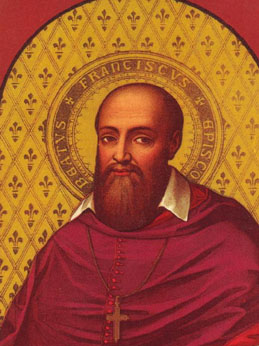
We continue with our look at Salesian spirituality by looking at the most well known work by Francis de Sales, “The Introduction to the Devout Life.”St. Francis wrote a great deal, and today is the patron saint of authors and of the press.He wrote many topical pamphlets addressing controversies of his day that are not read much today.But he also wrote masterpieces that have endured for centuries, and the “Introduction” is one of them.So popular was this work that the Protestant King James I of England carried a jewel encrusted edition of the book, with all the “Catholic errors” removed, of course.
As we saw in the past a key to Salesian spirituality is that it is universal in nature.All people are called to be saints, but how they do it is going to depend on their state of life.The married person and the vowed religious have different responsibilities to fulfill, and so need to follow paths that will lead to holiness while also helping them fulfill their duties.
St. Francis first question is what is the devout life?While some associate the devout life with praying or fasting, he tells us that these are part of the devout life, but that these things by themselves don’t make us devout.He writes of people who fast, but have hatred in their hearts, or pray a lot, but then gossips and speaks badly about and among their friends and family.Some people may give money to the poor but then won’t forgive their neighbors.This type of devotion is really hypocrisy and possibly superstition.On the other hand St. Francis writes:
But, in fact, all true and living devotion presupposes the love of God;—and indeed it is neither more nor less than a very real love of God…Love while shining on the soul we call grace, which makes us acceptable to His Divine Majesty;—when it strengthens us to do well, it is called Charity;—but when it attains its fullest perfection, in which it not only leads us to do well, but to act carefully, diligently, and promptly, then it is called Devotion.
Devotion in the highest sense of the word, then, is love of God, and of neighbor, or charity, which has become a habit, or virtue.This means that we do good without having to think about it, so much have we conformed ourselves to God’s will.This level of devotion is not arrived at overnight.It takes time and the purification of our desires and actions.In the end it is God’s grace working in us that will make this happen.But we also need to open ourselves and cooperate with God.This begins with making an examination of conscience and making a good confession.What is the best way to make an examination of conscience?This, along with the first stages of purification will be the topics of next week’s letter.
Last Saturday I put up a post weighing in on the controversy surrounding Christopher West and his interpretation of John Paul II’s Theology of the Body (TOB). I have since taken it down because I’m afraid I wrote too quickly. The appeal of a blog is that it is immediate, and allows the writer the instant gratification of getting his or her ideas out right away. Most of my entries are written within an hour or two. Others might get tinkered with for a little longer, but they rarely sit overnight before I post them. I am usually writing about spiritual and theological matters that I have already reflected on for years, or are critiquing movies or music drawing on my inner core beliefs, as well as the admittedly modest knowledge I’ve acquired about these topics over the years. Which is a long way around to say that I avoid shooting my mouth off about things I know little or nothing about. I do not need to be reminded that our desire for instant gratification can be destructive. While the post I took down was certainly not “destructive” I do fear I didn’t put enough time in reflecting on the issue and taking a look at both sides.
The problem is that this whole controversy is between Catholic intellectuals who might otherwise be considered to be “on the same side.” These are people who consider themselves orthodox, working closely with the Church hierarchy, and drawing on Scripture and Tradition in order to conform to these two fonts of the single Divine Revelation. They are not “progressives” challenging traditional views, or criticizing the Magisterium. It’s difficult for me because I can see where both sides are coming from.
And so I am taking a few steps back, but will return to this topic, because I do believe that it is important. TOB is increasingly being incorporated into catechetical programs and religious education materials for young people and adults. John Paul II’s theology is dense, and so we rely on people like Mr. West to help “break it down” into a language that the common person can understand. The little I have read of TOB leads me to believe that it has implications for theological and spiritual discussions beyond marriage and sexual ethics. I would not want to see it fall into disrepute because of a misinterpretation. At he same time Mr. West has been a long time laborer in the vineyard, respected by bishops and Catholic academics who I hold in high esteem, and so should be treated fairly and get a proper hearing before passing judgment.
As we pick up again the theme of Salesian spirituality I’d like to look at what we mean by the term “spirituality.” Today we hear the word spoken a lot, but I’m not always sure the people who use it understand what they are talking about. How many times do we read or hear of actors and other celebrities who call themselves spiritual, or who have adopted some form of Eastern spirituality that no one has heard of and doesn’t seem to be connected to any concrete belief system. The aim quite often is the improvement of their emotional or psychological well being and not necessarily finding better ways to guide their actions and moral choices. In the contemporary world spirituality often gets reduced to achieving a feeling of peace through some type of meditation or prayer routine. As Catholics, when we speak of spirituality we are talking about something very concrete and practical. Spirituality is how we live out our faith in Jesus Christ in our everyday lives. Prayer and meditation are a part of this, but the goal is not simply to have our anxieties and stresses relieved. The ultimate goal is union with God.
True spirituality takes into account our moral lives. We achieve union with God by purifying our actions and desires so that they are in conformity with God’s will for us. Then, when we come to a knowledge of God’s will, to go about doing it. It sounds simple, and in truth it is. But, as we all know, actually doing it can be difficult. This purification entails eliminating mortal sin from our lives, and then working on the venial sins that, while not completely breaking our relationship with God, keep us from truly soaring to the heights we were created for. This is not just a matter of not sinning, but of purifying our desires, to eliminate the attachment to sin. Catholic spirituality seeks to grant us inner peace, true, but it also seeks to make us moral people attentive to the needs of our brothers and sisters. We are to become like Christ, united to Him in a deep, intimate way.
One of the great beauties of the Catholic Church is that we have been given many different roads by which to reach this goal. These gifts of the Holy Spirit, also known as charisms, are represented by the various spiritual families that have grown up in the Church over the centuries. Benedictine, Franciscan and Jesuit schools are three of the major spiritual traditions that have enriched the Church. They along with a myriad of others offer unique perspectives how to unite our selves with God and fulfill His will in our lives. Salesian Spirituality was developed by St. Francis de Sales and adopted by Don Bosco, and is followed by a variety religious orders, congregations and lay groups including, of course the Salesians of Don Bosco. It is this brand of Catholic spirituality we will be exploring in the coming weeks.
I wanted to like Edward Sharpe & the Magnetic Zeros. I wanted to like their single, Home, that’s been getting fairly heavy airplay on alternative rock stations. It’s quirky and catchy. It’s folkie, but interestingly produced. It reminds me vaguely of the duet between Peter Yorn and Scarlett Johansson from last year, but this is more original, I think. I wanted to go to iTunes and download it, then add it to a mix I’m working on. Maybe burn it for a friend. But then it happened, probably on the third listen. I’m guessing I hadn’t heard it from the beginning, or just wasn’t listening to the words closely enough, but it happened. Before the chorus kicked in for the first time they went there, and for no good reason. Amid a list of decidedly banal objects that our hero likes less than his beloved, he inserts the Name above all other names. Why did he have to do that? (and don’t go complaining to Edward Sharpe, he doesn’t exist. Think “Lynyrd Skynyrd.”) I wanted to like it, but I just can’t.
I don’t know what the song writer’s motivation was. Maybe he was trying to be blasphemous. Maybe he was just trying to be cute or, more likely, shocking. Maybe he wanted to show that the Alpha and the Omega of our faith has no more value or meaning than pumpkin pie of chocolate candy. Anyway you cut it, the inclusion of the Messiah in this litany of the mundane is sad and cheap, and yes, offensive. Since Our Savior’s name doesn’t even rhyme within the line's context I have to conclude that he was determined to make his point, what ever that point is, no matter how self defeating.
For those who will protest, that it’s just words, and they have no meaning, it’s just a silly pop song, what’s the big deal? I say, words have meaning. They always have and they always will. No matter how contemporary intellectuals try to tell you otherwise, words have a power beyond our understanding.
There is a common notion, made popular by the late Lenny Bruce, that words have no inherent meaning. If we find a word offensive we need to put it into common usage. Sheer repetition will render the word ordinary and so lose its power to offend. He was referring to a particular word that African Americans tend to take issue with. His desire was for the President to start referring to black members of his cabinet by this name publicly as a way of dulling its impact (Yes, I understand Bruce was a comedian, but I think he was, in this case, trying to shock rather than be completely ironic). It’s almost fifty years later, and Mr. Bruce’s hypothesis simply doesn't hold up . Not only is this word unutterable outside of certain corners of the hip-hop community, in the halls of the mainstream media it is only mentioned by it’s first letter, the fear of giving offense is so great. The irony is that many of the same people who have rendered the “N” word unutterable hold Lenny Bruce as a hero.
Why has this word not been mainstreamed? Because it is ugly and hateful, and it projects a hate and ugliness beyond the intent of the speaker. Words have meaning. Yes, meaning can change over time. But that change comes in more organic ways. It can’t be decided on by a committee, it evolves without our knowing it. Words have a history of their own, and reflect the history they were born out of. Words have power. I would like to see one of those white intellectual college professor types get off the train at 125th Street in Harlem, descend the platform and begin to use that word with the people he meets. Then, let me know where to send the memorial bouquet.
But I digress.
Words have power. And of all the classes of words out there, names are the most powerful. As a teacher if I see a group of students on the playground doing something they are not supposed to, and yell out, “Hey, you guys, cut it out,” you know what’s going to happen? Nothing. Absolutely nothing. They are going to continue with what ever misbehavior they’re engaged in. If, on the other hand, I yell, “Pete, Nick, Bruno and Sasha, cut it out,” the odds are they stop quickly. If I include their last names, I guarantee they cut it out, stand at attention, and begin to look at their shoe laces in embarrassment.
Names have power. An exorcist is not supposed to engage the demon in conversation, except to find out how many there are, how long they plan on staying and what their name is. The demon does not give that last piece on information us easily because the exorcist will then have a powerful weapon to use against him.
The ancient Hebrews knew this thing about names. When Jacob wrestled the angel he asks for the mysterious visitor’s name. The “angel” tells him to pound pavement, punches him in his hip socket and changes Jacob’s name to Israel. Only God changes names in the Bible, so I’ll leave you to connect dots on that one. God gives Moses that mysterious answer of “I AM WHO AM,” in response to his request to know the divine name. Scholars still debate whether this was meant to be a proper name, a descriptor of God’s nature, or God’s way of telling Moses to mind his own business; no one controls the Almighty. In the Gospels it’s Jesus who changes Simon’s name to Peter, to denote the function the Apostle would have in the Church. Names have power, and the divine name is the most powerful of them all. This is why observant Jews to this day have such a respect for God’s name as revealed in scripture. It is not to be spoken; it is not to be even written down.
We have become sloppy, and throw the Lord’s name around as if He were an ordinary Joe (no offense to any Joes out there). But names have power, and Jesus’ name is holy and full of power. His words give us hope: Your sins are forgiven. His words have power: Go, and sin no more. His words give us a mission: Go and teach all the nations, baptizing them in the name of the Father and of the Son and of the Holy Spirit. His words give us a command: Do this in memory of me. His words give us His very Self: This is my Body, this is my Blood.
Our faith is based on the fact that words have power and it is by a Name that we are saved. I am a patient man. I believe that it's important to give generous leeway to the artist. I try to give the benefit of the doubt. I think we can be too quick to judge a song like John Lennon's God, for instance. Not that we agree with the sentiment, but to understand the pain, disillusionment and heart break that went into him writing that piece. But this particular number deserves no such consideration. This was just a sloppy attempt to be hip and Jesus' expense. I'm pretty easy, but don’t be sloppy with the Name. I may like quirky off beat pop, but I can’t take blasphemy, no matter how well produced and packaged; no matter how much I want to like it.
Inception OO 1/2 Rated PG-13 for sequences of violence and action throughout.
I took a rare trip to the multiplex this week and saw Inception. I walked away thinking that there was much less there than met the eye. Oh, yes, there was plenty of fancy CGI footwork going on, creating fantastic images that were truly amazing for their realism. It is in the realism that lies the problem. Dreams don’t make sense, and too much of this film made perfect sense to me. The dreams seemed too concrete sequential in there organization and layout. For all the money and technology obviously put into making this movie, there was terribly little imagination. I know that there are many people debating about what parts of the film were dreams and what parts were reality, but I never really questioned it while watching the movie because there was never any sense of doubt put into my mind by the film makers as to what I was watching. Plus, I never understood why I should care to know the difference to begin with. The entire premise served as nothing more than an elaborate excuse to make a shoot'em up action picture while feigning art.
Without going into too much of the plot, Leonardo DiCaprio and his intrepid band of dream crashers set about to plant an idea in someone’s mind instead of taking information out, which is their usual job. This is supposed to be impossible. Why it is such is never explained to my satisfaction, but I quibble. This plot devise is really a classic McGuffin (I defy those who saw the film to remember a week after seeing it what this “idea” was). What becomes the more dominant theme is the internal emotional conflict within the DiCaprio character’s mind.
Before I go into what I found wanting in the film, I will say, I was entertained. I had mixed feelings about seeing this thing knowing that it was two and a half hours long, and it did begin to drag a bit at the end. That said, it moved for the most part and didn’t leave me bored.
Where the film broke down for me was on the level of how the dreams worked. Real dreams function on a surrealist level. People, places, things, even the dreamer’s own identity can shift, morph, drop in or out of the mental picture without any rhyme or reason. Sometimes we figure out why things went the way they did, many times we don’t, that is if we can even remember the dream to begin with. Here, it’s all very planned out. The “architect” creates a maze like cityscape or building for the action to take place in and the only danger comes from mental projections that serve as defenders of the host’s subconscious. Things are predictable and incredibly safe. At least in The Matrix if something went wrong death was a possibility. Here the worse thing that can happen is a person stays in a perpetual dream state that really didn’t look half bad.
I guess that was the greatest problem for me; there was no risk involved. No risk to the characters and no risk for the viewer. The one time there was any sense of true menace was when a freight train came barreling out of nowhere (and even this ended up having a logical explanation). DiCaprio freaks out on poor Juno, I mean Ellen Page (the architect), because this wasn’t supposed to happen since this detail wasn’t in the design. All I could think of was, “well Leo, it’s a dream, of course stuff comes flying out of nowhere. Suck it up, you wus.”
There is no risk for the audience because nothing is really left dangling. Everything is served up on a silver platter. There is no ambiguity, no consequences, nothing is real and nothing to get hung about. And no, I don’t consider the ending all that suspenseful or clever. Since how one progresses through the various dream levels was clearly delineated, I never had a problem, outside of the opening sequence, and then only slightly, figuring out when they were dreaming and when they were awake. So the film’s own internal logic told me the story was resolved in the “real” world. That this little twist was added at the end did nothing to alter that conclusion. And even so, by the end I really didn’t care all that much.
This gets me back to where I started. The film fails because it is far too logical. It is a standard action/ heist movie masquerading as something more. Is it a bad movie? No. Like I said, I was entertained. I am and always will be a sucker for a well crafted summer blockbuster. But please, don’t tell me it was more than that. It just wouldn’t be logical.
This week we continue our look as St. Francis de Sales and Salesian spirituality.Last time we saw that all Christians have the call to be saints, but how we go about it is going to depend on the state of life we live in.As St. Francis wrote in his most well known book, Introduction to the Devout Life, the housewife in her kitchen is going to live the devout life differently than a contemplative nun, and a lawyer can’t spend hours in church like a monk in a monastery.Each has their own place, and own way to pray.Instead of spending long periods of time in prayer, active people need to find the little moments throughout the day to raise their minds and hearts to God.
In practical ways this can mean making sure we start the day with a Hail Mary or Our Father as soon as we wake up or praying before meals, even the when we eat in public (you’d be surprised at the positive witness this gives).Some of us commute to work, so playing a CD of holy music or of a spiritual talk in the car, or bringing a holy book to read on the bus or train can be a way of filling otherwise empty time.The church here is open until about four in the afternoon, so stopping by to pay a short visit to the Blessed Sacrament as you’re walking to the store or driving by is a way to make the day holy.And, of course, ending the day with prayer before bed is a must.Don Bosco always recommended three Hail Marys for the salvation of our souls.
Prayer is only the first step in the devout life.For life in Christ to be truly alive it must be lived out in action.Prayer allows us to transform our minds to be more like Jesus.The more we read and reflect on Sacred Scripture and read the lives of the saints and their writings the more we are to let them challenge us to be better, more faithful disciples no matter where we find ourselves in life.
But I must admit, there is one step that I did forget to mention.Before we can do any of this we must be honest with ourselves.We need to know who we are; our strengths and our weaknesses.Before the devout life can really be lived in its fullness we should make a good examination of conscience and go to confession.More on the Sacrament of Reconciliation and it’s place in Salesian Spirituality next time