
Wednesday, May 25, 2011
Sorry for the Delay


Thursday, May 12, 2011
Bill Gallo (1922-2011)

For me his iconic image will always be the cartoon he did when Thurman Munson, the Yankee captain, died in a plane crash in 1979; just two silhouetted boys walking away from home plate, downcast and despondent, not having the heart to play ball that particular day. Over head Munson is looking down behind the veil, gone but not forgotten. That particular piece helped me, as a twelve year old, come to know that there is a time for everything; a time to morn as well as a time to play, and we shouldn't deny ourselves either one. This and other Gallo favorites can be seen on the Daily News site.
Mr. Gallo, who lived in Yonkers, was an occasional visitor to my father's fruit and vegetable store in Bronxville. I wish I could tell some great story of pearls of wisdom he imparted on me, but I was too shy as a kid and stuck to the business of weighing his tomatoes and making change. My father, more naturally outgoing, was the one for small talk, and Mr. Gallo was always gracious.
So, our prayers go out for a true New York original, and his family. Sports in this town will never be the same.
Tuesday, May 10, 2011
Somethin' Stupid, but Cute: Thor

PG-13 (Action Violence)
OOO
I walked into the new movie Thor expecting to hate it. I had a couple of hours to kill and it was the only movie starting at that time. I'm not a comic book superhero freak, and know next to nothing about the ancient god Thor, be it through traditional Norse mythology or the Marvel Comics version the movie is based on. As the movie started I was given no reason to alter my initial expectation. I came in after the trailers started, which is unusual for me. I usually get there way ahead of time to stake out my seat in the last row, right under the projectionist. This being the number one movie of the weekend, a fact I was completely oblivious to, my tardiness meant that I had to sit in the second row with my nose up against the screen. Fortunately for me this was a 2D presentation rather than the much hyped 3D version showing on the screen next door. Nonetheless I could feel the headache coming on by the second preview.
The first twenty minutes or so of the movie did nothing to alleviate the budding migraine percolating in my temples or my feelings of doom heading into the theater. The film starts off with the usual mindless action, pretentious comic book mythology and shallow mellow drama. Then a funny thing, quite literally, happened; this comic book action adventure showed a self deprecating sense of humor that took me by surprise and saved the movie from being a run of the mill, live action cartoon.
Thor (Chris Hemsworth) is heir to the thrown of Asgard, a realm beyond the stars. His father Odin (Anthony Hopkins), the king, strips him of his powers and exiles him to Earth after he defies the king and begins a war with a neighboring world. The proud and arrogant boy must learn humility, and the small New Mexico town where he lands is just the place. While the earthbound Thor is still stronger than your average Joe, he's no match for a taser gun or a speeding RV. The team of scientists he runs into (pun intended), led by Natalie Portman and Stellen Skarsgard don't know what to make of this overly pretentious bore either. The government starts poking around, the town's people gawk, especially when four friends from Asgard show up, and the mocking one liners begin to fly.
At the heart to of the story we get mix of Grail legend, palace intrigue and Thor as Christ figure (no joke). While the action is what you would expect, it's the humor and real character development that sets this move apart. Not that this is Shakespeare or anything, but Thor is a different person at the end of the movie than he is at the beginning. And it makes sense because this first of the summer block busters was directed by Kenneth Branagh, he of the four plus hour Hamlet (1996) and various other Shakespearean and Gothic productions. Under his guidance the movie doesn't take itself too seriously while being careful not to fall into out and out parody.
This is not a must see, but you could do worse if you find yourself with a couple of hours to kill. But take my advise. Try to get there a few minutes early and get a seat a couple of rows back: your temples will thank you later.
Monday, May 9, 2011
Reflections on the Death of OBL
 It's been over a week since Osama bin Laden was killed, and its taken me that long to reflect on the event. Not that I've been struggling over whether the world is a better place without him; it clearly is. But it is the manner of his death that has preoccupied me. There have been some Catholic clerics weighing in on bin Laden's death, and most have in some way echoed a Vatican official's comments that, while the action was justified considering the evil this man had perpetrated in the past and the threat to world peace he still posed, it shouldn't be taken as an opportunity to gloat, but rather to reflect. There has been some debate over the justification for killing bin Laden, considering conflicting reports that have him unarmed when the SEALs came charging into the house. Couldn't we have captured him? Some ask, though admittedly not many: was this really a just use of lethal force?
My gut reaction was not not very theological to be honest; I simply didn't care how it was done, I was just content that it was finished. Osama bin Laden was a man of violence, an apostle of the the culture of death who got caught up in his own whirlwind of hate. It wasn't that he got what was coming to him, so much as he got what was going to get to him sooner or later. When Jesus told Peter that those who live by the sword die by the sword I don't believe he was making a sweeping pacifist statement, as many theologians today would claim. There is a legitimate right to self defense which the Church has always acknowledged in word and action (let's remember that the Swiss Guards don't carry water pistols). We live in a fallen world where not everyone wants to live in peace, and where some see those who do as weak and contemptuous. So we have guns and fighter planes and bombs while working for the day we never have to use them again. A perfect world? Not by a long shot, and all the protests and binding resolutions won't make it so.
So what does Jesus mean by warning Peter not to live by the sword? I believe Jesus was speaking of those who make violence a way of life, who have adopted the ways of war and terror as their primary option when faced with conflict and injustice. They unleash powers beyond their control, because once the cycle of violence has been started no one knows where it will end. War can make good people do evil things because nothing ever goes by plan once the bullets start flying. While we were justified in going to war with the Axis Powers in World War II, and I don't believe there is a moral equivalency between the two sides, we shouldn't think atrocities weren't committed all around.
I met a man recently who was in Vietnam who told a story I shall not repeat in detail here. Even though it wasn't a confession; the man didn't know I was a priest when he told me the story, I'm not sure I can get myself to type the words. It was a story of revenge and murder on a large scale. By the time he came home after his tour of duty he had already lost God, abandoning himself to a life of dissolute living. It was years before he could come to grips with what had happened on that dark night half a world away. He eventually found Christ again, and now dedicates his time and money to helping at risk youth. Even though he didn't say it, I knew it was his way of trying to make amends for the sins of his past life. This is a good, decent man who willingly participated in a horrendous thing. If but for the scourge of war this nightmarish detour in his life wouldn't have happened.
War destroys and perverts innocent lives, but for those who are the masters of war the end often comes swiftly and unprovided for. Whether it's Hitler in his bunker, Mussolini being hung upside down in the city square or bin Laden in his hideout last Sunday, there is usually no trial, no due process, no peace. In these cases we have the forces that were unleashed by their hatred eventually coming back to visit them. Is this God's vengeance? I would say it's closer to what Eastern religions call karma. More precisely it's natures way; the type of end that comes to a person who makes living by the sword his defining habit.
Does this mean we shouldn't question the means used to bring bin Laden to his final end? No it doesn't. We should never lower ourselves to the level of the unjust aggressor, and always strive for greater justice. I must admit that my initial reaction was not the right one. But I still can't say that I lament this man's passing either. He set upon a course long ago that only had one logical conclusion; the question was only from what direction the bullet was going to come from.
Saturday, April 30, 2011
Why I'm a Catholic 2
Sorry for the blue tint. I'm working with some new equipment, and need to get the kinks out.
Wednesday, April 27, 2011
Source Code (Beware: SPOILERS)
If you haven’t seen the movie SOURCE CODE yet and plan to, SKIP THIS POST FOR NOW: SPOILERS GALORE

When I was an undergraduate last century my Western Civ professor, Fr. John LaRocca, SJ, used to say, between lengthy quotes from The Jabberwocky that he would indiscriminately sprinkle throughout class, that to understand a period of history it was important to understand its metaphysics. As an 18 year old wet behind the ears kid I understood that statement about as much as Lewis Carroll’s nonsense verse the good Father was fond of referencing. But that little chestnut stuck with me over the years, and I’ve grown to understand it better and embrace it.
In Source Code, a slightly above average popcorn action movie that opened in early April, we get a clear view of our own age’s metaphysics. This foundational branch of philosophy can be tricky to define, and has to do with the nature of being and reality, and for our purposes can be extended to cover questions about what it means to be human and what our final end is. As with so many movies today the makers of Source Code seem to be saying that there is nothing beyond this life, and even living in a persistent vegetative state is preferable to death.
Jake Gyllenhaal plays an Air Force helicopter pilot who has been recruited (without his being aware of it) into a secret military anti-terrorism project. His handlers are able to project him, mentally, into the thoughts of a recently deceased man so that he can relive the eight minutes leading up to the bombing of a Chicago bound commuter train (please don’t make me try to explain this any further, just understand that the suspension of disbelief factor in this movie is high, but manageable). Naturally, each time he “wakes up” on the train he’s sitting across from a pretty young woman (Michelle Monaghan), who he falls in love with over the course of the mission. He’s told that there will be a second bombing and the goal is to find out who the bomber is so the second attack can be thwarted. He’s told clearly that this is not time travel. He can only see the past, but has no power to change what has happened. Or so it seems.
After a couple of run-throughs the Gyllenhaal character questions if he’s dead, and it’s explained that for all practical purposes he is except for some brain activity that render him perfect for the Source Code project. The experience inside the mental vision is so real, and he can go places his "host" didn't, changing events from visit to visit, he also questions whether it doesn’t represent some alternate reality. Convinced that he can change the past he talks his military handler (Vera Farmiga) into sending him back in, even after the mystery is solved, to see if he can indeed change history. He asks her to turn off his life support after the magic eight minutes are up so he can die, so ending his nightmarish service.
In the end, he’s right; there really is an alternate reality where the train doesn’t blow up, the bad guy goes to jail, the good guy gets the girl, living on, assuming the identity of the man whose thoughts he invaded, while his “other self” is still stuck in suspended animation on a military base.
What the movie says is that we are no more than a series of electrical impulses and firing synapses, and as soon as the psychic spark plugs stop igniting we’re done. Our greatest hope is to continue our lives in this world. At the end of the movie we leave Gyllenhaal and Monaghan on an idyllic spring day in Chicago’s Millennium Park, the rest of their “lives” ahead of them. I would love this ending, but I don’t live in an alternate reality; I know the skies will eventually darken bringing rain and snow, love will have its ups and downs, terrorists will eventually succeed, and that the pilot, or what’s left of him, will still be forced to relive horrors over and over again.
What we celebrate at Easter is the reality that as beautiful as this life is, and it truly is, there is something more. There is a definitive reality that is not alternate or parallel, but beyond, where the fullest potentialities of our human existence will be fulfilled. Scripture is admittedly vague on the particulars, I believe, because our experience is limited to this life. Any comparison that could be made would have to make reference to the best this world has to offer which is still infinity less than what’s in store. In the face of this uncertainty and without any reference to faith the movie does what is common in popular entertainments; a way is concocted to allow the characters’ natural lives go on as if nothing happened. But a point is avoided; one day the spark will go out, and then what? We are assured in the movie that everything will be alright, even for the vegetative pilot, but how do we really know that? If all we are is our physical selves and the mind is reduced to the brain the string will run out eventually. What the Resurrection does is break the cycle of life and death, ups and downs, lifting us up to heights unseen this side of the veil.
I don’t believe that Source Code is trying to advocate a world view so much as reflecting what’s already in the popular mind, or at least what’s in the mind of secular Hollywood. It’s an entertaining movie. I actually liked it better than the over-hyped Inception, maybe because its pseudo-philosophical mumbo jumb is more subdued, and its overall goals more modest. The leads are appealing, and Jeffrey Wright does a good job as the heavy. So I recommend it for its entertainment value, but as for its metaphysics, as Fr. LaRocca would have said, "Beware the Jabberwock, my son! The jaws that bite, the claws that catch! Beware the Jubjub bird, and shun the frumious Bandersnatch!"
Wednesday, April 20, 2011
Monday, April 18, 2011
Ebert Presents: At The Movies
Ebert Presents: At the Movies
PBS-Check local listings or go to ebertpresents.com
There is no denying that the greatest influence on me personally as an amateur film critic was the TV show hosted by Gene Siskel and Roger Ebert, that ran under various names, for almost 25 years. Their famous "Thumbs Up" or "Thumbs Down" designations that they gave to movies they either recommended or rejected became a part of the pop cultural landscape of the eighties and nineties. After Siskel's death in 1999 Ebert continued with guest critics until Richard Roeper, columnist for the Chicago Sun Times, was chosen as the permanent co-host in 2000. In 2006 Ebert's long struggle with cancer resulted in a surgical procedure that robbed him of his ability to speak, even as it saved his life. The show continued for another four years with numerous critics sitting in the balcony chairs made famous by the show's founders. As competent, and in some cases truly excellent, as those substitute critics were (I have to be honest here and say that I was never a big fan of Richard Roeper), the magic of the original show was simply missing. In 2010 the program that made film criticism popular and accessible to millions of people was finally laid to rest, something that should have been done years earlier.
This past January the show was revived where the original began, on PBS, as Ebert Presents: At The Movies, with Christy Lemire of The Associated Press and Ignatiy Vishnevetsky of Mubi.com taking the places of honor in the balcony. There is the same basic format, with one critic giving the main review and the other responding, then finally deciding thumbs up or down. There are also contributors who offer short video essays on current trends and cinema history, and even Roger Ebert makes an "appearance" from his office to review a film each week, with Bill Curtis narrating his words over clips of the movies being critiqued.
As with the original show's post-Siskel incarnation there is no arguing that the replacements are doing a competent job. Still, there is also a magic missing, a mysterious chemistry that left the show when Siskel died and can never be reproduced. That's because Siskel and Ebert had a very complex relationship with one another. These were highly intelligent, accomplished men who knew their own minds, and whose competitive spirits were not going to concede a single point to the other. Gene Siskel graduated with a philosophy degree from Yale and Roger Ebert was a Pulizer Prize winning journalist, both writing for rival Chicago newspapers when they were matched in 1975 for what started as a local monthly program. They really didn't want to be pared with each other at first. Each thought that he was the smartest critic in the balcony and didn't need the other. After a while they realized that it was the hotly contested give and take that caused the show to work. While Ebert speaks fondly of his late partner, there were times when the tension between the two men on camera was clear as crystal. The arguments could get so fierce you really had to wonder if these two guys liked each other at all. There was one famous episode, featuring segments on Stanley Kubrick's Full Metal Jacket, where you almost thought they'd have at it right there in the studio at the end of the show.
In the 2011 reboot new hosts Lemire and Vishnevetsky are young, camera friendly, and truly competent at their work. They both show an impressive knowledge of film history, especially Vishnevetsky, as well as having their fingers on the pulse of the contemporary scene. But the reviews themselves are rather bland, and so far I've seen no real tension between the two when they disagree. I'm not suggesting that they try to imitate the past, or stage some mock Jerry Springer smack down for the benefit of the audience, but a little passion would be nice. Siskel and Ebert were driven by their own personal competition, but also by their love of film and the belief that this liveliest of the lively arts is an important cultural and social expression worth fighting over. I have to believe that Lemire and Vishnevetsky have this same passion or they wouldn't be spending their lives as movie critics. I would just like to see that translated onto the screen more effectively.
As for the special features, they offer nothing that couldn't be seen in a more polished form on a program like CBS' Sunday Morning. These pieces, done by contributors drawn from various professional backgrounds as well as the blogosphere, are supposed to cover current trends in film making and highlight the medium's social and cultural impact. But there is something decidedly old school about them. The analysis is not all that enlightening and the presenters seem stiff, maybe because they're mostly new to television. But even Jeff Greenfield, an old pro at TV, seems a bit stilted at times.
All in all I give a mixed review to Ebert Presents. It's not a bad show, just not a necessary one. I can't blame Roger Ebert and his partners for wanting to keep the franchise going, and I'm truly inspired by his pressing forward with his career in spite of a horrible illness. But this show has been done before and done better. It's not Lemire and Vishnevetsky's fault that they're not Siskel and Ebert; in a way they're stuck trying to do someone else's act. And the chemistry of the original can't be conjured up out of thin air. The new hosts are willing participants who sought their jobs rather than two rivals forced to play nice with one another. And if they tried to fake it, then you really would have a bad show instead of what you have now, which is something decent, but decidedly ordinary. If they ever hope to get the show to work they might need to get out of the balcony, ditch the thumbs and find their own style. And yeah, a little of the old passion wouldn't hurt either
PBS-Check local listings or go to ebertpresents.com
 |
| Vishnevetsky, Ebert and Lemire |
This past January the show was revived where the original began, on PBS, as Ebert Presents: At The Movies, with Christy Lemire of The Associated Press and Ignatiy Vishnevetsky of Mubi.com taking the places of honor in the balcony. There is the same basic format, with one critic giving the main review and the other responding, then finally deciding thumbs up or down. There are also contributors who offer short video essays on current trends and cinema history, and even Roger Ebert makes an "appearance" from his office to review a film each week, with Bill Curtis narrating his words over clips of the movies being critiqued.
As with the original show's post-Siskel incarnation there is no arguing that the replacements are doing a competent job. Still, there is also a magic missing, a mysterious chemistry that left the show when Siskel died and can never be reproduced. That's because Siskel and Ebert had a very complex relationship with one another. These were highly intelligent, accomplished men who knew their own minds, and whose competitive spirits were not going to concede a single point to the other. Gene Siskel graduated with a philosophy degree from Yale and Roger Ebert was a Pulizer Prize winning journalist, both writing for rival Chicago newspapers when they were matched in 1975 for what started as a local monthly program. They really didn't want to be pared with each other at first. Each thought that he was the smartest critic in the balcony and didn't need the other. After a while they realized that it was the hotly contested give and take that caused the show to work. While Ebert speaks fondly of his late partner, there were times when the tension between the two men on camera was clear as crystal. The arguments could get so fierce you really had to wonder if these two guys liked each other at all. There was one famous episode, featuring segments on Stanley Kubrick's Full Metal Jacket, where you almost thought they'd have at it right there in the studio at the end of the show.
In the 2011 reboot new hosts Lemire and Vishnevetsky are young, camera friendly, and truly competent at their work. They both show an impressive knowledge of film history, especially Vishnevetsky, as well as having their fingers on the pulse of the contemporary scene. But the reviews themselves are rather bland, and so far I've seen no real tension between the two when they disagree. I'm not suggesting that they try to imitate the past, or stage some mock Jerry Springer smack down for the benefit of the audience, but a little passion would be nice. Siskel and Ebert were driven by their own personal competition, but also by their love of film and the belief that this liveliest of the lively arts is an important cultural and social expression worth fighting over. I have to believe that Lemire and Vishnevetsky have this same passion or they wouldn't be spending their lives as movie critics. I would just like to see that translated onto the screen more effectively.
As for the special features, they offer nothing that couldn't be seen in a more polished form on a program like CBS' Sunday Morning. These pieces, done by contributors drawn from various professional backgrounds as well as the blogosphere, are supposed to cover current trends in film making and highlight the medium's social and cultural impact. But there is something decidedly old school about them. The analysis is not all that enlightening and the presenters seem stiff, maybe because they're mostly new to television. But even Jeff Greenfield, an old pro at TV, seems a bit stilted at times.
All in all I give a mixed review to Ebert Presents. It's not a bad show, just not a necessary one. I can't blame Roger Ebert and his partners for wanting to keep the franchise going, and I'm truly inspired by his pressing forward with his career in spite of a horrible illness. But this show has been done before and done better. It's not Lemire and Vishnevetsky's fault that they're not Siskel and Ebert; in a way they're stuck trying to do someone else's act. And the chemistry of the original can't be conjured up out of thin air. The new hosts are willing participants who sought their jobs rather than two rivals forced to play nice with one another. And if they tried to fake it, then you really would have a bad show instead of what you have now, which is something decent, but decidedly ordinary. If they ever hope to get the show to work they might need to get out of the balcony, ditch the thumbs and find their own style. And yeah, a little of the old passion wouldn't hurt either
Friday, April 15, 2011
Pope Benedict, The Jews and the Death of Jesus
Note: I do need to make one correction on something I said in the video. I mentioned that all the popes going back to at least Pius IX (1846-1878) have tried to clarify the Church's teaching on who was responsible for Jesus' death, speak in a conciliatory way about the Jewish people. I meant to say Pius XI (1922-1939), who condemned anti-Semitism as being contradictory to discipleship in Christ, and called all Christians, by virtue of the fact that we claim the Patriarch Abraham as our father in faith, "spiritual Semites."
Friday, April 8, 2011
Tuesday, April 5, 2011
Sunday, April 3, 2011
Fr. Barron comments on Is Hell Crowded or Empty?
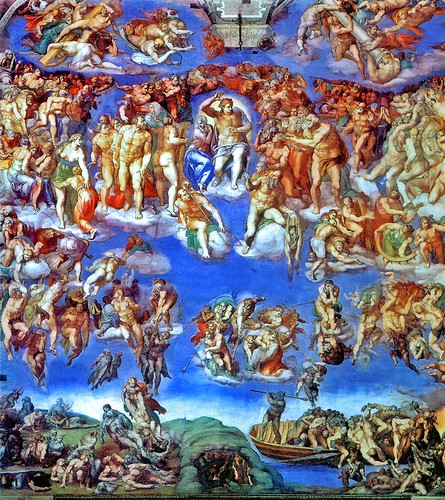 I know it looks like I'm shilling for Fr. Barron, but I got an e-mail from a Salesian about a popular book about hell by an evangelical preacher named Rob Hill. I Saw that Padre Steve put this video up on Da Mihi Animas about Hill's book and figured it was my cue to weigh in myself. I will eventually; I'm in the middle of reading the Pope's latest volume "Jesus of Nazareth: Part 2," and will comment on that first. Until then, Robert Barron's thoughts on the subject.
Friday, April 1, 2011
Stations of the Cross- The Way of Love
An online Stations of the Cross for those who can't make it to church today. There are a bunch on You Tube, but I decided to share one that just had a musical accompaniment.

Wednesday, March 30, 2011

Monday, March 28, 2011
Tips for Going to Confession

Fr. Z’s 20 Tips For Making A Good Confession
We should …
1. examine our consciences regularly and thoroughly;
2. wait our turn in line patiently;
3. come at the time confessions are scheduled, not a few minutes before they are to end;
4. speak distinctly but never so loudly that we might be overheard;
5. state our sins clearly and briefly without rambling;
6. confess all mortal sins in number and kind;
7. listen carefully to the advice the priest gives
8. confess our own sins and not someone else’s
9. carefully listen to and remember the penance and be sure to understand it;
10. use a regular formula for confession so that it is familiar and comfortable;
11. never be afraid to say something “embarrassing”… just say it;
12. never worry that the priest thinks we are jerks…. he is usually impressed by our courage;
13. never fear that the priest will not keep our confession secret… he is bound by the Seal;
14. never confess “tendencies” or “struggles”… just sins;
15. never leave the confessional before the priest has finished giving absolution;
16. memorize an Act of Contrition;
17. answer the priest’s questions briefly if he asks for a clarification;
18. ask questions if we can’t understand what he means when he tells us something;
19. keep in mind that sometimes priests can have bad days just like we do;
20. remember that priests must go to confession too … they know what we are going through.
Friday, March 25, 2011
Thursday, March 24, 2011
Roger Ebert and the Monks of Atlas
 Amen, amen, I say to you, unless a grain of wheat falls to the ground and dies, it remains just a grain of wheat; but if it dies, it produces much fruit.
—John 12:24
There has always been a tension in Christianity over how to view martyrdom. Most Christian writers and teachers over the centuries agree that it is not something to be sought after. In “A Man for All Seasons” Robert Bolt has St. Thomas More affirming the fact that our natural instincts in cases of mortal danger lead to “flight.” The saintly lawyer (no, the term is not an oxymoron) then goes over how he planned to use all of his skills as a barrister to avoid having his head separated from his body over the “King’s business.” But he concedes that a time comes when all the legal dodging and weaving can’t keep a person from standing firm in his or her faith, even if it means death, when no means of escape are available. Catholics have generally held martyrs up as examples to follow, where as some Protestants are less enthusiastic. I read a book on the early Church written by a member of the Calvinist-Reform tradition who thought the martyrs of the first centuries had, in many cases, needlessly forfeited their lives.
In the recent French movie, “Of God’s and Men,” based on true events, a community of Trappist monks in the Atlas Mountains of Algeria faces the prospect of death if they stay in their monastery. The country is experiencing a civil war, with Islamist terrorists on one side and an increasingly mistrusting government on the other. After much debate and internal dissention, the community makes the decision to stay. They have become a part of the fabric of the local village, which grew up around the monastery and stay, out of solidarity with the people. In his review of the film, which was positive overall, Roger Ebert, the Pulitzer Prize winning film critic, concludes that the monks made the wrong choice. He states that it was egoism for them to believe that their work could only be accomplished in that one place, and that their superior, Br. Christian, should have had the humility to lead his men to safety. If they had left they could have certainly continued their fruitful service elsewhere. Because of their choice other, equally needy, people were deprived of whatever years of service they would have had left, or so goes Mr. Ebert’s reasoning.
I was taken aback by this appraisal, to say the least. I could see someone thinking the monks foolish for their decision, but egotistical and prideful? I agree that there was no moral obligation for the monks to stay; it’s questionable how much their presence served to shield the village from the violence enveloping the country. But I believe that Mr. Ebert makes an error in focusing on the importance of the work the monks did, particularly that of the one who is a medical doctor. They are Trappists, and their vocation is to prayer and their goal is a contemplative union with God. Their call is to be an eschatological sign; a sign of the world to come. The life of prayer, radical poverty, and fraternal union that they follow is meant to be a prophetic action pointing to a reality beyond this one. That they may tend to the sick and cloth the poor are a natural extension of their baptismal vocation, but is not at the heart of the life they were called to as contemplatives. Their value, for lack of a better term, is not in what they do but rather in that they are.

On a deeper level the humility that all Christians are called to, but especially priests and religious, is to understand that the work we take up is not our own. Ultimately the responsibility lies with God. We come, we serve and then we move on; eventually we die and it’s the Holy Spirit that supplies the rest. This is exemplified in the Acts of the Apostles. St. Peter, the chief of the Apostles, is invisible after the fifteenth chapter and the book ends without any mention of his or St. Paul’s fate. This was the author’s way of letting us know that as great as these two pillars of the Church were, the success of the mission didn’t lie in their efforts or end with their deaths, but continues still in the work of the Holy Spirit active in the Church as a body.
This does not mean that the monks didn't bear a serious responsibility for their actions. God’s will must be discerned and cooperated with, and just because the monks concluded that His will was for them to stay doesn’t mean they necessarily got it right. We pray, discuss, bring it to authority if we must, and pray some more, them make a decision. Only time will tell if we are right or wrong. In the case of these monks they believed, after deep discernment, that they were fulfilling their vocation to be signs of God’s Kingdom in a concrete way, in a place where that concept's meaning had been perverted by hate and violence. I don't see that as egotistical or prideful.
Mr. Ebert is right, in that the movie itself avoids some of the tougher questions that could have been asked about the political situation that led to the turmoil, such as the legacy of French colonization. It could have also taken a more critical look at the monks own motivations for staying. There is no doubt that the ones who want to stay are presented as the “good guys” and the ones who want to leave are held in somewhat mild contempt, until they “see the light.” But in judging the real life situation to conclude that they made the wrong choice on moral grounds is hard for me to accept. As I wrote earlier, if they had left I don’t believe they would have been accused of moral cowardice. But I don’t believe we would be writing books or making movies about them either. In a world where justice is dispensed from the barrel of a gun, to quote Mao, and our worth as people is too often based on what we can do or earn, these men have captured people’s imaginations because they didn't do the willful or practical thing. Because they chose to allow themselves to die, like the proverbial grain of wheat, these men have bore spiritual fruit, arguably beyond what they could have accomplished by pulling up steaks and moving somewhere else.
Subscribe to:
Posts (Atom)