Sunday, February 6, 2011

The King's Speech: Part Two

The Real Princess Elizabeth (future Elizabeth II), Elizabeth, Queen Consort, King George VI and Princess Margaret on VE Day, 1945
As I was watching The King's Speech the one question that kept on coming back to me was, do people get it? While the story focuses on Prince Albert's relationship with his speech therapist, the underlying problem that forces him to seek therapy to begin with is the Abdication Crisis that would drive his brother Edward VIII from the throne.  Edward as King was also Supreme Head of the Church of England, and was forbidden constitutionally from marrying a divorced woman whose spouse (in this case spouses) were still alive.  I was wondering how contemporary audiences would process this.  In the United States we have had a divorced, remarried man whose former spouse was not only still alive but quite in the public eye, as president.  In fact we celebrate his birthday today.  His name was Ronald Reagan (his ex-wife, actress Jane Wyman, had a successful television show during his presidency).  Presently the State of New York has a newly minted governor who is divorced and living in the governor's official residence with a woman not his wife, not even civilly. I could see people shaking their heads and saying, what's the big deal about who he wants to marry, or sleep with for that matter? It's his life isn't it?  What does it have to do with being a public official?

The real Lionel and Myrtle Logue in 1906
Since the producers have King George as the hero this time out the above tack wouldn't have been helpful.  One controversy about the movie is its highly negative portrayal of the Duke and Duchess of Windsor, with some historians saying it went little too far.  The film makers concede to the exaggeration charge, explaining it as a dramatic devise that sets them in clear contrast with our heroes.  While Wallis Simpson's marital status is brought up, more serious objections arise over possible affairs that she may have been having at the time, include one with an official of the Third Reich.  Both are characterized as pleasure seeking and self centered, little concerned with their duties and responsibilities.  This brings me back to the original question, do people get it?  I'm writing not primarily about the social convention and religious principle at work in the abdication of Edward, but in the deeper questions about duty and responsibility.  In our contemporary, therapeutic culture, what is most important is individual self realization.  In this light the greatest responsibility we have is to ourselves and our personal happiness and fulfillment. The Duke and Duchess could just as easily be cast as heroes of nonconformity and revolutionaries who helped break down out dated social norms.  To make King George's dilemma relevant for the modern viewer it was important to find some personal, "human interest" angle.  Simple fidelity to duty just wouldn't suffice.

Wallis Simpson and Edward, Duke of Windsor

The solution found in The King's Speech is to turn the meetings between "Bertie," (the King's nickname) and Lionel Logue into counselling sessions as opposed to elocution lessons, with the therapist trying to dig out the crisis of his client's childhood.  Louge sees the greatness within Bertie, and even surmises that he's seeking his help because he does indeed secretly want to be king in place of his brother.  Why shouldn't he? He's good enough, he's smart enough, and doggone it, people like him!  The theme of duty to country is not absent from the film, but there is this sense that this alone was not going to capture the imagination of today's audience.  They had to come at it with therapeutic themes of self realization, of the little guy overcoming his fears and anxieties (even if he is a fabulously wealthy member of the Royal Family) for people to be touched by it.

What's lost here is that the real George VI, against his own desires, fulfilled his duties while Edward put conditions on service, ultimately walking away at a moment his country needed strong leadership the most.  Both men could be cast as heroes using the "therapeutic method," depending on what aspects of the self actualizing ethic you wanted to accent.  But only one is a hero when selfless duty is made the standard, and I'm afraid it's not the Duke.  As an American I can't identify with the Divine Right of Kings, but as a Catholic Christian I can connect with the notion of God's call that asks that we put personal desires, even legitimate, deeply held ones, aside for the greater good.  This ideal of self sacrificial love goes back to the Master Himself, who gave up his life on the cross for the life of the world.  I don't claim to know the heart of either man, but one, at least on the surface, lived fully the call to service he was born to, if not by a Divine right, then by a Divine call.

That The King's Speech follows the more contemporary, Oprahfied approach does not change my opinion.  It is a well crafted film that I think is Oscar worthy. I wouldn't punish it for being a product of its age. I guess I'm just a hopeless romantic who would like to see a return to the days when duty, self sacrifice and courage were as honored as feeling good about yourself.

Saturday, February 5, 2011

The King's Speech: Part One

The King's Speech 
OOOO
Rated R for some use of strong profanity

When I was a cleric working summer camp out in Newton, New Jersey we had a display case in the main office that housed all the trophies that were going to  be given out for excellence in the various activities we offered.  Small trophies were given out weekly, but the ones that got most of the attention from the campers were the large year end awards.  The most coveted of these trophies was the Camper of the Year Award.  It wasn't uncommon to have a kid stand in front of the case on the first day of camp saying to himself, and sometimes even out loud, "I'm gonna win that sucker this year."  Then he would spend the following five weeks hitting as many activities as he could, volunteering for every skit, making sure he was an altar server when it was his cabin's turn, helping unload delivery trucks, setting up and breaking down activities, shinning shoes, peeling grapes, and generally sucking up to any counselor with a vote.  Sometimes this strategy backfired when the youngster's naked ambition was so obvious; I mean no one likes a brown nose.  But often you had to give it to him simply because, by gum, the little noodge set a goal and persevered, even if his motives were less than noble.

The Kings Speech, which has been nominated for Best Picture, is the cinematic version of that kid in front of the trophy case.  From the opening credits it's practically screaming for that little gold statuette.  You have all the usual suspects assembled to insure success;  A supporting cast that includes veteran British and Australian actors Helena Bonham Carter, Geoffry Rush and even that old Shakespearean stand by Derek Jacobi.  Colin Firth takes the lead, giving a performance the Academy stumbles over itself to award: his character has a disability (speech impediment), is haunted by childhood scars (mean nanny, disaffectionate  father)  in need of overcoming his insecurities caused by the above issues and cruelly exploited by his dashing older brother (The Man keeping him down).  It's an underdog story all the way, that dares you not to be touched. The period costumes and scenery are picture perfect and cinematography flawless.  Throw in that it was made in cooperation with the BBC, and you don't have to wonder that the movie oozes class.  There is no doubt in my mind that from the first moment the idea for this movie was born in the producers' heads they stood in front of that imaginary award case in their minds saying, "I'm gonna win that sucker this year."  And you know what? I say give it to them.

2010, in my humble opinion, was a down year, quality wise, at the movies.  While I have not seen all ten movies nominated this year, the ones I did see left me underwhelmed.  It's true that The King's Speech is not particularly innovative, and in many ways is rather predictable. Nonetheless it is a well crafted and well acted movie.  And it is touching.  I hated myself for being so touched, because I knew they were putting me on, and I didn't care; they did it so well.  My favorite scene is a very small sequence in the film, where Prince Albert, having just assumed the throne after his brother's abdication, goes home as King George VI and meets his daughters.  It's already established that he is an affectionate, loving father.  But when he meets Princesses Elizabeth and Margarete for the first time as king, they stand far off, with the future queen reminding her sister to curtsy before they address him, quite earnestly, as Your Majesty.  I felt heart broken for the man, since he never wanted the crown and its responsibilities, and now it had built a wall between himself and his own children.  Manipulative? Yeah.  But effective and well done.

The only flaw, and it is a minor one, is the actor they chose to play Winston Churchill.  To be honest at first I thought he was trying to do Charles Laughton, and failing miserably.  Out side of that one point, The King's Speech does everything else right.  And why not? It set a goal for itself and certainly tried hard enough to achieve it.  So just give the little noodge his trophy already.

Friday, February 4, 2011

Random Notes, 2/4/11

Egypt
It's hard not to get caught up in the events of the past week.  In many ways it reminds me of the fall of the Berlin Wall, in the sense that things are moving so quickly that it's difficult to keep track of things and understand their meaning.  It's also similar to he events of 1989 in that the unrest in Egypt is a part of a wider movement that began in Tunisia and seems to be picking up in Yemen. Where it will stop no one can guess.  The big difference, of course, is that the fall of the Eastern Block came about through the efforts of a democratic movement resulting in the fall of dictatorships and the rise of free nations.  What will happen in the Middle East is far from certain.  Iran, all those years ago, deposed a dictator but replaced him with a repressive theocracy.  We may all agree that Hosni Mubarak is no friend of liberty, but is his immediate ouster the best course for Egypt and the wider Middle East, and for the world at large?    

The Church generally does not support revolutionary movements, for the reason that they are usually violent, bloody and leave the country in question worse than before.  There are also other reasons that have to do with the Church's traditional views on earthly authority and its origins in Heaven.  But more recent pronouncements on the subject have tended to focus on humanitarian concerns.  This does not mean that the Church opposes changes in government and civil structures.  It's all in the way that it comes about.  It is well known that Pope John Paul II worked behind the scenes, as well as in front of the crowds, for the fall of communism in Europe.  But what he was advocating was change from within, done in a peaceful, just manner. Of course that "change from within" also included the personal conversion of the individuals who make up the body politic.  He opposed the revolutionary movements in Latin America because they were violent, with some even using the Gospel to advocate violence.  He knew that all the communist rebels were going to do was replace one oppressive regime with another.

I hope this is not the case in Egypt, but my hope is not strong.

I've begun to read a short work on the book of Revelation, and while it is timely to the topics of today, I'll wait before moving my reflections of world events into that direction.

On A Lighter Note: A Strange Coincidence

It was pointed out to me that since we are in the year 2011 there will be a lot of fun with dates and playing with numbers, like January 1 could be written 1/1/11 and in November we'll have 11/1/11 as well as the granddaddy of them all 11/11/11.  Not that I'm into numerology and such things, try this little trick at home:

Take the last two digits of the year you were born and add it to the age you will turn during this calender year, and see what it comes out to.  It should come out to the same number for anyone born in the last century. 

New Jersey's School Holidays

The New Jersey Department of Education just released a list of over a hundred and twenty religious holidays that a student could be excused from school for.  It represents a "minimum list" of holidays, and individual schools boards can add to it as they see fit.  All the major religions are there and even some not so major; even Wicca (are you a good witch or a bad witch?).  But clearly we have a problem.  Catholic feasts like the Immaculate Conception are lumped together under a generic "Christian" label.  Even the Orthodox get a separate mention for the Dormition of the Theotokos, which corresponds to the Assumption.  I mean, why should the Baptists get a day off for a holiday they don't even believe in?  (Nothing against Baptists, I love them dearly) Why should they ride on our coattails?  I mean, you don't see us taking Reformation Day off, do you?  The ACLU is going to hear about this! (OK, maybe not.)

Saturday, January 29, 2011

Fr. Barron comments on "True Grit" (SPOILERS)


A different take on "True Grit" from Fr. Robert Barron.

The Rite

The Rite O
(PG-13) for disturbing thematic material, violence, frightening images, and language including sexual references.

Oh, January, that cinematic landfill where Hollywood dumps movies they know are awful before they even roll the credits on the first preview. The newest entry in that long proud tradition is The Rite, an exorcism tale that hit the big screen this weekend.

The problem right off the bat with this well intentioned mess is that it gets its background all wrong (please don't let the "inspired by a true story" thing fool you).  Movies about police departments, the military or the legal system will go to lengths to achieve realism.  Directors and actors doing war pictures have been known to go through a truncated basic training, getting to know how a soldier operates in the field.  They'll at the very least talk to military people, past or present, to try and get it right.  Spielberg even had Holocaust survivors on the set on Schindler's List so their experience wouldn't be misrepresented.  No movie gets it all correct, and even last year's best picture winner, The Hurt Locker, took flack for alleged inaccuracies in its presentation of an army bomb disposal team.  But there is such a level of carelessness and ignorance in dealing with the Church and the priesthood in movies that it staggers my mind.  What's sad is that The Rite is actually sympathetic toward the priesthood and the idea of a divine call, and that it gets so much wrong is disheartening.

The story follows Micheal Kovak (Colin O'Donoghue) who enters the seminary because of family pressure (plausible if this was 1951, or maybe if we were in some parts of the developing world today, but not in the contemporary United States).  He goes, planning on ditching right before making his "final vows" that make him a priest (professing vows do not make you a priest, ask any nun you happen to run into.  In fact diocesan priests don't take vows at all).   Four years later a priest / mentor is concerned when Michael passes his psychology and sociology finals but fails theology (that would be like saying a law student failed "law" but passed British literature; it makes no sense.  By the time a seminarian gets to the seminary he's specializing in theology and studying its various branches, not taking "core classes" like an undergraduate.  In the same way a law student studies torts and copyright law, among other things, and not law in some generic form).   Michael tells the priest of his doubts and he sends the young man off to Rome to take a class in exorcism, hoping it will shake him out of his unbelief (I'm not even going to go there, it would take too long).  Once there he's sent to see Fr. Lucas (Anthony Hopkins) a reclusive Jesuit and experienced exorcist.  Michael is sceptical, which is all well and good, but his unbelief endures longer than is reasonable.  Fr. Lucas correctly states that the prayers of liberation can take weeks or months to wear the demon down and defeat him (I've even heard years), but Michael, at the end of the film, is able to accomplish in an evening what Fr. Lucas couldn't get done after months of effort.  I won't go through every problem with the film, it would take too long, and yes, it's Hollywood, and they're making a dramatic film, not a documentary.  But getting some details right would be refreshing.

This particular sub genre of horror film is different from pretty much all the others because it's dealing with something that's real. It's rare, to be sure, but real all the same.  We had an exorcist speak to us one afternoon during a spiritual theology class (my lone exposure to the topic in 13 years of formation, outside of a couple of books I read on my own) and he said he had performed three exorcisms in his 15 years on the job.  Most people have some psychological problem that demands therapeutic or pharmaceutical treatment.  But the power of the Evil One is real and not to be taken lightly.  The movie weaves between reverence and humor in a way I don't think was always intentional.  It takes a low key approach to the scenes of possession when compared to the granddaddy of them all, The Exorcist, which did go over the top.  But it's also less informed on it's topic, never bothering to go into the causes for demonic possession which, when taken into account, make the final plot twist implausible.

The movie's only saving grace is its positive portrayal of the Church, the priesthood and faith in general, which I didn't take as a put on.  The priests were sympathetic, but human as well.  While it tried to present compassionately the struggles a priest goes through, it still can't compare with the Exorcist in that regard, especially William Peter Blatty's novel.  The Rite presents a Catholic Church that simply doesn't exist in the real world.  As much as I'm glad Hollywood was friendly this time, I wish they were also right.

Monday, January 24, 2011

Who Knows Where the Time Goes

It's hard to believe that it's been over ten days since I last posted something here.  When I say it's been busy, I'm not making some vague generality.  A parish normally quiets down after Christmas with the lull lasting until Ash Wednesday.  Then it's breakneck through May, what with confessions, Lenten programs, the Easter Triduum itself, 1st Communions, Confirmations, the backlog of infant baptisms that have to wait until Lent is over, the spare wedding here and there.  Summer brings another lull of sorts before September when school and religious ed begin again and it's a blur until Christmas. But nothing stopped after Christmas, and now January is almost gone and I'm not sure where it went.

There are a lot things I would have liked to have done this month, especially considering the feast of Don Bosco is coming up next week (never mind that today is St. Francis de Sales' feast day).  Francis de Sales in many ways is a key inspiration for me in working on this blog.  He wrote an incredible body of work, much of it in simple pamphlet form, to convince people of the truth of the Catholic faith during the Counter Reformation.  While these works might be considered polemic in the sense that they addressed controversies, defending the Catholic position staunchly, St. Francis was the Doctor of Charity who understood that it was not bombs or guns that would bring the separated brethren back into the fold, but loving kindness, as well as passionate and intelligent apologetics. I hope to follow in that tradition in some small way.


But the time has been a dictator, as Nina Simone would say, and I haven't had the time or the energy to put my full efforts into this space.  But I know I need to get focused, and the best way to do that is by developing a theme over a series of posts, and I've got one (but I don't want to let the cat out of the bag just yet).  For the rest of this week I'll write more on Francis de Sales and Don Bosco in preparation for the feast, and then on to a topic that I've been mulling over for quite some time.


But time; what a mystery.  I offer you all one of the great songs on the topic of time and change, by Fairport Convention, with the late Sandy Denny on vocals.

Wednesday, January 12, 2011

Black Swan

Black Swan
MPAA: Rated R for strong sexual content, disturbing violent images, language and some drug use.
Catholic News Service Media Review Office: O (morally objectionable)

In my quest to catch as many movies that will be getting Oscar nominations as I can I took time out of my R&R and saw "Black Swan."  Normally going to the movies is a part of taking a break, but this time it was work.  This is not a film that I would usually go and see.  Of the roughly twenty people at the midweek matinee I attended, I was one of three men.  It looked like the others were brought by their significant others, so I'm guessing that I'm the only man who went of his own accord.  But what made this movie work for me wasn't that it's a film that appeals to women more than men, but in the morally confused compass that guides it.

From the beginning it's clear that Nina (Natalie Portman), an up and coming ballerina, is a basket case.  She's living claustrophobically at home with her overbearing mother (Barbara Hershey, reminding me ever so slightly of Piper Laurie in "Carrie"), she has a history of self mutilation, is repressed, passive, and lacks any self confidence (which makes me wonder how she got as far as she did in such a competitive field). Her director (Vincent Cassel) acknowledges her technical prowess, which makes her perfect to play the "White Swan" in Swan Lake but complains she doesn't have the passion to play the seductive "Black Swan."  But she unwittingly changes the director's mind by rebuffing his romantic advances with a well placed bite, revealing the fire just below the surface. 

But in winning the role she so covets poor Nina's problems only get worse.  She has competition from a sultry newcomer (Mila Kunis), who may not have Nina's skills but possesses the passion that makes her perfect for the Black Swan. She feels guilt over replacing the company's aging and self destructive star (Winona Ryder, in a bit of art imitating life).  She also descends into what can only be described as paranoid schizophrenia, at the very time she takes the director's advise to free herself through sexual experimentation.  She sees people who aren't there, her mother's paintings take on lives of their own, and the viewer begins doubting what is real and what is a product of Nina's increasingly deteriorating mind. 

A point the movie seems to be making is that true freedom and self actualization comes from the elimination of inhibitions and indulging in unfettered sensual pleasures.  Obviously, I don't agree with that, but the movie itself seems to under mind its own point, with Nina's increasing self actualization being accompanied by increasing levels of insanity.  After all the barriers are knocked down Nina indeed dances the ballet of her life, but at quite a cost.

In one of the literature courses I took in college the main character of a book we were reading had a transformation from a shy milquetoast to a rather bold assertive fellow after his first sexual encounter.  The professor explained that the author was trying to say that we don't become fully human until we engage in sexual activity, an opinion she concurred with.  My initial thought was:  Mother Teresa, John Paul II, Therese of Lisieux, John Bosco, oh yeah, they never really actualized themselves as human beings, did they?  "Black Swan" makes the same mistake my professor did all those years ago.  Being human is more complex than we understand, and while our sexuality is an important part of what makes us who we are, the contemporary mind has exaggerated its place a bit.  The people I mentioned above had great passion, and lived their human lives to the fullest even though all were life long celibates.  They found themselves by giving themselves to others in selfless acts of love.  Mother Teresa's writings reveal a woman of tremendous passion, but it was not focused inwardly.  It was pointed out to the world in the service of others.  Any other path leads to self absorption, and possibly self destruction.

To be fair Nina's transformation involves more than just a sexual awakening, and it is important to learn how to get up on your own two feet and stand up for your self.  But the movie, always dealing in extremes, has Nina embrace a total will to power.  Her coming of age is won after a totally unapologetic pursuit of her goals that tolerates no rivals.  She becomes completely focused on what she wants and is even willing to kill for it.  In the end I'm guessing the film makers want us to see Nina as a heroine.  I couldn't help but see her as a tragic one, destroyed by the very journey of discovery and self realization that was supposed to save her.

I would be amiss if I didn't mention the "strong sexual content" that the MPAA alerts viewers to.  I'm going to save a fuller exploration of sex in movies for a later post, but for now I'll say it is pretty strong stuff.  Nudity is avoided, but not much else is left to the imagination.  It strikes me that if the material is strong, you don't have to resort to explicit content.  While I don't agree with the world view the film puts forward (if it even has one), the material is strong enough, the performances good enough, that they didn't have to resort to shock.  But as I wrote, more on that later.

Monday, January 10, 2011

I Stand Corrected

In my review of the new Narnia movie I questioned how Susan and Peter, the elder Pevensie children, made it over to the US in the midst of World War II.  I have it on good authority that there was a wartime program of bringing children to the US to escape the Blitz.  One review I read later explained that as young adults the two had some service related jobs that brought them to the States.  Either way their transatlantic journey was not implausible as I first imagined.

Thursday, January 6, 2011

The Chronicles of Narnia: The Voyage of the Dawn Treader

Chronicles of Narnia: The Voyage of the Dawn Treader
OO 1/2
Rated PG for some frightening images and sequences of fantasy action. 

I am at a distinct disadvantage walking into any Narnia movie because I haven't read the books by C.S. Lewis that the films are based on.  Or maybe that's a good thing, since I can review the movie on it's own terms without nitpicking over whether they included every detail from the original stories.  This is not just idle chatter on my part, because if the new Narnia movie (Chronicles of Narnia: The Voyage of the Dawn Treader) falls short of it's predecessors, as I believe it does, it might be because they tried to include too much.  From the little I have read, of the three this film is the least faithful to its original text, and considerable simplifications were made. But the plot still takes too long to come into focus as they seemingly tried to cram as much as they could into a tween friendly 115 minutes.

The story begins with siblings Lucy (Georgie Henley) and Edmund (Skandar Keyens) living out the final days of World War II with their uncle and aunt in Cambridge while their older brother and sister are off in America (how they got there safely in the midst of the War is a mystery to me, but I'll let that one go by). The returning characters are joined by cousin Eustace (Will Poulter), a budding skeptic who has no patience for his cousins' talk of Narnia and other fairy tales.  Even after he gets swept into the fantasy world by way of a magical painting he doesn't believe what's happening is real, concluding it must be some perverse trick.  Ben Barnes returns from the last film as Caspian, though he's lost his mixed up Spanish-Eastern European accent and speaks as a Englishman.  They are now at sea, though the purpose of their voyage remains a bit murky. 

Since explaining the plot briefly is impossible, I won't. The problem with the story in general is that it takes too much time for the movie to decide on its objective.  We go through about three false starts before our intrepid adventures figure out what it is they were brought back to Narnia for. This was a bit frustrating, because just when it gets my imagination going, the film switches gears and moves into another direction.  Just as the action heats up, it stops abruptly to give us more exposition to set up the next episode.  It's not until the last third of the movie that things really begin to get going, and then it ends. 

That said, I'm recommending the movie, especially for younger teens.  There are solid lessons to be learned about courage, loyalty, resisting temptation, and self acceptance.  The action is solid, especially in the climactic sequence.  The returning actors know their roles, but don't seem bored by them.  While out side of Cousin Eustace there aren't any new characters to speak of, there is a clear passing of the baton that sets up the pictures to follow.  Does The Dawn Treader pale in comparison with the first two movies?  Yes it does.  But on a rainy afternoon it's worth the ride.  I just hope next time they trim the sails a bit.

Monday, January 3, 2011

Pizza and Wings

I hate decorating for Christmas.  Call me Scrooge if you will, but it just seems like a colossal waste of time and energy.  I don't mind Christmas decorations, mind you, I just don't want to be the one to put them up. Bah! Humbug!  So after wasting most of the Advent Season I got one of our parishioners, a young man who used to work in the office, to help me drag the artificial tree down stairs and decorate it.  It was just a few days before Christmas, and he came by after work.  After we got that and the Nativity scene set up and lit, we went out for pizza and wings. We were met by another of our intrepid youths.  Both guys are in their mid twenties, one got married this past spring and the other has been seeing a young lady for the last few months.  I'll call them Steve and Eddie, because they actually read this blog from time to time and I don't want to embarrass them.

After we settled into Michelino's, a pizza place up the street from the parish, Eddie, the newlywed, began peppering me with questions.  "What do you think of Fr. Benedict Groeschel?" "Do you believe Jesus really rose from the dead?" "Have you ever watched Fr. John Corapi?" "Do you really believe in the True Presence?"  These questions, and some others, weren't asked in an accusatory way.  It was more like a boxer feeling out an opponent in the early rounds of a fight.  He was trying to figure out who I was and what I was about (even though we had met years ago at a Salesian leadership retreat).  I've been blessed to have been to many talks and retreats given by Fr. Benedict, and admire him greatly.  I'm not as familiar with Fr. Corapi, but have caught his TV programs and radio shows, and like him as well.  As for the doctrinal issues, my only answer was that I wouldn't have given up marriage and family for a myth or a metaphor.

Eddie seemed relieved in a way at the answers I gave.  He said that I was one of the few priests he knew who held such "by the book" beliefs.  I was saddened to hear that, actually.  I don't consider myself too far in one direction doctrinally.  I'm not pushing for a Tridentine Mass to be said in my parish, though I have nothing against it.  There are people who think I should get more worked up over Catholic politicians who don't let their faith influence their politicking.  I tend to avoid controversy, really.  My forays into controversial topics here has been pretty limited, actually.  But there are certain basics we must hold to; such as the True Presence of Christ in the Eucharist, the bodily resurrection of Jesus, the supremacy of the Pope, devotion to the Blessed Mother, and the Virgin Birth, the great mystery we celebrate during the Christmas Season.  If not what is the point being a Catholic?

On a personal level, the answer I gave about living chaste celibacy for the sake of the Kingdom wasn't just some flippant remark.  If Jesus didn't really rise from the dead, if it was just some "spiritual" return, or a group hallucination, or, worse yet, a fabrication, than any sacrifice we make, even the smallest, is a waste of time, never mind the putting aside of family life.  It is that Jesus is Lord of life with power over death, the Bread of life that gives us his very self by way of the sacraments that makes the vows poverty and obedience, as well as chastity, worth living.  That Jesus' message of repentance and mercy needs to be preached to a new generation is what gives purpose to sacrifices religious and priests make.  That Jesus was an historical person, who lived at a particular time in a particular place; that the events of his life were witnessed to and handed down in both written and spoken form;  that his death had a special significance beyond that of other deaths; that his death did not end with the grave but in resurrection in a body, both glorified and tangible;  that we are destined for that same resurrection is the foundation of the faith.  Without it let us eat, drink and be merry, for tomorrow we die.

If I am one of the few "by the book" priests out there (and I know that there are a lot more than just me), then we can see why the vocation crisis is so deep.  If priests are skeptical about the basics of the faith, who will actually see the priesthood as something to aspire to?  If the Mass is just a memorial in the ordinary sense, why sacrifice to be able to celebrate it?  Young people do have generous hearts, but they want to give themselves for something real, not a fable.  If we don't believe it's real, they aren't either, or else they will believe in the truth but not in us as credible ministers of God's Word and sacraments. Either way we shouldn't wonder why so few are following in our foot steps.

Saturday, January 1, 2011

Snowy Day, Dream Away

First off I want to wish all of you a happy, healthy and prosperous New Year, filled with all the Lord's blessings.  It wasn't my intention to take over a week off from the blog, but since the passing this week of Fr. Hector Poulin, SDB most of my time was taken up with helping to coordinate the funeral arrangements.  This was Fr. Hector's last assignment before going to St. Philip's Residence in Tampa, Florida.  He had been suffering from Alzheimer's, and Fr. Pat Diver, my predecessor here, had done God's work caring for him until he needed more specialized care.  So we had the funeral here at St. Anthony's yesterday, New Year's Eve, with the burial up at our cemetery in Goshen, New York.  But I did start on a reflection on the weather before things got too crazy, and  here it is:

The best laid schemes of priests and pastors oft get buried under 31.8 inches of snow.  Last Sunday, the day after Christmas, I waited out the storm here in Elizabeth, hoping to get out Monday.  The last time I tried to beat a winter storm to New England I ended up right in the middle of it, crawling a long at 15 miles an hour, barely keeping on the road.  So I hunkered down for the night.  The next morning the sun was out, even if the birds weren't chirping, so I figured I could make my  get away.  I shoveled a path from the garage to the street and I tested out our new four wheel dive Honda.  Not that I'm trying to sell you cars folks, but it passed with flying colors.  It was after 1PM before I got going and figured the main roads would be cleared.  Needless to say the roads, even Elizabeth Avenue, were a mess.  Added to that, every entrance to the Jersey Turnpike was clogged with semis, vans and other assorted and sundry vehicles stuck in the snow.  No matter which approach I tried, the results were the same; there was no way to get out of Elizabeth.

The story was the same all over the Metro Area;  un-plowed streets, stuck cars and mass transit shut downs.  It would be easy to jump ugly on the poor sanitation department.  If it is true that the New York City sanitation worker's union was using the blizzard to stage a labor slowdown then you'd have a gripe, to put it mildly.  But we as a people have to come to grips with the fact that the government is not bigger than the weather.  There are going to be times when even the best, most efficient municipality is going to get overwhelmed by mother nature.  This was the type of storm that happens maybe once in a generation around here.  I'm not sure if it's more correct to say that we've been conditioned, brain washed or spoiled into believing that the government is some all powerful force that has the ability to save us in every situation, and make everything right in an emergency with time to spare.  But it just doesn't happen that way.  These are human institutions that can do great good, but are also limited and fallible.  As much as we don't want to believe it, the street isn't always going to get plowed quickly, the garbage picked up promptly and, more disturbingly, the ambulance might not always get there on time.

I'm not saying we shouldn't demand that the government do its job, but to understand that it doesn't replace our responsibility to prepare ourselves and use common sense in times of crisis.  Sometimes we should just stay home (memo to self on that one) and out of the streets, and enjoy the downtime while it lasts.  Also, people out of the streets means fewer cars stalled and abandoned that makes the city's job of plowing that much tougher.

Well, that's all I have to say about that.  But there is a wider point to be made about our reliance on government and whether we've become a nation of wussies (yeah, I'm going there).  More next time. 

Thursday, December 23, 2010

True Grit


True Grit OO 1/2
PG-13 for some intense sequences of western violence including disturbing images   

Back when I saw "The Social Network" I was surprised to see a trailer for an updating of the 1969 John Wayne western "True Grit."  The question that came to my mind immediately was, why?  Is Hollywood really so bereft of new ideas that it has to go back to retread a movie that was a bit behind the times even when it came out (remember that 1969 was the year "The Wild Bunch" was released)?  I have to be fair, and state upfront that I've never been a big fan of westerns.  I like John Wayne, but was more familiar with him in movies like "The Quiet Man" and "Flying Tigers."  It always struck me that the original "True Grit" was a bit overrated, as was the Duke's performance (if he was going to get an Oscar it should have been for "The Shootist," or maybe "The Man Who Shot Liberty Valance").  I know a number of Duke fans that are probably pretty sore at me right now, but that's the way it goes, Pilgrim.

My greatest fear when I saw that trailer was that this was going to be some postmodern, Sam Peckinpah meets Quentin Tarantino, bloodfest.  I was determined not to see it, but succumbed  to the temptation, mainly because it was made by the Coen Brothers.  The 2010 "True Grit," based, as was the original, on the 1968 novel by Charles Portis, is darker than the 1969 vintage.  This is to be expected considering the team tackling the project, but its no "re-imagining."  In fact I was surprised how much of the original dialogue was left in tact (I cheated and saw the John Wayne version again to prepare myself).  The violence here is more graphic, as you might imagine, but not over the top.

The Coen Brothers' goal was to be more faithful to the book, and from what I gather that is where the main differences between the two versions can be found (not having read the novel, I have to take their word for it).  So, It's the same story as the older movie.  14 year old Mattie Ross hires U.S. Marshall Ruben "Rooster" Cogburn to chase after her father's killer, Tom Chaney, who has escaped into Indian territory, and is thus out of reach of the local authorities.  They're joined along the way by Texas Ranger La Boeuf (pronounced La Beef) who wants to bring Chaney, who goes by several aliases,  back to Texas on a separate murder charge.

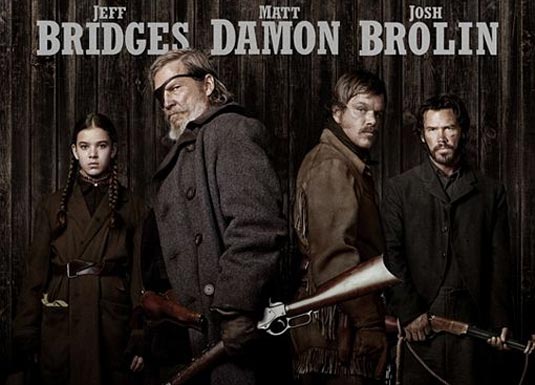
Jeff Bridges has the unenviable task of following the Duke into Rooster Cogburn's eye patch, and takes the sure road by moving the character in another direction.  Rooster is still a surly drunk, but he allows his face and eyes (I mean eye) to do more of the talking.  Any one is an improvement over Glen Campbell, who was shockingly awful as the La Boeuf  the first time around. In his place Matt Damon brings humor and, at times, his best Matthew McConaughey impersonation to the show.  The real revelation is young Hailee Steinfeld in the role of Mattie Ross, the 14 year old girl seeking to avenge her father's murder.  She has good presence on the screen, and comes off as smart, naive, tough and innocent all at the same time.  Not an easy task for an experienced adult actor to pull off, let alone an adolescent of any kind.  Josh Brolin, who plays Chaney, has very little screen time for someone who got his name listed above the title.  While he does what he can with the little screen time he has, he's not even the most interesting villain in the movie.  That distinction has to go to Barry Pepper who plays the leader of a gang Chaney has joined up with.

The Coen Brothers are talented film makers, and "True Grit" is very well made.  While the film displays their trademark use of light and dark, comic and action timing and a generally engaging visual style, I found this a very straight forward movie, which is a change for them.  This is possibly because they weren't looking to reinvent the wheel this time out, as much as grease it up a bit. 

For all my reservations walking in, this ended up being a movie I wanted to like and recommend.  It was slow in parts, but the Coens always seem to bring you back to something interesting eventually.  Through it all the question that came back to me was why was this movie made to begin with?  I won't spoil the end, which differs in some specifics from the original, but to say we get to see Mattie as an adult.  We see the consequences of her journey, and I could only wonder if it was worth it.  Roger Ebert and the late Gene Siskel use to always criticize films that used children in danger as a plot point.  They felt it was cheep and exploitative.  This doesn't exactly fall into that category, but Mattie sees and does things that no 14 year old should have to.  In a sense we see her innocents taken from her before our eyes.  There is no way that the physical and emotional scars she experienced didn't change her, and not for the better. The ending doesn't take that into account, one way or the other.  The film makers never ask the deeper questions, which is a missed opportunity, really.  Unlike most Coen Brothers movies I can think of we have the style, but it's not serving any real purpose.

I've started giving these "hallow" ratings, which is all a bit of a lark, to tell the truth.  But I actually had trouble deciding on a number rating for "True Grit."  The production values, the acting, the cinematography, the writing are all of the highest caliber.  But the lessons are murky, if at all, and that's a shame.  In a world ruled by violence and the will to power, "True Grit" seems to be saying that revenge is its own reward, no matter the cost.  In my book no amount of movie magic can make that right.  While I'll be rooting for Ms Steinfeld to get a nomination for best supporting actress (you could even argue best actress since the story is told from her perspective), I'll be hoping the Coen Brothers return to deeper waters the next time out.

Monday, December 20, 2010

Vocation Talk III

In wrapping up this series on vocations, it's important to acknowledge that God's call is a mystery that unfolds over time.  There may be a moment when we get a flash of recognition that points out for us the direction we should go.  But if we actually sit down and think about our life we can see how the Lord was preparing us for that moment of decision.  Some people don't get there because they've never been open to this idea that God is calling them to something.  Perhaps they've never had guides or mentors to help them.  Maybe they simply have never been evangelized properly.  It could be that they've accepted uncritically "the spirit of  the world" that tells us that our lives really have no meaning beyond what we decide as individuals; there is no need to reference anything or anybody outside ourselves, let alone God.  Worse yet are those who try to turn someone away from following a vocation, especially to the religious life or priesthood.  There may be the need to ask a person to wait before actually entering a formation program, especially if there are questions of maturity involved.  But to try to sabotage a vocation is a grave offense.  It is a denial that the vocation is God's, not ours, and needs to be treated like a gift that should not be obstructed, rejected or ignored.

While those who maliciously hinder someone from following their vocation have put themselves in a grave moral situation, those who have the call also have a responsibility to be open to where God is leading them.  This gets us back to my original point from the first post on this topic.  It is true that Don Bosco's belief that those who do not follow their vocation are going to Hell is extreme, and not the way we would present the issue today.  At the same time I'm not sure we haven't given in a little to the "spirit of the world' I wrote of above.  It's popular today to say that if we don't follow God's "Plan A" there's always a "Plan B."  God is merciful and will never abandon us to a miserable existence, but gives us all the opportunities we need to be happy in this life and be with him forever in the next, even if we don't do what he asked of us the first time around.

I don't disagree with this proposition, actually.  I do believe that God gives us more chances in life than we realize, even if we don't follow His so called "Plan A."  But our spiritual journey involves surrender to God's will.  This means that we put aside our own desires, wants and aspirations, pick up our cross and follow Christ where He leads us.  In doing this we end up fulfilling ourselves and using those gifts and talents we've received in a deeper way than if we had followed our own desires.  But if we say no to God the first time, will we have the spiritual wherewithal to say yes to "Plan B," "C" or even "D"?  It doesn't matter what we opt for, in the end life in Christ means self denial and submission to His will.  If we fail to do that then the question we need to ask is what kind of purgation are we preparing for ourselves.  If "No" has become the default position of our lives, than yes, I believe the eternal consequences may be even worse than a stretch in purgatory.

I have to state clearly that I reject any proposition that turns salvation into a formula and doesn't allow for God's mercy to breath.  I reject any doctrine that says "If you do A, B or C Heaven awaits, and if you do D, E or F Hell is a certainty." God's grace and mercy is greater than any theological formula.  But if we have set our lives on a course away from God's will we put ourselves in grave danger. The farther we move away from God the more difficult it is to steer ourselves back.  The more we become use to doing our own will without reference to a Divine call or standard the more it becomes a habit that proves harder and harder to break.  We may not always perceive God's call perfectly.  We may not even fulfill it perfectly.  We may have to struggle with pride and selfishness as we grope along the path of life.  But as long was we are moving with God, in the right direction, He will lead us home safely.  As long as we remain attentive and open, then we will be ready to see the other possibilities he has in store if we did pass on God's primary vocation for us.  But no matter the road we end up walking, it will always lead through Calvary first before bringing us to the Empty Tomb.

Sunday, December 19, 2010

The Fighter

The Fighter OOO

Rated R: officially for profanity, drug abuse and boxing violence. There is some mild sexual content, at least as mild as R rated movies go.

I must admit that I broke my number one rule in preparing for a movie review, which is not to read other notices before seeing a movie I intend to critique. I didn't read the entirety of Kyle Smith's review of "The Fighter" in the New York Post, and still haven't, but did see the first line as I was cruising through the website the other day.  He wrote, "Pity the boxing movie that thinks it can be both 'Raging Bull' and 'Rocky.'"  While I liked the movie more than Smith, that line kept coming back to me while watching the new Mark Wahlberg, Christian Bale vehicle.  For a moment I thought the quip was my original thought, but quickly realized that it was too good a line and must have come from somewhere else.  While the insight isn't original, its nonetheless true. "The Fighter" does try to play it both ways: it wants to be a gritty and realistic character study of self destruction and family dysfunction and an uplifting underdog story with a rousing ending.  It's not a great movie, and its weakness is this playing of both themes, the result being that "The Fighter's" conflicting spirits end up diluting each other.

The story follows the misadventures of Dickie Eklund (Bale), a drug addled, washed up boxer from the fighting town of Lowell, Massachusetts, and his younger half brother Micky Ward (Wahlberg), a promising young fighter trying to make it to where his brother never did.  Micky is managed by his mother and trained by the unreliable Dickie, both of whom seem to be using rather than really guiding him.  There is a menagerie of half sisters sired by I'm not sure how many fathers, that serve as comic relief of sorts (they remind me a little of a cross between the witches from Macbeth and the evil step sisters from Cinderella).  Throw into this the always watchable Amy Adams, playing against type as a tough working class bartender, and you get an interesting mix of characters in what amounts to an opera played at the poverty line.

It's easy to like the Wahlberg character, because well, he sort of plays this same likable person in every movie.  He does it well, so I won't knock it.  Bale and Adams are clearly bucking for Oscar nominations. For her part Adams is less flashy, but very convincing in her turn as a college drop out  whose life went into a direction she didn't plan.  Bale channels his inner Robert De Niro / Daniel Day Lewis, obviously having lost all kinds of weight for the part.  I didn't recognize him at first, he looked so emaciated.  He also does one of those total immersions into a character, were the viewer forgets the actor he or she is watching, a quality that has made Lewis so admired.  He's no Daniel Day, and it's tempting to accuse him of going over the top, but in truth I've met people like this;  braggarts and posers who really have nothing to back it up on the inside.  Does he over act? Yeah, a little, but in real life all self delusional Could-Have-Beens usually do.  

Just as Bale's performance begs comparisons to others, so does the entire style of the movie.  Director David O. Russell begins in a semi documentary mode, then moves into a more conventional film language as things proceed, but he always seems to hearken back to Marin Scorsese, especially in the soundtrack.  But unlike the Master, who uses music to evoke a mood and recall a particular time and place, Russell's choices are from all over the map and are only there because they might sound cool, not because they may actually comment on the action (think of the use of Donavon's "Atlantis" during the murder of Billy Batts in "Goodfellas").  He even has the audacity to use The Rolling Stones' "Can't You Hear Me Knocking," a Scorsese favorite. But true to form he plays Keith Richards' famous guitar intro and the song's rousing chorus, but omits any lines with drug references.  As with the rest of the movie, he want to keep it real, just not too real.  
   
In fairness, I liked the theme of conversion and redemption that the movie develops.  Dickie really is a different, better  person at the end of the story, and I didn't take that as a cop out.   As is my complaint with so many contemporary movies, they are so concerned with getting that happy ending and making everyone look good that the story loses its edge.  While I bought Dickie's conversion, I think the rehabilitation of Alice, their mother, was less believable.  "The Fighter" was made with the cooperation of its two real life heroes, so I can understand that they don't want to sell dear old Ma down the river.  But she is so unlikable all the way through the movie, and her actions so consistently self serving, I couldn't believe that it was all just some sort of misunderstanding.

So, this isn't a great movie, and will regrettably get the Oscar buzz it so craves but doesn't really deserve.  But for the performances of the central actors, including Melissa Leo, whose character Alice may have been unlikeable, but was always entertaining, I give this one OOO (3) out of four Hallows.  


Wednesday, December 15, 2010

Odds and Sods: Pro Football, Hot Stove Baseball and Oscar Buzz

The New York Football Giants

I haven't made any comments on the NFL yet mainly because I don't get to see enough games.  Being in a parish means that I'm tied up most Sundays until about 4pm, and the Giants have had an exasperating number of 1pm kickoffs this season.  I actually saw the G-Men more on average when I was in Chicago than I have this year.  Plus, baseball really is my game.  I feel more comfortable being an armchair manager than quarterback.

That said I feel good about the Eagles game coming up.  As good as Vick has been, the Giants should have won their last match up.  They were sloppy and unfocused, which I don't think they'll be this time.  The only concern is the injury bug that's hit them again.  Manningham and Smith, their two important wide receivers, are doubtful for Sunday.  But they're built for the run, and if the winds whip in the new place like they use to at Giants Stadium the passing game might prove to be less important to the overall game plan. 

As a Giant fan I'm supposed to hate the Cowboys, but I really don't.  Don't get me wrong, I want to beat them as much as anyone, but I don't have that real visceral repulsion and disgust at the sight of their logo like I do for the Red Sox, for instance.  In football that type of dislike is reserved for the Eagles.  The games are always rough and physical, and unlike our history with Dallas, Philly and New York are usually good at the same time.  2007 is one of the few times I remember the 'Boys and us actually duking it out for the division or in the playoffs.  Our real rivals over the years have been the 'Skins, Eagles and 49ers back in the day.  So I really want this game.  And, just my luck, another 1pm start time.  Oh, well.

Hot Stove Report

As I texted Ryan "The Man, The Myth and the Legend" Phelan, AKA Stony Point's Phillie Phanatic #1, I was as surprised as anyone that Cliff Lee went to Philadelphia, but not that he passed on the Yankees.  When he didn't decide by Sunday my ever trustworthy gut told me he was going elsewhere.  It was too may years and too much money to be agonizing over the decision.  I just don't think he wanted New York, and not only because of his wife's bad experience at the ALCS.  I think if he really wanted to come here it would have happened in July.  He may not have had a no trade clause, since Phillie traded him a year ago to Seattle (much to his disappointment), which would blow my theory up, I admit.   But something tells me he wasn't all that sad about not being shipped to New York.  Just my gut again, not infallible, but pretty accurate.  

As for all the disappointed Yankee fans out there, don't be sad.  As Joel Sherman wrote in the Post today, the last time we missed out on a big time free agent pitcher (Greg Maddox in 1992) the ground work was still laid for the Joe Torre era dynasty.  So fear not.  The farm system is strong, the core is solid, and now we can see how creative a GM Brian Cashman really is.

Oscar Buzz
I also read in the Post this morning that "The Social Network" is a leading contender for Best Picture at the 2011 Oscars.  Really?  I have to admit that my movie going has been pretty limited this year, so I don't have a lot to compare it to, other than the couple of thousand movies I've seen in my lifetime. This was basically a two hour commercial for Facebook.  A well made piece of propaganda, to be sure, but is it really in the same league with "There Will Be Blood?" (Oh, yeah, didn't win) or "Saving Private Ryan?" (again, didn't win) and don't even try to put it in the same sentence with "Citizen Kane" (dummy me, that one didn't get the little statuette either).  OK, so after the smoke clears the Oscars are pretty meaningless.  If this little piece of mid-level ego candy wins it will only reinforce the fact that the highly coveted award isn't worth its $1.00 buy back price.

Tuesday, December 14, 2010

Vocation Talk II

As I mentioned in the last post on vocation, proposing the idea of a divine call in life is problematic today because society has become more secular and our focus has become more self centered.  God is no longer seen as a reference point to figure out what the meaning of our lives are.  We make our educational, career and even marriage choices based solely on personal preference, not on an understanding of the meaning of our lives in particular and what our God given purpose for being here is.

I am not suggesting we go back to the days when one's profession was determined by social class or marriages were arranged.  Coming to an understanding of our vocation begins with knowing our talents, abilities, likes and dislikes.  True love often starts as infatuation or a simple physical attraction.  But in both realms of work and romance these initial feelings need to be tested over time.  In the case of a couple contemplating marriage they must be honest with one another and themselves.  They have to talk things out about all sorts of things from how many children they want to how they would handle the family finances and care for elderly parents when they get sick. If a couple has substantial differences when answering these and other basic questions they need to be worked out before the wedding.  It's fullish to think that they'll work these things out afterward.  Then they have to be honest about if they think they are going to have a reasonable chance of making their marriage work.   Divorce courts and annulment tribunals are glutted with cases from couples who thought they could change their spouse or, worse yet, never had the conversation to begin with.

Above all Christ has to be the central point of reference throughout this process of discovery.  I've concentrated on marriage, but it's the same when contemplating a career.  The questions that have to be asked are: will this person I want to marry help me become a saint?  Is this profession I want to enter help me save my soul?  What is the purpose God gave me in my life and what path will best help me fulfill it? We have to own the decisions we make, and yes, listen to our hearts.  But our heart and head need to be moving in the same direction with Christ steering the ship.

I've written a lot but haven't addressed the central question I began with:  how is my vocation in this life linked to my eternal salvation?  Next time, I promise, we'll look at that question and finish up this topic of God's call.

Sunday, December 12, 2010

Vocation Talk I

My post on death contained a concept that I'd like to develop a little; about the relationship between our vocation in this life and our salvation in the next. I brought it up and left it there, but it's an important point that I don't want people to misunderstand.

Back in Don Bosco's day the belief was that if you didn't follow your vocation you were in grave danger of being damned.  This was why he suffered such a deep crisis as a young man when he was deciding whether he should become a diocesan priest or enter the Franciscans.  His anxiety was so great that he experienced health problems.  I think that it's hard for us today to grasp the significance of this struggle in young John's life.  Many today don't even know the difference between a priestly call and a religious one, assuming that the two are identical.  A diocesan priest is not bound by vows, doesn't live in community, unlike a religious, and lives a relatively independent life when compared to a member of a religious order or congregation.  The call to be a Salesian, a Jesuit or a Franciscan, to name only three religious communities, is distinct from the call to the priesthood.  This is why we have religious brothers; men who take vows in a community but don't seek priestly ordination.  To make the right choice for Don Bosco was crucial, because to not find out and follow God's call in this life meant losing God forever in the next.

When I was going through formation this belief of Don Bosco's was often put aside as an example of 19th century piety that we've outgrown.  While I agreed that the strong way Don Bosco presented the connection between vocation and salvation doesn't seem to leave enough room for God's mercy and understanding, I think we have been too quick to to put aside the main kernel; that there is a connection between following our vocation and our eternal happiness.

What makes the discussion difficult to begin with is that the entire idea of vocation has been lost to certain extent.  This in spite of the fact that the Church has gone to great lengths to broaden our understanding of the term.  Back in the day vocation almost always meant the call to be a priest, brother or sister.  Today we recognize marriage as a vocation, along with the the different professional paths a person might follow in the "secular" world.  To be a lawyer, a doctor a carpenter or an electrician can also be seen as vocations.  The idea is that each of us has been put in this world for a reason.  God gave you particular talents and abilities to use in the service of our neighbors in building up of the Body of Christ.  There is no one exactly like you in the world, no one who can make the exact contribution you can.  The goal of our formative years is to get in touch with what those qualities are that we have and seeing where God would want us to use them.  It's not an easy process, and takes time, patience, prayer and guidance before it becomes clear.

Coming to a knowledge of our vocation is essential for us if we are truly going to be happy in this life.  I also believe that it has an impact on our eternal happiness as well.  While I wouldn't use the strong language of Don Bosco, we shouldn't be so quick to dismiss his basic premise as out dated or unrealistic.  How so?  Well, tune in next time and I'll finish my take on vocation and salvation

Thursday, December 9, 2010

The Ax Lies At The Root

This past Sunday we had the Gospel reading from Matthew about John the Baptist that contains the passage that I use in the "topic" space at the top of the page and gave the inspiration for the blog's title.  After our weekly lectio divina on Saturday morning I was gently ribbed by my confreres for not choosing that phrase for my shared meditation.  Even Padre Steve told me he kept on thinking about the blog when he proclaimed the Gospel at Mass (I'm sorry for being a cause of distraction). The title of the blog has been a source of confusion for many people, and I get a lot of jokes about it.  I even had the idea of changing it, but once the traffic began to pick up it made more sense to leave it be.

When I was first thinking about what I wanted to do with this space I was reading a lot different articles, especially on Spirit Daily about the end times.  The result was that I had the eschaton firmly in mind when I was coming up with themes I wanted to pursue in this space. As things developed and the blog took on a life of it's own the topics taken up by The Ax ended up being broader than what I first had in mind. In spite of this their roots are still firmly planted in the idea that the world as we know it is passing away and we need to hold on to the things that last.  These "things" are not the material possessions that we have, but the deeper spiritual virtues that will sustain us through the crisis of life.  Knowing what these spiritual things are and valuing them demands a purification of the mind and the will that is at the heart of repentance.  This is the very thing John was calling the people of Jerusalem to on the banks of the Jordan River.  The Church begins this Advent Season by focusing us on the End Times and the need for repentance as a way of preparing for Christmas, and for our final encounter with he Lord in His glorious Second Coming.

I have many people ask me if we are living in the End Times right now.  They think because I'm a priest that I have some inside track on these things, but I tell them the Lord keeps that info close to his vest, and hasn't brought me into the loop yet.  What I can say is that I do believe we are coming to the end of an historical epoch.  I don't see things holding if the political and economic situation continues as it is.  I'm not talking about if we should follow Republican or Democrat policies, whether we should raise taxes or cut them, for instance (though I do have an opinion on that).  There is a crisis of the national soul that has it's roots in self loathing that is truly disturbing and more consequential than the particular government programs we end up following.

A long time ago our public education system began promoting what they call values free education.  The idea was that the role of the educator is to train critical thinkers, not patriotic citizens.  Even though I went to education school at a Catholic sponsored university, most of the professors did not practice the faith and bought into this philosophy, lock, stock and barrel.  The central tenet of "critical thinking" is the belief that all values systems are equally valid, so that Western Culture is seen as no better than any other, and in fact worse in many ways.  The result is that there are generations that have been taught that the United States is no better than any other nation, and in many ways a force for evil in the world.  I wonder if, as a result of this style of education, we see our nation as something worth saving?

There is a fine line between patriotism and nationalism.  The latter is associated with aggressive, totalitarian regimes.  Nationalism is uncritical of itself, to be sure, and intolerant of other cultures.  Patriotism is a love of country that allows for self examination and purification based on a country's founding principles and enduring values, uniquely expressed throughout it's historical and cultural life.  But before that self examination can take place the citizens have to know what their founding principles are and be convinced that these values are really worth preserving. I fear that the last two or three generations of Americans don't know and, worse yet, don't care about such things.  We have become materialist and consumerist, and as long as our bodily needs and material desires are being met nothing else really matters.  We may even claim to disdain the very values that made the material benefits we enjoy possible.  Every nation needs to go through periods of self examination and purification in order to grow, prosper and be perfected, but none can survive if it is consumed by self loathing, and I fear that we have reached that stage.

True patriotism calls us to self examination and even self criticism, but not self loathing.  Patriotism is not opposed to discipleship in Christ.  John Paul II was a proud Pole who fought for the soul of his nation by appealing to Poland's cultural identity and national ideals.  He also recognized that all culture needs to be purified by the light of the Gospel.  To love the United States, to see it as unique and gifted by God is not a vice.  To understand that We the People are imperfect and need cleansing is no crime, either.  But to carry this examination of the national conscience to the point of self hatred endangers our will to survive.

This spiritual sickness I write of is a strange mixture of profound self centeredness and self loathing.  While we have stopped believing in American exceptionalism, it hasn't made us more outward looking.  The world is at it's most unstable point since the late 1930's, but we are consumed by technology and acquiring "gadgets," pointless entertainments and diversions while the political and economic system crumbles around us.  I'm not even going to get into how I see the sexual revolution playing into all this (I'll save it for another time).  We are heading toward a defining moment in history and how we make a collective examination of conscience and conversion to the Lord will determine how we weather the crisis.

John the Baptist was preparing the way for Jesus and His Kingdom, but was also speaking to a people on the verge of great political and social change.  He was calling them to repent of their sins and convert their lives because only this radical turning back to God could help them endure the times of trial yet to come.  40 years after Christ's death and Resurrection Jerusalem, along with the Temple, was destroyed by the Romans.  Jewish life was changed forever, and even though the modern State of Israel exists today, the Holy City is not the center of worship in the same way it was at the time of Jesus.  For the Jews of the First Century it was as if the world had come to an end.  I am no prophet, nor am I the son a prophet.  I do not know what the future brings for sure.  But unless there is a turning back to God on a large scale I fear what things will be like if and when when the bottom finally falls out.

Monday, December 6, 2010

Thank You: 2000 Pageviews and Counting

According to the Blogger stats page The Ax hit 2000 pageviews all time this afternoon, most of them since August.  I uploaded the counter at the bottom of the page in about the middle of October and wasn't web savvy enough to know I should have started the count farther in. So while it's not accurate, it does tells me that more than half the hits have come within the last month and a half.  The site is growing, and that's what matters.

Well, I just want to say thank you to all the loyal readers out there for coming back and spreading the word.  You are all in my prayers.   

By Request: Dearest - Buddy Holly

The Beatles: The Final Chapter


Wednesday marks the thirtieth anniversary of the murder of John Lennon, so I'm going to take this opportunity to put the final touches on my reflections on his former band the Beatles.  In that first post back in October I referred to the myth that had built up around Lennon, and that I had stopped believing it a long time ago.  I stand by those words, but my purpose is not to criticize him in particular, or at all, really.  There is a mythology that has been constructed around the 1960's in general that I have grown weary of.  But we can only evaluate John Lennon's legacy fully if it is seen in the context of the Beatles.  If we do that we see a highly talented man who contributed to an extraordinary musical force, but not an individual genius who forged his own unique vision.

The Beatles were, as I wrote earlier, a band whose cultural and musical impact simply can't be over estimated.  But their success was very much a team effort, and that team included producer George Martin and manager Brian Epstein.  If Martin was the musical translator who took their innovative concepts and put them in conventional musical language, it was Epstein who kept the egos in line and the more easily distracted members of the outfit focused.  Lennon would say later that it was Epstein's death in 1967 that was the real beginning of the end of the Beatles.  Once it was over none of the individual members had anything like the creative or commercial triumphs they did as a functioning unit.

It's in this light that I assess the legacy of not only John Lennon, but of his other three band mates as well.  Together, with the proper guidance, no one could touch them.  But apart their efforts suffered by comparison.  Even their one attempt to self produce, the sessions that would eventually become the album Let It Be, was a messy, acrimonious affair that took over a year put into it's final shape, and this only after the mad genius Phil Spector was given run of the master tapes.  Individually each had solid solo careers, to be sure, but it all pales in comparison to what they accomplished in their time as the Beatles.

And so, when I'm asked if I think John Lennon was a genius, I have to say no.  He was a talented song writer, to be sure, but it's hard to argue that his solo work did much to push Rock music ahead.  I could say the same thing about Paul McCartney, and for Sir Paul I think this is a far more damning indictment.  Of all the Beatles McCartney was the natural showman who reveled in the lime light.  He wanted to be a star, and grabbed at it with both hands.  He also paid the most attention in the studio, playing a big role in making their final album, Abby Road, the artistic success it was.  But for all his clever studio work and world tours during the 1970's, his work was very good at best, but never genius.  John Lennon and George Harrison both knew, way before the Beatles broke up, that there was more to life than the fame and fortune that came with being international Rock stars.  Harrison was more up front about it, but if you look at how Lennon conducted his post-Beatle years, you can see he felt the same way.

After a few productive years his output sputtered, punctuated by his legendary "lost weekend" of excessive living.  Once he settled down, the last five years of his life were spent in relative anonymity in New York City.  The nature of these years is debated, some holding to the official narrative that he was a house husband quietly raising his child at the Dakota Apartments, others claim that he was under the evil spell of his wife Yoko Ono who jealously sabotaged his career.  What ever the truth is, when he emerged in 1980 to resume his music career he comes off as a man comfortable being himself (maybe for the first time in his life), content with or without fame, as expressed in his song "Watching the Wheels."  I don't think it's a crime or an insult to say that John Lennon wasn't a genius.  His accomplishments are great, and was a part of something unique; a musical and cultural phenomenon that still makes news after more than 40 years.

In the end what we can say for certain is that John Lennon was a man searching for meaning in his life.  The bed-ins, the war protests, the primal scream therapy, the passive aggressive struggles to get out of the Beatles and the confusion and disillusionment that followed were all a part of a journey to find out what his place in the world really was.  While he was publicly critical of Bob Dylan's famous Born Again phase in the late 70's, I've read articles that speculate that he had his own private flirtation with Christian Fundamentalism during those last Dakota Years, as ironic as that may sound.  As I wrote, I do believe Lennon reached a certain peace before he was killed, but how much I'm not sure we can really say.  The tragedy of John Lennon's murder was more than that we lost a great artist.  It is that a son lost a father and a wife lost her husband, and a man's journey to find himself was cut short.

Sunday, December 5, 2010

Wikileaks 2

My biggest fan, and critic, just got finished hitting me over the head for my post on Wikileaks, so I guess some explanation is needed.  I wasn't commenting in the last post on the soldiers who leaked the information, simply those who are distributing it.  Yes, leaking the information is not only illegal, but in certain situations, like when soldiers lives are put in danger, morally wrong.   The distributing of it in my mind is morally wrong as well, but I'm not sure it's illegal.  That's why I wrote that while I don't like what he's doing, I don't want to see our Wikileaker arrested.  (I'm reminded of a "Man For All Seasons" when William Roeper wants Sir Thomas More to arrest Richard Rich because he had broken God's law.  More's response was, "Then God can arrest him.") But if the CIA, MI-5 or Mossad can shut it down, I won't squawk either. 

Leaks have been the way of the world since the Pentagon Papers (who am I kidding; they go back a lot longer than that), but now with the internet and the fact that so much is done electronically the ability to leak and distribute is greater than ever.  It puts a greater stress on governments to keep their secrets secret.  And we need to understand that we do not live in a Christian society any longer.  Fulton Sheen said over thirty years ago that we are living at the end of Christendom, meaning there was no longer a unified Christian culture we share in the West.  So to appeal to morality to people whose moral compass is pointing in a different direction than our own is pointless.  What needs to be followed in the rule of law, and some creative counter intelligence.

PS:
There is something very strange about the entire affair, to tell the truth, and my guess is that there is more than meets the eye.  This is not meant to be a political blog, and I sort of regret bringing the topic up to begin with, but the genie is out of the bottle already, so here goes.  The present administration wasn't thrilled about having to fight the War on Terror to begin with, and I'm not suggesting the upper levels of the executive branch are in on anything, but I could see some lower level people with the right clearance in the DOD or State Department helping things along.   Only a theory.

Saturday, December 4, 2010

Short Takes: "Unstoppable," Wikileaks


"Unstoppable" OOO (Hallows)
Rated PG-13 for sequences of action and peril, and some language.

I took Padre Steve's advise and caught Denzel Washington's latest movie, "Unstoppable."  Fr. Steve's take on it is right on, predictable but enjoyable at the same time. And once again Denzel takes what really is a zero role and makes something out of it.  Take his dialogue and motivation and give it to another actor and you'd get something below the average Lifetime Channel crisis/disease of the week movie.  But in the hands of the Master from Mount Vernon you get an Academy Award caliber performance every time out, and that's no exaggeration.  It's only this material that keeps his performance from getting that type of buzz, not the effort or execution.  In fact I don't know any other actor who is as good in so many bad movies, he simply never phones it in (I didn't like "Training Day," the movie he won the Best Actor for).  And I don't think Unstoppable is a bad movie.  If it gets me squirming in my seat for fear of someone getting squashed by a train, it's doing it's job, and this one did.

Wikileaks

This is not a topic I comment on lightly, because I only know the barest minimum about it.  But since this is the Internet, and the whole point of blogging is to spew opinions without regard to what you actually know, I figured I'd have a go at it.

My general temperament is such that I don't like it when top secret documents are dumped in the middle of Main Street.  Call me what you will, but I just don't like it.  I'm just naive enough to believe that it puts American soldiers and agents in danger.  We know Iran is a menace, we know that China doesn't have our best interest in mind, we know North Korea is run by a whack job and that all these people are doing business with one another, or at least we should know it.  That we're spying on one another, and that even friendly nations snoop around each others' medicine cabinets shouldn't be a big surprise.  We know, or should know, that we live in a dangerous world.  Is knowing every detail really going to help us or the diplomatic process make the world safer?

Few people know this, but in 1903 the US and Germany were on the verge of war over Venezuela.  Our South American neighbor defaulted on big loans to Germany, England and Italy, and the Europeans called them on it.  We invoked the Monroe Doctrine, sending ships of our own to the area to counter a German blockade.  Diplomacy eventually won the day and war was averted, but how close we actually came to open conflict wasn't known until decades later when many of the diplomatic cables were made public.  It's all debatable, but I wonder if things would have ended the same if every communique between the parties had been printed in the newspaper the next day?  Some of the Wikileaks documents contain the personal feelings of the diplomats themselves.  Does it help the diplomatic process knowing that some attache thinks Hamid Karzai is a moron?  In 1903 would things have gone smoother if some cable was made public saying that Theodore Roosevelt really though the Kaiser was a megalomaniacal dunce?

All that said, as I understand it, it's the government's responsibility to keep secrets secret.  I could be wrong (and anyone who know for sure can let me know) but I think it's against the law for a government employee, for instance, to leak top secret info, but not for the press or some other branch of the media, new or old, to publicize it.  So I'm not really angry at this Julian Assange guy for doing the same thing others have done in the past, but on a much larger scale.  Do I like it? No, I really don't.  But unless you can prove he's on the payroll of some government or terrorist organization I don't want to see him put in jail either. And if governments are hacking his site, or sabotaging his operation he shouldn't cry.  He decided to play in the big leagues, and should know that the play gets rough.

Friday, December 3, 2010

Death. There, I Said It

As I was driving back and forth between Elizabeth and Pittsburgh last weekend I was thinking about a lot more than just radio stations and Classic Rock.  Better than 14 hours round trip alone through the mountains of PA leaves a lot of time to think about things, like your life and where you've been, where you're going and what hopes and dreams you have along the way.  The fact that I was going to a funeral added to the reflectiveness, to be sure.  I joke that I'm living the dream as a Salesian priest, and that's no lie.  But there certainly are things I'd like to accomplish before it's time to shuffle off this mortal coil.  I'd like to leave St. Anthony's a better, stronger parish, building on the foundations left by my predecessors and leaving something to work with to my successor.  I've been working on a novel for almost three years, it'd be nice to finish that, maybe get it published.  This blog is an extension of my literary ambitions, to be sure; I'd love to see the readership grow.

It's important to dream, to aspire, to have healthy ambitions.  We were put in this world to be active, to share in God's creative work.  While only God can create in the true sense of the word, we have the ability to shape, influence and mold reality, leaving this place better than how we found it.  I truly believe that before we can do that we need to understand that we are only here a brief moment, and then we move on to the next phase of our existence.  There is an urgency to our lives because sixty, seventy or even eighty years are not as many as they sound.  We need to fulfill our vocations (not our destinies) because our peace and happiness in this life depends on it, and our eternal salvation very well may.

If you've noticed, I haven't used the words death or dying yet, but our death is exactly what I'm talking about.  We, as a society, have grown almost neurotically fearful of talking about it, and it's to our detriment.  It's ironic, really, because movies where people die by the score, sometimes depicted in the most gruesome ways imaginable, are among the most popular entertainments around.  For a long time film critics have bemoaned the fact that the movie ratings system here in the States has been applied in a tougher way to sexual content than it is to violence.  That's a topic for another time, only to say that as gratuitous sex in the media has desensitized us to the true meaning of our human sexuality, the trivialization of murder has done a similar thing to how we look at death.

In many horror films death is random, pointless and unmourned.  Without over analyzing things too much, I wonder if, as faith fades as a reference point in the popular culture, we don't actually see life itself in a similar way.  We are born, we forge a life of our choosing and we die. It's not that we don't mourn the dead, that we do.  But as the meaning of our existence becomes limited to the years we have here on earth, with no eternal consequences, death loses it's true meaning.  Death becomes an inconsolable tragedy because it really is an end, a black hole from which there is no return, so let's not talk about it.

What I experienced last weekend at the funeral of Br. Donald's mother was what happens when faith is the driving engine of our lives.  There were tears, for sure.  There was the pain and sting of separation.  I would not presume to guess at the internal thoughts and feelings, so I won't.  I can only testify that in the midst of the obvious grief, there was a peace as well; a peace that Mrs. Caldwell had run the race and used the last months of her life to prepare well to meet the Lord.  There was a peace among the children that, just as their mother had fulfilled her vocation as a wife and mother, they attended her in her need, fulfilling their call as children.  Peace comes when we know what our vocation is and fulfill it.  It gives our life meaning and makes regret a forgotten word.

It is not that Christians should face death stoically or with some affected cheerfulness.  Remember that Christ cried at the grave of Lazarus.  But understanding that life has meaning, that meaning is wrapped up in finding and fulfilling our vocation and that our vocation has eternal implications should give us peace.  We mourn, we cry, certainly, but not without hope.  And death is not something we should be afraid to talk about, but actually prepared for.  We do this by living everyday to the fullest, always ready to start the next phase when the Lord comes calling.